Cash Strategy: Put Every Dollar in the Right Place
By Article Posted by Staff Contributor
The estimated reading time for this post is 1146 seconds
Part 4 of the Financial Middle Class High-Yield Savings Guide
The goal is not to earn the highest possible return on every dollar.
The goal is to put every dollar in the place where it can best accomplish its purpose.
For much of my adult life, I thought about money the way many people do.
More money meant more security.
More investing meant more wealth.
More saving meant more discipline.
None of those ideas is entirely wrong. But all of them leave out something important:
Not every dollar has the same job.
The money you may need next Tuesday should not be managed like money intended for retirement thirty years from now.
A home down payment needed next summer should not be exposed to the same risks as money intended for your children or grandchildren decades from now.
Your mortgage payment requires immediate access.
Your emergency fund requires stability.
Your home-purchase fund requires protection and a predictable timeline.
Your retirement savings require long-term growth.
One sign of financial maturity is not simply having more money. It is understanding what each portion of your money is supposed to do.
That understanding is the foundation of a sound cash strategy.
Key Takeaways
- A personal cash strategy separates money according to its purpose, time horizon, and required level of access.
- Checking accounts are designed for routine spending, not long-term storage.
- A high-yield savings account is usually well suited to first-line emergency savings.
- Three to six months of essential expenses is a common emergency-fund starting goal, but income volatility, dependents, insurance, debt, and personal circumstances may justify more or less.
- Money needed within five years generally should not be exposed to investment risk that could force you to sell at a loss.
- Long-term money may require diversified investments to provide growth and address inflation risk.
- The best allocation is one you can maintain through changes in interest rates, financial markets, employment, and family circumstances.
What Is a Personal Cash Strategy?
A personal cash strategy is a system for deciding:
- How much money should remain immediately available
- How much should be reserved for emergencies
- Where money for planned expenses should be kept
- Which dollars can be committed to long-term investing
The strategy is built around four considerations.
Purpose
What is the money expected to pay for?
Time horizon
When is the money likely to be needed?
Liquidity
How quickly must the money become spendable?
Risk capacity
What would happen if the balance declined shortly before the money was needed?
These questions matter more than whether one account currently pays a slightly higher interest rate.
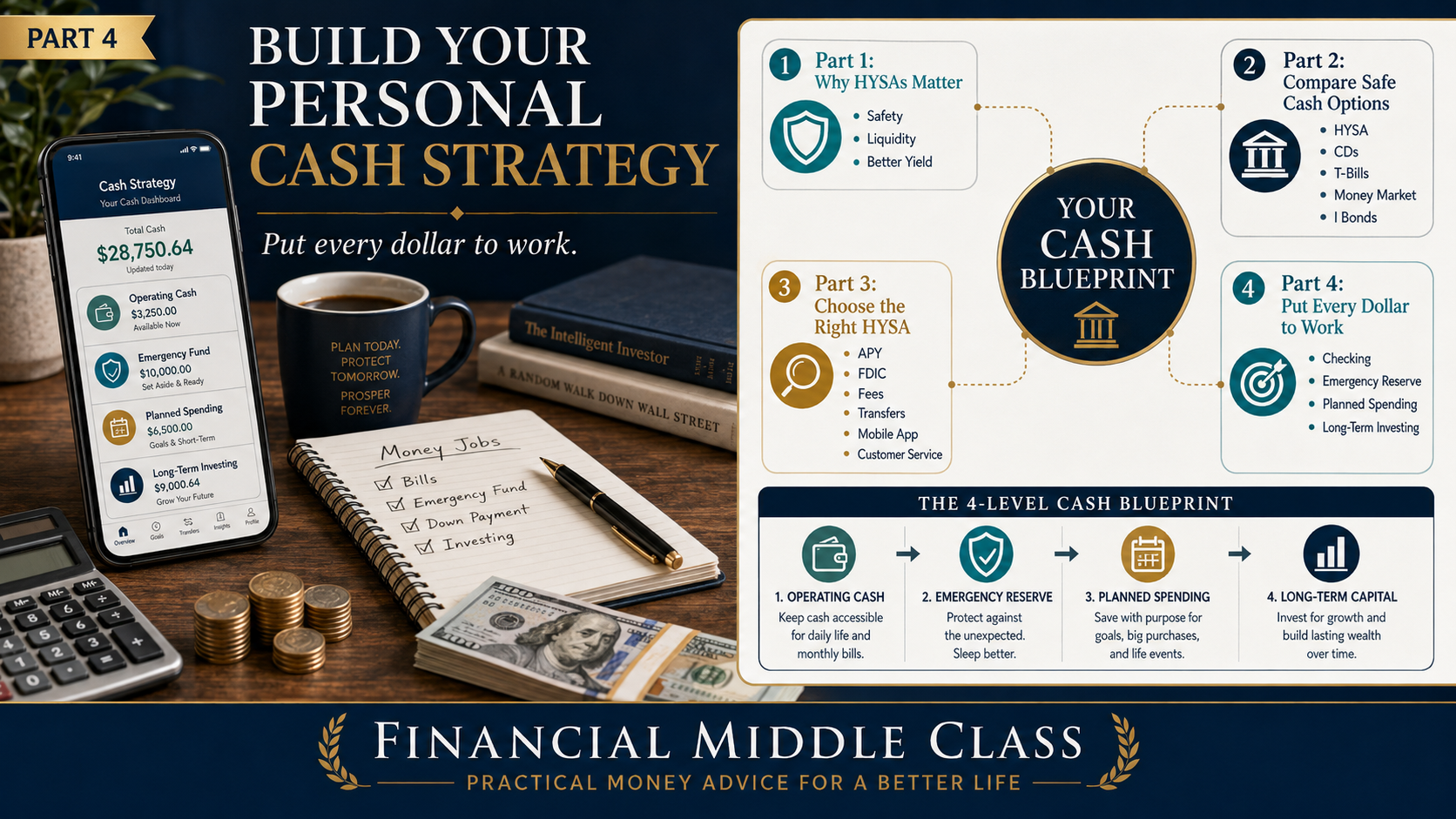
The Financial Middle Class Cash Blueprint
The blueprint divides household money into four broad levels.
| Level | Purpose | Possible home | Access requirement | Main risk to manage |
|---|---|---|---|---|
| 1. Operating cash | Bills and ordinary spending | Checking account | Immediate | Overdrafts and excess idle cash |
| 2. Emergency reserve | Unexpected expenses and income interruptions | High-yield savings account | Fast and dependable | Insufficient reserves or transfer delays |
| 3. Planned spending | Expenses expected within several years | HYSA, CD, or Treasury bills | Matched to spending date | Market loss, maturity mismatch, or penalties |
| 4. Long-term capital | Retirement and goals many years away | Diversified investments | Not immediately required | Market volatility, inflation, and insufficient growth |
The levels should not be interpreted as four accounts that every household must open.
They are four financial jobs.
One institution may provide several accounts. One savings account may contain several labeled savings buckets. A household with a simple financial life may need fewer accounts than a household with irregular income, multiple properties, or business responsibilities.
The purpose of the framework is organization, not complexity.
Step 1: Maintain Operating Cash
Operating cash is your household’s working capital.
It pays for:
- Mortgage or rent
- Utilities
- Groceries
- Transportation
- Insurance
- Childcare
- Minimum debt payments
- Credit-card balances you intend to pay in full
- Regular subscriptions
- Other predictable monthly obligations
A checking account is generally the appropriate home for this money because checking is designed for frequent transactions.
How much belongs in checking?
Approximately one month of routine expenses can be a reasonable starting point, but it is not a universal rule.
The right checking buffer depends on:
- How often you are paid
- Whether income arrives on predictable dates
- When automatic payments are withdrawn
- Whether your bank charges overdraft fees
- Whether transfers from savings are immediate
- Minimum-balance requirements
- The amount of irregular spending that flows through checking
Someone paid every two weeks may need a different buffer from a business owner whose income arrives unpredictably.
A practical checking target is:
Enough to pay all obligations due before the next expected income or transfer, plus a reasonable cushion for timing differences and small surprises.
When checking becomes too large
Money that is not expected to be spent during the current billing cycle may be able to earn more in a high-yield savings account.
But do not reduce checking so aggressively that ordinary payment timing creates overdrafts, declined transactions, or repeated transfers.
Efficiency is useful.
Fragility is not.
Step 2: Build an Emergency Reserve
An emergency reserve exists to absorb unplanned expenses and temporary income disruptions without forcing you to borrow at a high interest rate or sell long-term investments at a bad time.
The CFPB describes a dedicated emergency fund as an important step toward financial protection and emphasizes that the appropriate amount depends on the household’s situation. FINRA commonly identifies three to six months of expenses as a useful general goal while noting that people with variable income may need a larger reserve. ts as an emergency?
Examples may include:
- Job loss
- A reduction in working hours
- Medical expenses
- Insurance deductibles
- Essential car repairs
- Necessary home repairs
- Emergency travel
- Temporary caregiving responsibilities
- A major appliance failure
A vacation, predictable annual insurance premium, or planned holiday spending is not an emergency merely because the money was not budgeted.
Those expenses belong in planned savings or sinking funds.
Start with essential expenses
Do not automatically multiply your full lifestyle spending by six.
First calculate the expenses that would continue during a financial disruption:
- Housing
- Food
- Utilities
- Insurance
- Transportation
- Healthcare
- Childcare
- Minimum debt payments
- Essential communications
- Other unavoidable obligations
Discretionary travel, dining, entertainment, and optional subscriptions may be reduced during an emergency.
Emergency-fund planning ranges
The following are discussion ranges rather than universal recommendations.
| Household circumstance | Planning consideration |
|---|---|
| Stable dual-income household | The lower or middle portion of a three-to-six-month range may be reasonable when either income can cover most essentials |
| Single-income household | The higher end of the range—or more—may be appropriate because one job loss affects the entire household income |
| Household with dependents | Consider childcare, healthcare, education, and caregiving obligations |
| Self-employed or commission-based worker | A larger reserve may be warranted because income is less predictable |
| Worker in a volatile or specialized field | Consider how long replacing the income could realistically take |
| Homeowner with an older property | Add likely deductibles and repair exposures |
| Retiree | Coordinate the reserve with Social Security, pensions, required withdrawals, healthcare expenses, and the investment-withdrawal plan |
| Household with strong secondary resources | Reliable spousal income, substantial taxable investments, or other accessible resources may affect the amount needed |
The CFPB’s guidance is appropriately simple: the amount should reflect the unexpected expenses you have encountered and the risks present in your own financial life. Even a small reserve can provide meaningful protection while you work toward a larger target. uld the emergency fund be kept?
A first-line emergency reserve generally requires:
- Principal stability
- Federal insurance
- Fast access
- No market-price volatility
- No early withdrawal penalty
- No complicated qualification process
A properly insured high-yield savings account often fits those requirements.
Deposits at an FDIC-insured bank are generally insured up to $250,000 per depositor, per insured bank, for each account ownership category. Federally insured credit unions provide comparable coverage through the National Credit Union Share Insurance Fund. s should verify coverage rather than assuming that several accounts at the same institution each receive a separate $250,000 limit.
Step 3: Protect Money for Planned Spending
Planned spending includes money you expect to use within the next several years.
Examples include:
- A home down payment
- A vehicle purchase
- A wedding
- College tuition due soon
- A major renovation
- A tax payment
- A business purchase
- A planned move
- A major insurance premium
- A family event
Investor.gov cautions that money needed for a short-term goal—generally five years or less—should not be placed in investments that could force the owner to sell at a loss when the money is needed. d less flexible the spending date, the more important principal protection becomes.
Which account should hold planned spending?
| Situation | Possible choice | Why |
|---|---|---|
| Date is uncertain and access may be needed | High-yield savings account | Flexible deposits and withdrawals |
| Expense has a firm date | CD or Treasury bill maturing before that date | Greater rate or maturity certainty |
| Goal requires regular monthly contributions | HYSA or savings bucket | Easy automation and tracking |
| Money may be needed unexpectedly | HYSA | No maturity date or conventional early withdrawal penalty |
| Saver lives in a state with income tax | Treasury bill may be worth comparing | Treasury interest is generally exempt from state and local income taxes |
| Spending date may change | HYSA or short maturity | Reduces the risk of being locked into the wrong term |
A CD or Treasury bill should not mature after the date when the money may be required.
A product that pays slightly more but restricts access at the wrong time is not a better choice.
Step 4: Invest Long-Term Capital
Long-term capital is money that is not needed for current bills, emergencies, or reasonably foreseeable short-term goals.
Possible purposes include:
- Retirement
- Long-term education funding
- Financial independence
- A future business
- Generational wealth
- Charitable giving
- Other goals many years away
Investor.gov explains that time horizon should influence asset allocation. A person with a longer horizon may be able to accept more market risk, while someone with a shorter horizon may need less volatile assets. It also warns that keeping long-term money entirely in cash can expose the saver to inflation risk and insufficient growth. s is a guideline, not a switch
Money needed within five years generally should not be exposed to substantial market volatility.
But money needed six years from now does not automatically belong entirely in stocks.
Consider:
- How flexible the goal date is
- How much loss you could tolerate
- Whether you could delay the purchase
- Whether you have other resources
- Your emotional response to market declines
- The importance of the goal
- Your overall investment allocation
Consider high-interest debt
Before moving a large amount of excess cash into investments, review high-interest debt.
Paying down expensive revolving debt can produce a more certain financial benefit than keeping excess cash in a savings account or taking market risk in search of an uncertain return.
This does not mean draining the emergency reserve to pay every debt immediately. It means that cash allocation, debt reduction, and investing should be evaluated together.
Use the appropriate investment account
Long-term investments may be held through:
- Employer retirement accounts
- Traditional or Roth IRAs
- Health savings accounts when eligible
- Education accounts
- Taxable brokerage accounts
- Other accounts appropriate to the goal
Eligibility, contribution limits, withdrawal rules, taxes, and employer matching should be reviewed before deciding where to contribute.
The emergency fund’s role is not merely to sit safely.
It can help prevent you from interrupting long-term investing or selling investments during a financial setback.
A $100,000 Cash Strategy Example
Consider a hypothetical household with $100,000 currently held in cash.
Assume the household:
- Has stable employment
- Pays credit-card balances in full
- Has adequate insurance
- Expects a home renovation in approximately one year
- Has access to appropriate long-term investment accounts
- Does not need the full $100,000 for another near-term goal
An illustrative allocation might look like this:
| Purpose | Amount | Possible home |
|---|---|---|
| Operating cash and bill buffer | $8,000 | Checking account |
| Emergency reserve | $30,000 | High-yield savings account |
| Renovation expected next year | $20,000 | HYSA, CD, or Treasury bill timed to the project |
| Long-term capital | $42,000 | Invested gradually or immediately according to the household’s investment plan, account eligibility, and contribution limits |
| Total | $100,000 |
This is not a recommended allocation for every household.
It demonstrates the process of assigning money according to purpose.
How the example might change
Self-employed household
A self-employed household might hold more than $30,000 in emergency and operating reserves because business and household income may fluctuate together.
Household buying a home soon
A household expecting to close on a home within twelve months might keep substantially more in protected short-term accounts and invest less of the $100,000.
Retired household
A retiree might maintain a larger near-term spending reserve to reduce the need to sell investments during a market decline. The amount should be coordinated with Social Security, pensions, required distributions, healthcare costs, and the portfolio-withdrawal plan.
Young household with high-interest debt
A younger household carrying expensive credit-card debt might direct part of the excess cash toward debt reduction before investing the entire long-term portion.
The correct allocation cannot be determined from the cash balance alone.
Should You Keep Checking and Savings at Different Banks?
You do not necessarily have to leave a longtime bank to benefit from a high-yield savings account.
A two-bank system can work well:
- Keep checking at a local bank or credit union
- Hold emergency and planned savings at a competitive online bank
- Link the accounts electronically
- Transfer money according to a defined schedule
Advantages
- Continued access to branches or familiar service
- A potentially higher savings APY
- Separation between spending and savings
- Reduced temptation to spend the emergency fund
- Ability to choose the strongest account for each purpose
Disadvantages
- Transfers may take time
- Another login and tax form must be managed
- Fraud alerts must be monitored at two institutions
- Large deposits may need to be divided for insurance purposes
- Account inactivity or changing terms may be overlooked
Test the system
Before relying on an online savings account during an emergency:
- Transfer a small amount into the account.
- Wait until it becomes fully available.
- Transfer part of it back to checking.
- Record the number of business days required.
- Review transfer limits.
- Confirm weekend and holiday procedures.
- Store the institution’s customer-service information.
Online banks can receive the same FDIC deposit insurance as branch-based banks when the legal bank is FDIC-insured and the account is a covered deposit product. However, consumers should verify the institution rather than assuming that every app or financial platform is itself a bank. ns When HYSA Rates Fall?
High-yield savings accounts became more noticeable as short-term interest rates increased.
Those rates will not remain at the same level forever.
Federal Reserve policy affects a range of short-term interest rates throughout the financial system. When short-term rates fall, banks often reduce savings APYs, although each bank sets its own rate and may change it at a different time or by a different amount. SA falls from 4% to 2.5%.
That does not automatically mean the account has stopped doing its job.
Ask instead:
- Is the rate still competitive?
- Is the money properly insured?
- Can I access it when needed?
- Does the account charge fees?
- Is there another safe option that better matches the goal?
- Would moving the money introduce penalties, maturity risk, or additional complexity?
An emergency fund is not successful because it earns 4%.
It is successful because it remains available when an emergency occurs.
The interest is an important secondary benefit.
The Psychology of Cash
Personal finance is not purely mathematical.
It is also behavioral.
Two people can hold the same investments and react very differently when markets decline.
One may remain calm through a 30% decline.
Another may feel distressed after a much smaller loss.
Risk tolerance is not the only issue. Risk capacity also matters.
Risk tolerance describes how much volatility you are emotionally willing to accept.
Risk capacity describes how much loss your financial circumstances can absorb without disrupting your goals.
A person may be emotionally comfortable with risk but lack the financial capacity to accept it.
A well-funded emergency reserve can improve both financial resilience and investment behavior.
When near-term needs are protected, a household may be less likely to:
- Sell investments during a decline
- Stop retirement contributions
- Use high-cost credit
- Withdraw from retirement accounts prematurely
- Abandon a long-term plan because of a short-term expense
That does not mean more cash is always better.
Excessive long-term cash can lose purchasing power to inflation and miss opportunities for growth. Investor.gov identifies inflation as a principal risk of cash equivalents. ot maximum cash.
It is sufficient cash.
Myth vs. Fact
| Myth | Fact |
|---|---|
| “A savings account is a bad place for money.” | Savings accounts are appropriate for emergency funds and short-term goals. The problem is using low-yield cash for money that should be invested long term. |
| “Online HYSAs are not safe.” | An online-only bank can be FDIC-insured. Verify the legal institution, account type, and insurance coverage rather than relying on the app’s branding. |
| “I should invest every available dollar.” | Money for bills, emergencies, and short-term goals should not depend on market performance. |
| “Three months is enough for everyone.” | Emergency-fund needs vary with income stability, dependents, insurance, debt, and other available resources. |
| “The highest APY is always the best.” | APY must be considered alongside fees, access, insurance, transfer speed, qualifications, and service. |
| “An HYSA will make me wealthy.” | An HYSA is designed primarily for stability and liquidity. Long-term wealth generally requires saving, investing, income growth, and time. |
| “If the Federal Reserve cuts rates, I should close my HYSA.” | A lower APY does not eliminate the need for accessible emergency and short-term savings. Compare the account with other safe options. |
| “Every account at my bank receives $250,000 of insurance.” | Accounts in the same ownership category at the same insured institution are generally combined when coverage is calculated. Day Cash Strategy |
Week 1: Identify every dollar’s current job
Gather:
- Checking-account balances
- Savings-account balances
- CDs
- Treasury securities
- Money market accounts
- Brokerage cash
- Business cash
- Other liquid accounts
Label each amount:
- Current spending
- Emergency savings
- Planned spending
- Long-term capital
- Unassigned
Do not move anything yet.
First understand the current system.
Week 2: Calculate your targets
Determine:
- One month of routine cash flow
- Essential monthly expenses
- Emergency-fund target
- Known expenses within five years
- High-interest debt balances
- Long-term goals
- Federal insurance exposure
Separate predictable expenses from genuine emergencies.
Week 3: Build the account structure
Choose accounts based on function:
- Checking for operating cash
- HYSA for the first-line emergency reserve
- HYSA, CD, or Treasury bills for planned spending
- Appropriate investment accounts for long-term capital
Verify FDIC or NCUA coverage.
The standard FDIC limit is generally $250,000 per depositor, per insured bank, for each ownership category. NCUA uses a comparable ownership-based structure for federally insured credit unions. utomate and test
Set up:
- Automatic transfers after payday
- Separate savings buckets when useful
- Low-balance checking alerts
- Large-transaction alerts
- Monthly savings reviews
- Beneficiary designations
- A test transfer between banks
Then schedule a review every three to six months or after a major life event.
Possible review triggers include:
- Marriage or divorce
- A new child
- Home purchase
- Job change
- Business launch
- Retirement
- Major illness
- Significant income change
- Large inheritance or windfall
- A move to another state
Consistency matters more than building a theoretically perfect system that you cannot maintain.
Frequently Asked Questions
How much money should I keep in checking?
Keep enough to cover obligations due before your next expected income or transfer, plus a cushion for timing differences and modest unexpected spending.
One month of routine expenses may be a useful starting point, but the right amount depends on pay frequency, automatic payments, overdraft risk, and transfer speed.
How much should I keep in an emergency fund?
Three to six months of essential expenses is a common starting goal.
A larger reserve may be appropriate for households with one income, variable income, dependents, specialized employment, high insurance deductibles, or significant home and vehicle risks. The CFPB emphasizes that the amount should be based on the household’s own circumstances. entire emergency fund be in an HYSA?
An HYSA is often appropriate for the first-line reserve.
Some households keep a smaller immediate buffer in checking and the remainder in an HYSA. Larger reserves may also be divided among insured banks, CDs, or short-term Treasury securities, provided enough remains readily accessible.
Should I invest money I will need in five years?
Money required within five years generally should not be exposed to investments that could force you to sell at a loss.
If the goal date is flexible, a limited investment allocation may be considered based on risk tolerance and capacity, but money required on a fixed date usually deserves greater protection. ld I do if my HYSA rate falls?
Compare the new rate with other insured savings accounts, CDs, Treasury bills, and money market deposit accounts.
Do not move the emergency fund solely because rates declined. Consider access, taxes, penalties, maturity dates, fees, and administrative complexity.
What if I have more than $250,000 in cash?
Review the ownership categories and the total deposits held at each insured institution.
Do not assume that opening multiple accounts at the same bank increases coverage. You may need to use different insured institutions, ownership categories, or other appropriate cash-management tools. The FDIC provides its Electronic Deposit Insurance Estimator for evaluating coverage. ghts
The most important lesson in this four-part guide is not that everyone should place every spare dollar into a high-yield savings account.
It is that money must be managed according to purpose.
Checking provides operating liquidity.
High-yield savings provides emergency readiness.
CDs and Treasury bills can provide structure for planned spending.
Diversified investments can provide long-term growth.
Each serves a different financial function.
A high-yield savings account will not make most people wealthy by itself.
It will not eliminate inflation.
It will not replace retirement investing.
It will not solve an income problem.
What it can do is protect money that should not be exposed to unnecessary market risk while allowing that money to earn a more competitive return than it might receive in an ordinary low-yield account.
That is not exciting.
It is useful.
A sound financial foundation rarely attracts attention. It quietly performs its job in the background:
- The mortgage is paid.
- The car is repaired.
- The deductible is covered.
- The job transition is manageable.
- The investment portfolio is left alone.
- The family has time to make a thoughtful decision.
That is the real purpose of a personal cash strategy.
At Financial Middle Class, building wealth is not about forcing every dollar to chase the highest possible return.
It is about making one thoughtful decision after another.
Assign every dollar a purpose.
Give it the right level of safety.
Give it the right amount of access.
Then allow the dollars intended for the future enough time and appropriate risk to grow.
When every dollar has a job, financial decisions become clearer.
And a stronger financial middle class begins with households that have enough stability to plan beyond the next emergency.
Financial Middle Class Action Step
Before the end of this month, divide your available money into four categories:
- Operating cash
- Emergency reserve
- Planned spending
- Long-term capital
Any dollar that does not fit one of those categories is not necessarily misplaced.
But it deserves a deliberate decision.

RELATED ARTICLES
Best HYSA: How to Choose Beyond the Highest APY
A competitive interest rate matters, but it is only one part of choosing a high-yield savings account. Compare insurance, fees, access, transfer speed, and promotional conditions.
High-Yield Savings vs. CDs, Treasury Bills, and Other Safe Places for Cash
High-yield savings accounts are excellent for accessible cash, but they are not always the best choice. Compare HYSAs, CDs, Treasury bills, money market accounts, and I bonds.
Leave Comment
Cancel reply
Gig Economy
Business / Aug 08, 2026
The Missing Middle in Black Entrepreneurship
Black entrepreneurship has expanded dramatically. The next challenge is helping more Black-owned businesses move from self-employment to employer firms and sustainable scale.
By FMC Editorial Team
Personal Finance / Aug 01, 2026
Cash Strategy: Put Every Dollar in the Right Place
Your checking account, emergency fund, short-term savings, and investments should not be managed the same way. This cash strategy helps assign every dollar to the right...
By Article Posted by Staff Contributor
Personal Finance / Aug 01, 2026
Best HYSA: How to Choose Beyond the Highest APY
A competitive interest rate matters, but it is only one part of choosing a high-yield savings account. Compare insurance, fees, access, transfer speed, and promotional conditions.
By Article Posted by Staff Contributor
Personal Finance / Aug 01, 2026
High-Yield Savings vs. CDs, Treasury Bills, and Other Safe Places for Cash
High-yield savings accounts are excellent for accessible cash, but they are not always the best choice. Compare HYSAs, CDs, Treasury bills, money market accounts, and I...
By Article Posted by Staff Contributor
American Middle Class / Aug 01, 2026
High-Yield Savings Accounts: A Safer Home for Your Cash
A high-yield savings account can pay several times the national savings rate while keeping qualified deposits federally insured. Here is how it works, what to watch...
By Article Posted by Staff Contributor
Real Estate / Jul 30, 2026
Mortgage Lock-In Is Freezing the Housing Market
Millions are trapped by 3% mortgages. Learn how mortgage lock-in worsens affordability—and why homeowners are renovating instead.
By FMC Editorial Team
Real Estate / Jul 26, 2026
Is South Florida More Expensive Than New York? The Complete 2026 Relocation Guide
Is South Florida more expensive than New York? Compare housing, taxes, insurance and 104 municipalities before you move.
By Article Posted by Staff Contributor
Personal Finance / Jul 25, 2026
The Time Value of Life Experiences: What Compound Interest Leaves Out,
Money compounds, but life experiences do too. Explore what compound interest leaves out—and how to balance saving with living.
By MacKenzy Pierre
American Middle Class / Feb 18, 2026
How Wealth Is Passed Across Generations in the United States: Mechanisms, Evidence, and the Policy Debate
How wealth passes between generations—trusts, taxes, and the debate. Get the facts, figures, and tradeoffs. Read now.
By FMC Editorial Team
American Middle Class / Feb 16, 2026
The S&P 7,000: How Wall Street Disconnects from Main Street
S&P 7,000 can rise while wages, benefits, and towns fall behind. See why the market isn’t the economy—read now.
By MacKenzy Pierre
Latest Reviews
Business / Aug 08, 2026
The Missing Middle in Black Entrepreneurship
Black entrepreneurship has expanded dramatically. The next challenge is helping more Black-owned businesses move from...
Personal Finance / Aug 01, 2026
Cash Strategy: Put Every Dollar in the Right Place
Your checking account, emergency fund, short-term savings, and investments should not be managed the same...
Personal Finance / Aug 01, 2026
Best HYSA: How to Choose Beyond the Highest APY
A competitive interest rate matters, but it is only one part of choosing a high-yield...