
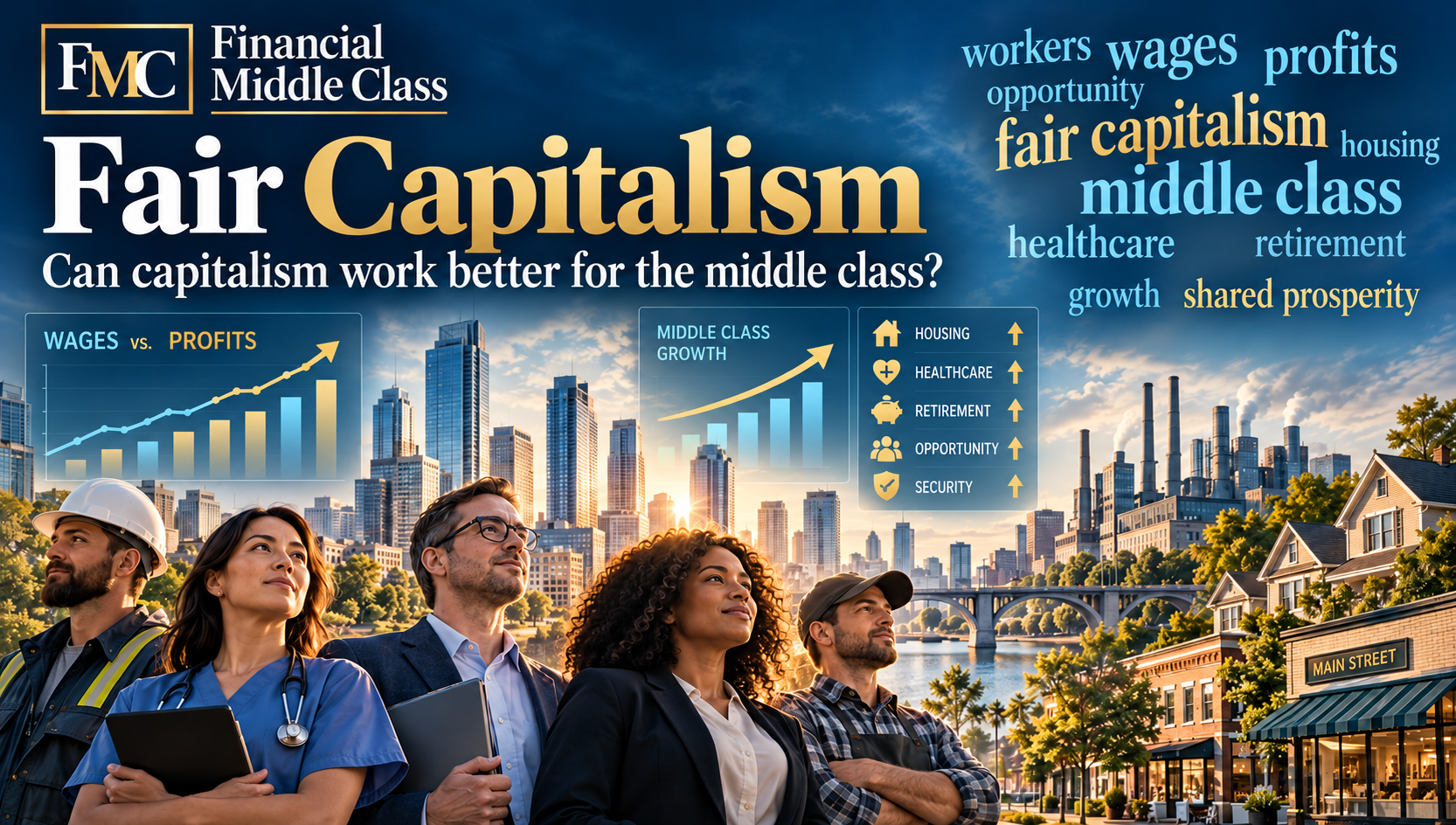
Fair Capitalism: We Don’t Need to Abolish Capitalism. We Need to Fix It.
By MacKenzy Pierre
The estimated reading time for this post is 1514 seconds
America doesn’t need less ambition, fewer entrepreneurs, or an apology for making money. It needs an economy in which more of the people helping create prosperity can actually enjoy it.
Capitalism is the best economic system we have.
I believe that, and I don’t see a compelling reason to abolish it and replace it with something else. What we need is fair capitalism—as fair as we can reasonably manage to make it.
There is a great deal about capitalism worth defending. At its most basic level, it allows people to exchange their hard-earned money for goods and services they believe will improve their lives. It gives entrepreneurs an opportunity to turn ideas into businesses, rewards those willing to take risks, and encourages companies to compete for customers.
That arrangement has produced some extraordinary things.
Consider the technologies we use every day, the medical advances that have improved our lives, or the businesses that have transformed entire industries. Some of these achievements emerged from government research and public investment. Others originated in private laboratories, universities, or the minds of entrepreneurs who believed they could create something better.
What capitalism has often done particularly well is bring those innovations into the marketplace, attract the capital necessary to develop them, and make them accessible to millions of consumers.
Few countries have been as successful at this as the United States.
Our enormous consumer market, developed financial system, research universities, access to investment capital, and culture of entrepreneurship give Americans advantages that are difficult to replicate elsewhere.
There is also something distinctive about our attitude toward ambition. In America, someone can announce an intention to build the next great company, and while some people may laugh, others will want to know how they can invest.
As an immigrant, I have a particular appreciation for that spirit. I know what it means to live in a country where people from different backgrounds can imagine building something that changes their financial circumstances, and perhaps those of their children.
I don’t take that opportunity for granted.
But my admiration for American capitalism doesn’t mean I am blind to its shortcomings. In fact, I would argue that those of us who believe most strongly in capitalism have a particular responsibility to question the ways in which it is failing ordinary Americans.
An economy can be enormously successful at creating wealth while becoming less successful at ensuring that working people have a reasonable opportunity to build financial security.
And that, I believe, is the contradiction we need to address.
When Did We Begin Treating Labor Primarily as an Expense?
I have no objection to entrepreneurs becoming wealthy.
If someone develops a product that millions of people want, takes substantial financial risks, builds a successful business, and creates jobs, I believe that individual deserves to benefit from the success. The possibility of becoming wealthy is one of capitalism’s important incentives.
But successful companies rarely become successful through the efforts of one person.
Behind every profitable enterprise are employees who manufacture products, maintain equipment, serve customers, manage inventory, develop technology, and perform the countless tasks necessary to keep the business operating.
Their contribution is not incidental.
Yet our economic conversations frequently treat labor as an expense to be minimized rather than a source of value to be recognized.
When a company announces layoffs that are expected to reduce expenses, investors may respond favorably. When management reports improved operating margins, analysts often celebrate the discipline that made those improvements possible.
Sometimes those decisions are necessary. Businesses cannot ignore costs, and maintaining an inefficient workforce indefinitely is neither financially responsible nor economically sustainable.
But the emphasis on reducing labor costs can obscure something important. Employees are not simply an expense associated with producing goods and services. Their knowledge, experience, judgment, and productivity are among the reasons those goods and services have value in the first place.
I wonder whether American corporations have become so focused on measuring the cost of labor that we sometimes undervalue what labor contributes.
Interestingly, that concern is not new. American business history contains examples of employers who approached the relationship between a company and its workforce differently.
When American Businesses Invested in Workers and Shared Their Success
Consider Milton Hershey and Oneida Limited.
These were two very different American enterprises, but both recognized that a company’s prosperity was connected to the economic well-being of the people who worked for it.
When Milton Hershey began developing his chocolate empire in Pennsylvania in the early twentieth century, he didn’t limit his ambitions to building a profitable factory. He helped develop an entire community around it, complete with housing, schools, parks, transportation, and recreational facilities.
Hershey believed that employees who lived in comfortable surroundings and had access to decent amenities would form a more stable and productive workforce.
There were practical business reasons for that belief. A community that offered a good quality of life could attract employees, encourage them to remain with the company, and help support the long-term success of the enterprise.
That philosophy became particularly evident during the Great Depression.
While unemployment devastated communities across America, Hershey financed an ambitious construction program that provided jobs for more than 600 workers. The Great Building Campaign produced landmarks such as the Hotel Hershey, Hershey Community Theatre, and Hershey Sports Arena.
The projects improved the town while providing employment during one of the worst economic periods in American history.
Hershey’s approach was not without contradictions. His management style was paternalistic, and the company experienced labor disputes, including a major sit-down strike in 1937. Investments in a community did not necessarily translate into satisfactory wages or working conditions for every employee.
Still, Hershey recognized that a successful business had an economic interest in the well-being of the community surrounding it.
Oneida Limited approached the relationship between labor and capital from a different direction.
The American silverware manufacturer grew out of a communal society established in upstate New York in 1848. Although it eventually became a conventional commercial enterprise, aspects of its early philosophy influenced its employment practices.
By the early twentieth century, Oneida had introduced arrangements that allowed workers to share in the company’s financial performance.
According to its historical publication, First 100 Years: 1848–1948, the company made its first formal profit-sharing payment of approximately $300,000 in 1922. Between 1922 and 1925, employee bonuses totaled approximately $1.175 million.
Oneida also developed service-related compensation and retirement provisions intended to provide employees with additional financial benefits.
These arrangements had limitations. The profit-sharing plan followed financial difficulties and involved workers accepting wage reductions in exchange for a share of potential future profits. Employees therefore assumed some of the company’s economic risks.
Profit sharing is not necessarily a substitute for adequate and predictable wages, particularly for employees who depend on every paycheck to meet basic expenses.
But Oneida’s approach reflected a belief that workers should have an opportunity to participate in the prosperity they helped create.
What interests me about Hershey and Oneida is not that either company offers a perfect model for modern employers. They don’t.
Hershey emphasized investment in the community surrounding the workforce. Oneida experimented with distributing some of the enterprise’s financial success to employees.
Both approaches recognized a relationship between corporate prosperity and employee well-being that deserves renewed consideration.
We shouldn’t romanticize the past. Many American workers during those periods faced difficult conditions, discrimination, limited protections, and considerable economic insecurity.
But neither should we forget that American businesses have experimented with ways of aligning their own success with the financial interests of employees.
That history challenges the idea that responsible employment practices are somehow foreign to capitalism.
They are part of capitalism’s own development.
And during the 1960s, that same question about the value of employees even found its way into an unlikely place: corporate accounting.
The Forgotten Accounting Experiment That Tried to Recognize Human Capital
During the 1960s and 1970s, accounting researchers began questioning whether traditional financial statements adequately reflected the economic benefits companies received from investing in employees.
The field became known as human resource accounting.
One of its early corporate participants was R.G. Barry Corporation, an Ohio-based footwear manufacturer.
Working with researchers associated with the University of Michigan, the company experimented with measuring expenditures on recruiting, selecting, training, and developing employees.
Beginning in 1969, R.G. Barry included supplemental, unaudited human-resource financial statements alongside conventional financial reporting. The experiment was eventually discontinued.
For anyone familiar with accounting, the reasoning is interesting.
On a traditional balance sheet, assets include cash, inventory, buildings, equipment, and other resources that satisfy accounting recognition requirements.
A company can purchase an expensive machine, record it as an asset, and recognize its cost over its useful life.
But that same company may spend substantial amounts training employees to operate the machine.
Much of that training expenditure is generally recognized as an expense when incurred, even when the training is expected to benefit the company for years.
Human resource accounting questioned whether that treatment fully captured the economic significance of employee development.
There were legitimate obstacles.
A company owns its equipment. It does not own its employees. Workers can resign, change employers, or pursue different careers. The future benefits of employee development are also difficult to measure reliably.
Nor should people be treated as corporate property.
But the experiment raised a question worth remembering.
If investing in equipment can increase the long-term value of a business, why shouldn’t investing in better-trained, healthier, and more financially secure employees be viewed through a similar economic lens?
An expenditure can be recorded as an expense while still producing economic benefits for years.
Corporate leaders understand that distinction when they invest in research, technology, marketing, or organizational development.
Yet when companies discuss improving wages and benefits, the conversation can become narrowly focused on how much those improvements will reduce current earnings.
That is the thinking I would like us to reconsider.
A worker’s compensation appears as an expense on the income statement. But the worker’s contribution to the business cannot be understood simply by looking at that expense.
And we don’t have to go back to the 1960s to find a company that seems to understand the distinction.
Costco: A Modern Business That Invests in Its Workforce
Costco operates in one of the most competitive industries in America.
Retailers constantly contend with pricing pressure, inventory management, operating expenses, and changing consumer preferences. Labor represents a significant part of those expenses.
Yet Costco has built an employment philosophy emphasizing competitive wages, meaningful benefits, internal advancement, and employee retention.
According to its fiscal 2026 annual report, Costco’s average U.S. hourly wage was approximately $33 at the end of the fiscal year.
The company also reported a retention rate of approximately 94% among employees in the United States and Canada who had at least one year of service. More than 8,100 hourly employees completed its six-week supervisor training program during the fiscal year.
Those figures are significant for a large retailer.
A 94% retention rate doesn’t mean every employee is satisfied. Nor does a $33 average hourly wage mean every worker earns that amount or that the compensation meets the living expenses of every household.
But Costco’s approach challenges the assumption that minimizing employee compensation is necessarily the best way to improve business performance.
Experienced employees understand a company’s systems, products, and customers. They require less introductory training and are often better positioned to resolve problems.
Replacing employees repeatedly can be costly. Recruiting, onboarding, training, and the loss of institutional knowledge all have economic consequences.
Costco appears to recognize that investing in employees and retaining experienced workers can produce operational advantages.
I am not suggesting that every American business can replicate Costco’s model. Its membership revenue, purchasing power, scale, and operating structure distinguish it from many other retailers.
Nor does Costco’s success prove that paying higher wages automatically causes higher profits.
But the company demonstrates that a major American corporation can invest substantially in its employees while operating a successful and competitive business.
That is an important distinction in an economic debate that too often assumes businesses must choose between rewarding shareholders and treating workers well.
The interests of workers and investors will not always align. There will be disagreements over compensation, staffing, productivity, and profits.
But they are not inherently opposing interests.
And that raises a broader question.
If companies can benefit economically from investing in employees, shouldn’t we consider how public policy might encourage more of that behavior?
Corporate Profits Are Strong. Financial Security Is Another Matter.
According to the Bureau of Economic Analysis, corporate profits from current production reached approximately $4.71 trillion at a seasonally adjusted annual rate in the second quarter of 2026, compared with approximately $4.03 trillion for 2025.
These figures measure economy-wide corporate profits under national income accounting rules. They are not equivalent to corporate cash balances or the profits available for distribution by individual businesses.
Still, they illustrate the extraordinary earning power of the American corporate sector.
I consider corporate profitability a strength.
Profitable companies invest, expand, employ people, pay taxes, and generate returns for shareholders, including millions of ordinary Americans with retirement savings invested in the stock market.
But aggregate corporate profits tell us little about the financial circumstances of the average worker.
Many Americans struggle to build emergency savings, afford housing, pay medical expenses, or prepare for retirement.
And having a job isn’t always enough to protect someone from severe financial hardship.
A University of Chicago study published in 2021 found that approximately 53% of people experiencing homelessness in shelters had formal employment earnings during the same year. Among those experiencing homelessness outside shelters, the figure was approximately 40%.
Those figures do not mean everyone was employed full-time while homeless. They measure earnings during the year, not necessarily employment at the precise moment of homelessness.
Nevertheless, they challenge an assumption deeply embedded in American economic thinking: that employment reliably protects people from poverty and housing insecurity.
It doesn’t always.
Of course, homelessness is more complicated than wages. Housing shortages, family circumstances, healthcare, disabilities, and other factors all contribute.
But surely we can agree that working should provide a stronger foundation for financial stability than it does for many Americans.
There is a related issue involving public assistance.
Programs such as Medicaid and SNAP support millions of households, including families with working members. They also serve children, older adults, people with disabilities, and others who need assistance for reasons unrelated to an employer’s compensation policies.
I support these programs. They serve an important purpose.
But when someone works substantial hours for a financially successful corporation and still struggles to afford basic necessities, I think we have a right to ask whether the employer is doing enough.
To what extent should taxpayers help support the basic living expenses of workers whose employers have the financial capacity to compensate them better?
The answer is not simple. Household size, local living costs, medical needs, and other circumstances affect whether someone qualifies for assistance.
Still, I believe our economic policies should encourage companies capable of providing better compensation and benefits to do so.
Which brings me to a proposal I think deserves serious consideration.
My Proposal: Make Preferential Corporate Tax Treatment Something Companies Earn
For decades, American politicians have argued over whether corporate taxes should be higher or lower.
Supporters of lower taxes generally point to investment, competitiveness, and economic growth. Supporters of higher taxes argue that corporations should contribute more toward the public institutions and infrastructure that make their profits possible.
Both perspectives have merit.
But I think we are overlooking an opportunity to use corporate tax policy to encourage better economic outcomes for employees.
Here is what I would propose.
Restore a top federal corporate income tax rate of 35%, while creating preferential treatment for companies that meet verified standards of employee compensation, benefits, and retirement security.
Before the Tax Cuts and Jobs Act of 2017, the United States had a graduated federal corporate tax structure with a top statutory rate of 35%. The legislation replaced that structure with a flat 21% rate.
I would not simply recreate the old system.
Instead, I would establish a higher ordinary statutory rate while allowing qualifying corporations to reduce their tax burden by meeting meaningful employee-welfare standards.
In principle, a corporation that satisfies the full requirements could qualify for a federal income tax rate as low as 21%.
That would make preferential treatment something a company earns rather than receives automatically.
I recognize that 35% and 21% are illustrative starting points. Whether those rates would produce the desired economic benefits would require careful modeling.
But the principle is straightforward.
If the federal government provides favorable tax treatment, why shouldn’t part of that benefit depend on how companies invest in their employees?
Establishing Meaningful Standards
I would start with a living wage.
Not merely the federal minimum wage, but compensation reflecting the cost of basic necessities where employees work.
A worker living in Miami faces different housing costs from someone living in rural Mississippi. Any meaningful standard should account for those differences.
The MIT Living Wage Calculator offers one possible starting point, although policymakers would have to determine how household composition and geographic variation should be reflected in the requirements.
Paid vacation and sick leave should also matter.
I have always found it troubling that someone working for a profitable corporation might have to choose between taking a day off because they are sick and earning enough to pay their bills.
Employees have families, health concerns, and responsibilities outside work. Those are ordinary features of life, not evidence of a lack of commitment.
Affordable healthcare coverage would be another qualification.
Simply offering insurance shouldn’t be sufficient if employees cannot realistically afford the premiums or face excessive out-of-pocket expenses.
Retirement contributions should also be part of the framework.
Too many Americans approach retirement with inadequate savings after decades in the workforce. Employers cannot guarantee financial security, but they can help employees build it.
I would favor meaningful employer-funded contributions to qualified retirement plans, including contributions that benefit employees who cannot afford to contribute much from their own wages.
A contribution equal to at least 3% of eligible compensation, independent of employee contributions, could be an initial benchmark worth studying.
The appropriate threshold would require analysis rather than guesswork.
Employees Should Help Verify the Benefits
I would also establish an independent verification process.
Corporations are good at describing their employment practices in annual reports, recruitment materials, and sustainability statements.
But written policies and employees’ actual experiences are not always the same.
A company might advertise generous vacation benefits while maintaining a workplace culture that discourages employees from using them.
Payroll records, benefits documentation, confidential employee assessments, and independent audits could help determine whether companies genuinely meet the standards.
Employee feedback should inform the process, but it shouldn’t become an unrestricted vote over corporate tax liability.
The objective would be to verify measurable employment practices rather than reward attractive corporate messaging.
Making the Incentive Work
The exact tax mechanism would require considerable study.
One option would be graduated rate reductions based on the number and quality of employment standards a company meets.
Another would use tax credits tied to verified investments in employee compensation and benefits.
The second approach might make it easier to target specific expenses, although it would introduce its own complexities.
We would also need to recognize that wages and many qualifying benefit expenses are already deductible in calculating taxable corporate income. A new incentive would represent an additional benefit beyond that existing treatment.
Small businesses may require different compliance arrangements from multinational corporations.
And safeguards would be necessary to prevent companies from outsourcing lower-paid workers, reclassifying employees as contractors, or reorganizing subsidiaries merely to qualify.
Because many businesses operate as partnerships, S corporations, or other pass-through entities, policymakers would also need to consider how the incentive would apply beyond traditional C corporations.
These are not minor details.
A poorly designed policy could reward companies that would have provided generous benefits anyway without doing much to improve outcomes for other workers.
But I believe the underlying idea is worth exploring.
Imagine a corporate board discussing improvements to employee wages, healthcare, or retirement benefits while also evaluating how those improvements might affect the company’s tax liability.
Employee financial security would become a more explicit consideration in corporate financial planning.
That is the kind of incentive I would like our economic policies to create.
The Economics Must Work, Too.
There are legitimate objections to raising corporate taxes, and I don’t think they should be dismissed.
Although a corporation legally pays income taxes, the ultimate economic burden can fall on shareholders, workers, and consumers.
Higher corporate taxes can influence investment decisions, wages, prices, and returns to capital.
They can also encourage companies to move certain investments or reported profits abroad, particularly when other countries maintain lower rates.
And employers will not all respond to an employee-related tax incentive in the same way.
A business with a large workforce and relatively modest taxable profits may find that improving compensation costs far more than the potential tax savings.
Another company may already satisfy every requirement and receive a tax reduction without changing anything.
Those outcomes would undermine the proposal’s effectiveness.
Before adopting such a system, I would want independent economists to examine its likely effects on employment, compensation, investment, consumer prices, government revenue, and international competitiveness.
We should also compare it with alternatives such as wage subsidies, refundable tax credits for workers, or more direct incentives for employer retirement contributions.
If another policy could achieve the same objective at a lower economic cost, I would favor the better approach.
My commitment is to making capitalism fairer, not defending a particular tax formula simply because I proposed it.
But I don’t think these concerns invalidate the broader concept.
Tax policy already influences corporate decisions. We provide incentives for research, capital investment, and other activities considered economically beneficial.
Why should employee financial security be excluded from that conversation?
How We Arrived at This Version of Capitalism
Some of today’s attitudes toward corporate responsibility reflect changes in economic thinking that accelerated during the 1980s.
Ronald Reagan and Margaret Thatcher helped popularize a more market-oriented philosophy emphasizing lower taxes, deregulation, privatization, and greater reliance on private enterprise.
Those reforms emerged from genuine economic difficulties.
The 1970s brought inflation, weak economic growth, and increasing concerns about industrial competitiveness. There were legitimate reasons to reconsider existing policies.
But over subsequent decades, maximizing shareholder value became an increasingly influential objective in corporate management.
Executive compensation grew more closely connected to financial performance and stock prices. Companies faced pressure to improve operating margins, increase efficiency, and generate attractive returns on invested capital.
Some of those incentives contributed to stronger business performance.
Others encouraged companies to focus heavily on financial measures that may not fully capture long-term investments in employees.
I wouldn’t blame Reagan and Thatcher for every problem facing American workers today. Globalization, technological change, declining union membership, housing policy, automation, and decisions made by both major political parties have all influenced our economy.
But I do believe we have allowed shareholder returns to become too dominant in how we evaluate corporate success.
Shareholders matter. They include pension funds, retirement savers, and ordinary Americans who depend on investment returns.
Their interests deserve consideration.
But corporations also depend on employees, customers, functioning communities, public infrastructure, and institutions that support economic activity.
We don’t need to abandon the pursuit of profit or return to the economic policies of the 1970s.
We need to recognize that shareholder returns, while important, are not the only measure of whether capitalism is serving society well.
Fair Capitalism Is Still Capitalism
Something about our political discourse has always troubled me.
Suggest that employees should receive better wages or more generous benefits, and the conversation can quickly turn into an argument about socialism.
I think that misses the point.
Capitalism has never operated without rules.
We have antitrust laws to protect competition, securities regulations to promote financial transparency, and labor standards intended to protect workers.
These arrangements don’t abolish private enterprise. They establish conditions under which markets can function more effectively and economic participants can pursue their interests.
The Scandinavian countries offer an interesting comparison.
Denmark, Norway, Sweden, and Finland maintain substantial social protections while supporting privately owned businesses, entrepreneurship, investment, and international trade.
Their economies are not identical to ours, and their policies cannot simply be imported into the United States.
But they demonstrate that capitalism can coexist with different approaches to taxation, worker protections, and social insurance.
I happen to believe America’s entrepreneurial culture is one of our greatest strengths. I would be reluctant to support reforms that seriously undermine it.
But we shouldn’t assume that every policy intended to improve workers’ economic circumstances represents a threat to free enterprise.
Fair capitalism isn’t about preventing people from becoming wealthy.
It’s about making financial security more attainable for people who work hard but may never become wealthy.
A Strong Middle Class Is Good for Business
There is a practical reason to care about the financial health of working Americans.
Businesses need customers, and customers need purchasing power.
A household that spends nearly everything it earns on rent, groceries, transportation, insurance, and utilities has little financial flexibility.
It may want to purchase a home, replace an aging vehicle, take a vacation, or start a small business. But those aspirations become difficult when income barely covers necessities.
Greater financial security allows households to save, invest, spend, and take calculated economic risks.
Of course, higher wages don’t automatically produce enough additional demand to offset every increase in business costs. Productivity, prices, competition, and employment all matter.
Still, a broad base of financially stable households is an important economic strength.
It also matters for entrepreneurship.
Someone living paycheck to paycheck may have an excellent business idea but lack the savings necessary to pursue it.
Financial security can provide the flexibility to take a chance, change careers, or invest in an opportunity.
That is particularly relevant in a country that prides itself on entrepreneurship.
We celebrate those willing to take risks, but we sometimes overlook how difficult risk-taking becomes when one missed paycheck threatens a family’s financial stability.
A strong middle class supports capitalism as consumers, savers, investors, homeowners, and potential entrepreneurs.
We should consider that when deciding which economic outcomes our policies ought to encourage.
Capitalism Must Continue to Earn the Public’s Confidence
My concern about the future of American capitalism goes beyond wages and corporate taxes.
An economic system needs public confidence.
People are generally more willing to accept differences in wealth when they believe they have a reasonable opportunity to improve their own circumstances.
They may accept that some entrepreneurs become billionaires while others achieve more modest success.
But that acceptance becomes harder to sustain when housing becomes unaffordable, retirement feels increasingly uncertain, or a full-time job doesn’t provide enough income to establish financial stability.
We can point to GDP growth, strong corporate profits, and rising stock prices.
Those statistics matter.
But they don’t fully describe the economic experiences of people struggling to pay their bills.
And when people begin to believe that the system no longer offers them a reasonable chance of advancement, dissatisfaction can grow into distrust of the system itself.
Some may become more receptive to political movements promising sweeping economic changes. Some reforms may be constructive; others may underestimate the importance of private enterprise, competition, and investment.
I would rather see us address legitimate grievances before they become a broader rejection of capitalism.
Not because capitalism should be protected from criticism, but because I believe it remains capable of delivering better outcomes than many Americans are experiencing today.
We Don’t Need Perfect Capitalism. We Need Fairer Capitalism.
I began by saying that capitalism is the best economic system we have.
I still believe that.
I believe in entrepreneurs who take risks, investors who provide capital, and businesses that compete to offer consumers better products and services.
I believe people should be able to accumulate substantial wealth when they create something valuable.
And as an immigrant, I have a particular appreciation for a country where ambition is encouraged and economic opportunity remains central to its national identity.
But I also believe that people who contribute to successful businesses deserve a reasonable opportunity to build financially secure lives.
That doesn’t mean everyone should earn the same income.
It doesn’t mean corporations can guarantee financial security regardless of personal circumstances.
And it doesn’t mean government should dictate every aspect of how businesses operate.
It means we should recognize that the prosperity of a company and the financial well-being of its employees are related—and look for ways to strengthen that connection.
Hershey and Oneida explored different approaches to investing in workers and sharing economic success. R.G. Barry’s human resource accounting experiment challenged the limitations of treating employee development solely as an expense. Costco demonstrates that investing in employee compensation, benefits, and retention can remain part of a competitive business strategy today.
None offers a complete model for reforming American capitalism.
But their histories and practices are worth studying.
My proposed corporate tax incentive is one way we might encourage more companies to invest in employee financial security.
It needs further economic research, and I would welcome alternatives capable of producing better results.
The objective matters more than the mechanism.
I want American companies to remain profitable, shareholders to earn attractive returns, and entrepreneurs to have every reasonable opportunity to succeed.
But I also want the people who work for those businesses to have a fair chance of affording housing, maintaining their health, building savings, and retiring with dignity.
As an immigrant, I have seen enough of what American capitalism makes possible to know that it is worth preserving.
I have also seen enough of the financial pressures facing ordinary Americans to believe that preserving it requires more than celebrating its successes.
We have to be willing to improve it.
I don’t want to abolish capitalism.
I want more Americans to have a reason to believe in it.
Because the greatest threat to American capitalism may not come from those who want to abolish it, but from those who refuse to reform it.

Senior Accounting & Finance Professional|Lifehacker|Amateur Oenophile

RELATED ARTICLES
The Sunday Scaries: How Financial Independence Can Help You Reclaim Your Weekend
The Sunday Scaries can begin long before Monday morning. Building emergency savings, lowering monthly expenses, and increasing financial independence may help you reclaim your weekend.
The Missing Middle in Black Entrepreneurship
Black entrepreneurship has expanded dramatically. The next challenge is helping more Black-owned businesses move from self-employment to employer firms and sustainable scale.
Leave Comment
Cancel reply
Gig Economy
American Middle Class / Oct 12, 2026
Fair Capitalism: We Don’t Need to Abolish Capitalism. We Need to Fix It.
Fair capitalism means preserving entrepreneurship and profits while ensuring working Americans share more meaningfully in the prosperity they help create.
By MacKenzy Pierre
American Middle Class / Oct 12, 2026
The Sunday Scaries: How Financial Independence Can Help You Reclaim Your Weekend
The Sunday Scaries can begin long before Monday morning. Building emergency savings, lowering monthly expenses, and increasing financial independence may help you reclaim your weekend.
By Article Posted by Staff Contributor
Business / Aug 08, 2026
The Missing Middle in Black Entrepreneurship
Black entrepreneurship has expanded dramatically. The next challenge is helping more Black-owned businesses move from self-employment to employer firms and sustainable scale.
By FMC Editorial Team
Personal Finance / Aug 01, 2026
Cash Strategy: Put Every Dollar in the Right Place
Your checking account, emergency fund, short-term savings, and investments should not be managed the same way. This cash strategy helps assign every dollar to the right...
By Article Posted by Staff Contributor
Personal Finance / Aug 01, 2026
Best HYSA: How to Choose Beyond the Highest APY
A competitive interest rate matters, but it is only one part of choosing a high-yield savings account. Compare insurance, fees, access, transfer speed, and promotional conditions.
By Article Posted by Staff Contributor
Personal Finance / Aug 01, 2026
High-Yield Savings vs. CDs, Treasury Bills, and Other Safe Places for Cash
High-yield savings accounts are excellent for accessible cash, but they are not always the best choice. Compare HYSAs, CDs, Treasury bills, money market accounts, and I...
By Article Posted by Staff Contributor
American Middle Class / Aug 01, 2026
High-Yield Savings Accounts: A Safer Home for Your Cash
A high-yield savings account can pay several times the national savings rate while keeping qualified deposits federally insured. Here is how it works, what to watch...
By Article Posted by Staff Contributor
Real Estate / Jul 30, 2026
Mortgage Lock-In Is Freezing the Housing Market
Millions are trapped by 3% mortgages. Learn how mortgage lock-in worsens affordability—and why homeowners are renovating instead.
By FMC Editorial Team
Real Estate / Jul 26, 2026
Is South Florida More Expensive Than New York? The Complete 2026 Relocation Guide
Is South Florida more expensive than New York? Compare housing, taxes, insurance and 104 municipalities before you move.
By Article Posted by Staff Contributor
Personal Finance / Jul 25, 2026
The Time Value of Life Experiences: What Compound Interest Leaves Out,
Money compounds, but life experiences do too. Explore what compound interest leaves out—and how to balance saving with living.
By MacKenzy Pierre
Latest Reviews
American Middle Class / Oct 12, 2026
Fair Capitalism: We Don’t Need to Abolish Capitalism. We Need to Fix It.
Fair capitalism means preserving entrepreneurship and profits while ensuring working Americans share more meaningfully in...
American Middle Class / Oct 12, 2026
The Sunday Scaries: How Financial Independence Can Help You Reclaim Your Weekend
The Sunday Scaries can begin long before Monday morning. Building emergency savings, lowering monthly expenses,...
Business / Aug 08, 2026
The Missing Middle in Black Entrepreneurship
Black entrepreneurship has expanded dramatically. The next challenge is helping more Black-owned businesses move from...