
The Missing Middle in Black Entrepreneurship
By FMC Editorial Team
The estimated reading time for this post is 1563 seconds
For several decades, efforts to expand Black entrepreneurship have concentrated primarily on business formation. Entrepreneurs are encouraged to register a company, develop a business plan, establish business credit, pursue certification, attend training programs, and seek startup financing.
This emphasis has contributed to significant entrepreneurial participation. Black Americans now own millions of businesses across professional services, health care, construction, transportation, retail, personal services, food services, and other industries.
The next challenge is different.
The principal issue is no longer simply whether Black Americans are starting businesses. It is whether a greater share of those businesses can develop into stable employer firms and, over time, into larger enterprises with professional management, durable customer relationships, productive assets, and transferable value.
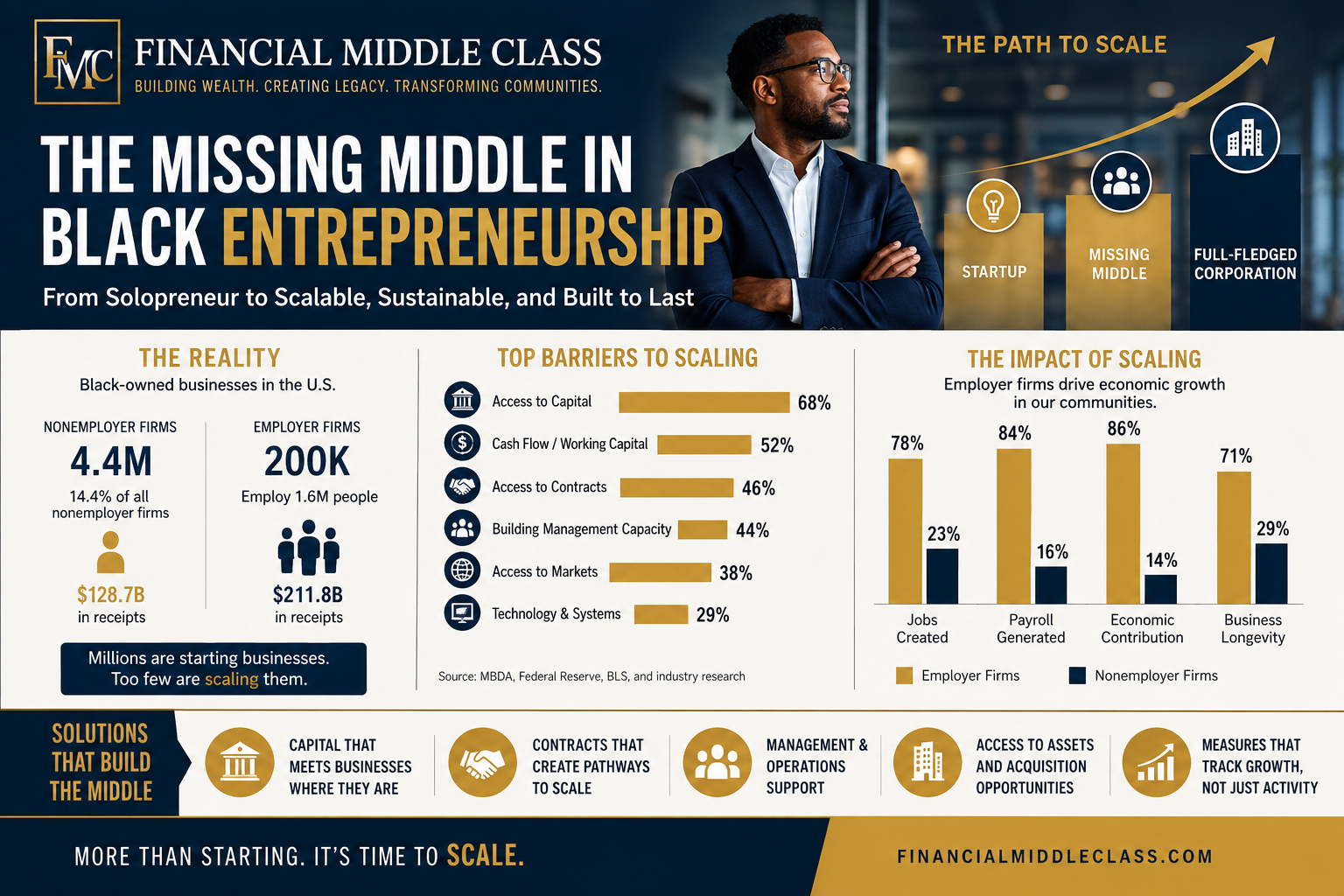
In 2023, Black Americans owned approximately 4.4 million nonemployer businesses—firms without paid employees. These businesses generated about $128.7 billion in receipts. Black-owned businesses represented 14.4% of all nonemployer firms in the United States.
The number of Black-owned employer firms is substantially smaller. Census data show roughly 200,000 Black-owned employer firms. In the preceding reporting cycle, 194,585 Black-owned employer firms generated $211.8 billion in receipts, employed 1.6 million people, and paid approximately $61.2 billion in annual payroll.
The difference between millions of nonemployer businesses and approximately 200,000 employer firms identifies the central issue.
Black entrepreneurship has a missing middle.
The phrase does not refer only to middle-market companies, commonly defined as businesses generating at least $10 million in annual revenue. It also describes the underdeveloped path between self-employment and organizational scale.
That path includes several important transitions:
- From owner-operated work to a business with employees.
- From informal practices to standardized operations.
- From personal credit to institutional financing.
- From isolated transactions to recurring customer relationships.
- From subcontracting to prime contracting.
- From founder control of every function to professional management.
- From income generation to asset and enterprise-value creation.
Business formation remains important. But formation and development are not interchangeable. A strategy designed to increase the number of entrepreneurs will not necessarily increase the number of established companies.
Developing more Black-owned employer firms will require a distinct set of policies, financial products, advisory services, customer relationships, and performance measures.
The Economic Difference Between Self-Employment and an Employer Firm
A nonemployer business can provide substantial value to its owner. Independent consultants, attorneys, accountants, therapists, tradespeople, designers, and other specialists may build profitable practices without hiring employees.
Remaining small can be a rational choice. Some owners prioritize autonomy, flexibility, specialization, or control over organizational growth.
The policy concern is therefore not that every nonemployer firm should become an employer firm. It is that owners who are capable of and interested in expansion often lack a practical route to achieve it.
The movement from self-employment to an employer business changes the economic function of the enterprise.
A self-employed professional generally generates revenue through the direct application of personal time, skill, or reputation. Income may be strong, but productive capacity remains tied closely to the owner.
An employer firm begins to organize the labor of other people. It can serve more customers, distribute responsibilities, develop specialized functions, and continue operating when the founder is unavailable.
This distinction matters for economic development. Employer businesses create jobs, payroll, management positions, vendor relationships, and opportunities for employee advancement. They also have greater potential to accumulate operating assets and build enterprise value that can eventually be sold or transferred.
The transition is nevertheless difficult. Hiring even one employee introduces payroll obligations, employment taxes, insurance requirements, supervision, compliance, technology, and recurring overhead. An owner must commit to these costs before knowing with certainty whether future revenue will support them.
The first employee may therefore represent one of the most consequential transitions in the development of a small company.
Programs intended to support Black entrepreneurship rarely treat it that way.
Why Business Formation Programs Do Not Necessarily Produce Scalable Firms
Much of the entrepreneurship-support system is organized around the needs of early-stage founders. Common services include business-plan development, legal formation, introductory accounting, credit education, marketing, and pitch preparation.
These services are useful when delivered to entrepreneurs who need them. The problem arises when similar programs are offered to firms at fundamentally different stages.
An entrepreneur considering a new business faces questions about market demand, legal structure, initial pricing, and startup costs.
An owner operating a company with $1 million in revenue and ten employees faces different questions. That owner may need to improve gross margins, manage working capital, obtain a commercial credit facility, strengthen middle management, implement financial controls, or prepare to perform a larger contract.
A general workshop cannot resolve those issues.
The advisory system should distinguish among at least four categories:
- Aspiring entrepreneurs evaluating an idea.
- New businesses establishing initial operations.
- Established small businesses seeking to add employees and capacity.
- Growth-stage companies preparing for larger contracts, acquisitions, or geographic expansion.
Without this differentiation, technical assistance may generate substantial participation without producing corresponding business development.
The relevant question is not only how many entrepreneurs completed a program. It is whether the intervention helped businesses improve profitability, hire employees, secure recurring customers, access appropriate financing, or expand operational capacity.
The Capital Gap Changes as a Business Grows
The financing required to open a business differs from the financing required to scale one.
A small service company may be launched using personal savings, credit cards, or a modest loan. Expansion may require considerably more capital to finance payroll, equipment, inventory, facilities, insurance, technology, and customer-acquisition costs.
Growth-stage firms commonly need financing in amounts that fall between traditional microenterprise programs and conventional commercial lending.
A business may need:
- A $100,000 working-capital line.
- A $300,000 equipment loan.
- Financing to mobilize a large contract.
- A commercial mortgage.
- Capital to open another location.
- Funds to purchase an existing company.
- Subordinated or patient capital that can support expansion without immediate repayment pressure.
These needs cannot be addressed through startup grants alone.
Black-owned firms also tend to encounter the financing system with fewer personal and family resources available to support the business. Home equity, inherited wealth, personal liquidity, and financially secure relatives frequently serve as informal forms of business capital. Unequal access to these resources affects how a company starts and how much risk it can absorb.
A firm that begins with inadequate capital may delay hiring, rely on outdated systems, underinvest in marketing, or use expensive short-term debt. Those decisions can weaken its financial profile and make conventional financing even more difficult to obtain.
Federal Reserve Small Business Credit Survey research has repeatedly identified differences in financial conditions and credit access among firms based on the race and ethnicity of their owners. Research on startups owned by people of color has also found that these firms may have strong expectations for employment growth while encountering significant financing constraints.
The appropriate response is not a single Black-business loan fund. A functional capital system must provide financing at multiple stages and connect those products to the business’s actual use of funds.
Microloans may support formation. Working-capital lines support ongoing operations. Equipment and real-estate loans support productive assets. Contract financing bridges the period between performance and customer payment. Acquisition financing allows entrepreneurs to purchase existing cash flow.
Each product solves a different problem.
Growth Frequently Creates a Cash-Flow Problem Before It Creates Wealth
Revenue growth is often treated as evidence that a company is becoming financially stronger. That is not always the case.
A company can be profitable on its income statement and still lack enough cash to operate.
Consider a business awarded a large contract. It may need to recruit employees, purchase materials, secure insurance, obtain bonding, and perform the work before receiving payment. If the customer pays 60 or 90 days after invoicing, the company must finance the entire operating cycle.
The larger the contract, the larger the cash requirement may become.
This problem is particularly important in government and corporate procurement, where small suppliers often operate with less liquidity than incumbent firms. A contract can create economic opportunity, but only when the supplier can finance performance.
Prompt-payment requirements are therefore a business-development policy, not merely an administrative improvement.
Government agencies and large corporations can also reduce the financing burden by providing mobilization payments, establishing contract-backed lending arrangements, shortening approval cycles, and sharing accurate payment data with lenders.
Lenders, in turn, can underwrite more effectively when a firm holds a credible contract with a reliable institutional customer.
Capital and procurement should therefore be designed as connected systems. Providing a contract without working capital can expose a company to failure. Providing capital without access to customers may leave the company with additional debt but no durable source of repayment.
Procurement Can Create Scale, but Certification Alone Cannot
Large institutional buyers can play an important role in the development of Black-owned firms.
Government agencies, hospitals, universities, financial institutions, manufacturers, and major corporations purchase a wide range of goods and services. A multiyear contract from one of these buyers can give a small company predictable revenue, references, operational experience, and the confidence to invest in employees and systems.
Minority-business certification is intended to improve access to these opportunities. However, certification should be understood as an eligibility mechanism, not a business outcome.
A supplier may become certified without receiving a contract. It may receive a small subcontract that does not lead to broader opportunities. It may also participate in supplier-development events without gaining direct access to procurement decision-makers.
The Government Accountability Office has documented several barriers affecting minority-owned small businesses in federal contracting, including difficulty reaching contracting officials and reduced opportunities resulting from contract bundling. Contract bundling combines previously separate contracts into a larger procurement that smaller firms may be unable to pursue.
Bundling may lower administrative costs for the buyer, but it can also reduce the number of qualified small suppliers.
Procurement programs should therefore be evaluated using measures that reflect economic participation:
- Total spending with Black-owned firms.
- Average and median contract size.
- Number of firms receiving contracts, rather than simply registering.
- Share of work performed as a prime contractor.
- Contract-renewal rates.
- Payment speed.
- Industry distribution.
- Movement from small to progressively larger assignments.
- Graduation from subcontracting to prime contracting.
- Revenue concentration and dependence on a single institutional buyer.
The objective should be supplier progression.
A smaller subcontract can provide initial experience. A larger subcontract can establish capacity. A joint venture can allow the firm to participate in more complex work. Prime contracting can create direct customer ownership and stronger margins.
These stages should form a deliberate development path rather than a collection of disconnected opportunities.
Case Study: BLK & Bold and the Infrastructure Behind Distribution
The development of BLK & Bold illustrates how access to large customers can help a small founder-led business move into the missing middle, but also why distribution alone is not sufficient.
Pernell Cezar and Rod Johnson founded the coffee company in 2018 using approximately $20,000 of their own money. The business began with limited production capacity and without an established national retail network.
It subsequently entered major retail channels, expanded its wholesale relationships, invested in production and distribution, and became the first nationally distributed Black-owned specialty coffee brand in the United States.
By 2023, the company reported distribution through approximately 11,000 retail and food-service locations and appeared on the Inc. 5000 in 2023 and 2024. More recent reporting has described a 33,000-square-foot production facility, approximately 25 employees, and products distributed through more than 12,000 stores. The company also expanded into Costco in 2025.
The significance of the case is not simply that a Black-owned consumer brand obtained shelf space.
Retail distribution created a different type of company.
A business selling primarily through its own website or directly to individual customers can adjust production in relatively small increments. A company supplying national retailers must satisfy larger purchase orders, maintain inventory, meet packaging and delivery requirements, manage retailer deductions, forecast demand, and absorb the delay between producing goods and receiving payment.
The move into national distribution therefore required BLK & Bold to develop capabilities that are not visible from the store shelf. These include manufacturing capacity, quality control, logistics, inventory management, account management, and working capital.
The company’s experience also demonstrates the importance of customer diversification. A large retailer can accelerate growth, but dependence on a small number of retail accounts creates risk. Changes in a retailer’s merchandising strategy, supplier programs, payment practices, or consumer demand can materially affect a smaller supplier.
This is why supplier-development programs should not end when a product reaches the shelf.
A supplier entering a national retail relationship may need purchase-order financing, inventory capital, demand forecasting, logistics support, retailer-compliance expertise, and assistance negotiating contract terms. Without those capabilities, a large order can place greater strain on the company than a smaller business model did.
BLK & Bold also demonstrates why the missing middle should not be defined only by revenue. The relevant transformation is organizational. The company moved from a founder-financed venture into an enterprise with employees, dedicated production space, institutional customers, national distribution, and operating responsibilities extending beyond the founders’ direct labor.
Its continued development will depend on how effectively it converts retail reach into stable margins, diversified customer relationships, management capacity, and retained capital. National distribution is an important milestone, but the durable measure of scale is whether the organization can continue investing, adapting, and operating as market conditions change.
For policymakers and corporate buyers, the case illustrates what supplier development should accomplish. The objective is not merely to introduce a small brand to a retailer. It is to help the supplier acquire the financial and operating capacity required to become a reliable long-term participant in the retailer’s supply chain.
Scaling Requires Organizational Capacity
Capital and contracts do not by themselves create a durable company.
A growing firm must develop the operational capacity to use both effectively. This includes accounting, cash-flow forecasting, project management, human resources, compliance, cybersecurity, insurance, quality control, and performance measurement.
Many founders possess substantial industry expertise but limited experience building an organization.
A skilled contractor may understand construction but not enterprise accounting. A health-care provider may understand service delivery but not workforce planning. A consultant may understand the client’s problem but not how to build a repeatable sales process.
These are management challenges.
The technical-assistance system should respond accordingly.
Growth-oriented firms often need embedded, specialized support rather than generalized education. Depending on the company, that support may include:
- A fractional chief financial officer.
- An operations adviser.
- A procurement specialist.
- An employment attorney.
- A technology or cybersecurity consultant.
- An industry-specific sales adviser.
- An executive recruiter.
- A commercial-lending specialist.
The engagement may need to continue for one or two years and should be tied to defined operating milestones.
For example, an advisory team might help a company improve monthly financial reporting, reduce receivables days, establish job-costing systems, hire an operations manager, secure a credit line, and prepare for a larger contract.
This approach is more expensive than a workshop. It is also more closely aligned with the requirements of organizational growth.
The Founder Cannot Remain the Company’s Entire Management Structure
Many small firms reach a point where the founder becomes the principal constraint on further growth.
The owner approves expenditures, handles major sales, resolves customer complaints, supervises employees, manages vendors, and reviews every important decision. The company may generate significant revenue but remain dependent on one person.
This structure creates several risks.
Decision-making becomes slow. Employee development is limited. Strategic work is displaced by operational problems. The founder may also become unable to leave the business for an extended period without affecting performance.
Building a management layer is therefore a central part of moving into the middle.
The company may need an operations manager, controller, sales director, human-resources professional, project manager, or department supervisor. These positions do not always generate revenue directly, but they allow the organization to function at greater scale.
Small companies frequently delay these hires because management salaries appear unaffordable. However, the absence of management may prevent the business from improving productivity or taking on more work.
Growth programs should recognize this sequencing problem.
Possible responses include cost-sharing for critical management positions, executive fellowships, fractional-management services, and partnerships that place experienced operators inside qualifying firms for a defined period.
The purpose is not to displace the founder. It is to help the founder develop an organization that does not require direct involvement in every transaction.
But adding managers is only part of the transition. As firms become larger and more financially complex, they also need governance structures and financial controls that are appropriate to their size.
The experience of Uncle Nearest provides a useful example of why that transition matters.
Case Study: Uncle Nearest and the Risks That Accompany Scale
Uncle Nearest grew from a newly introduced whiskey brand into a nationally recognized spirits company with extensive production and real-estate assets. Its development demonstrated the commercial potential of a differentiated brand, national distribution, substantial investment in production capacity, and access to significant external financing.
The company also accumulated substantial debt.
In 2025, lender Farm Credit Mid-America initiated litigation involving more than $100 million in loans and credit facilities. A federal court subsequently placed Uncle Nearest and related entities under a court-appointed receiver.
In March 2026, the founders attempted to place Uncle Nearest and two affiliated entities into Chapter 11 bankruptcy. The bankruptcy court dismissed the petitions two days later, determining that the founders did not possess the authority to make the filings because control of the companies had been vested in the receiver.
The litigation surrounding the company, its founders, lender, and receiver has involved disputed claims. The case should therefore not be interpreted as establishing personal misconduct or assigning final responsibility for the company’s financial condition.
It does, however, illustrate an important management problem.
The systems required to launch and rapidly expand a founder-led business are not necessarily sufficient to manage a complex enterprise with multiple entities, substantial secured debt, real estate, production facilities, inventory, regulatory obligations, and numerous stakeholders.
At an early stage, centralized founder control can increase speed and preserve strategic consistency. As a company grows, governance must usually become more formal.
Decision rights must be clear. Financial reporting must become more rigorous. Debt and liquidity require continuous monitoring. Boards and senior executives must be capable of challenging assumptions. Lender obligations and covenants must be integrated into financial planning.
Growth financed by debt creates an additional discipline.
New facilities, inventory, expansion projects, and acquisitions may increase the company’s long-term productive capacity, but debt service must ultimately be supported by cash flow. Assets that may be valuable over time do not necessarily provide the liquidity required to satisfy near-term obligations.
This distinction is particularly important in industries such as distilled spirits, where inventory can remain in production or aging for years before it generates revenue. Capital may be committed long before the product can be sold.
Expansion decisions therefore require careful management of both the balance sheet and the timing of cash flows.
The Uncle Nearest case also demonstrates why lender management becomes a distinct executive responsibility as a company scales. Large credit facilities typically involve collateral requirements, covenants, reporting obligations, approval rights, and ongoing communication. A serious breakdown in any of these areas can become an operational threat regardless of the strength of the underlying brand.
The relevant lesson is not that Black-owned companies should avoid substantial borrowing or ambitious expansion. Businesses in capital-intensive industries generally cannot reach significant scale without external financing.
The lesson is that access to capital must be accompanied by governance and financial infrastructure appropriate to the amount and complexity of that capital.
Business-development programs often treat receipt of financing as a successful outcome. For a growth-stage company, obtaining capital begins another phase of management responsibility. The company must deploy the funds effectively, maintain sufficient liquidity, comply with financing requirements, prepare for downside scenarios, and ensure that its governance structure evolves alongside its obligations.
This adds another dimension to the missing-middle problem.
The objective cannot be simply to help Black-owned businesses reach scale. It must also be to help them develop the institutional capacity required to manage and sustain it.
Acquisition Should Be Treated as a Major Entrepreneurship Strategy
Most entrepreneurship programs focus on starting new firms. Less attention is given to acquiring existing ones.
This is a significant omission.
Many owners of established small and midsized businesses are approaching retirement. Their companies may already have employees, customers, equipment, vendor relationships, licenses, and positive cash flow. When no successor is available, these businesses may be sold, closed, or absorbed by larger competitors.
Acquisition can allow an entrepreneur to begin with operating capacity rather than building every component from the beginning.
A buyer may obtain:
- An existing customer base.
- Trained employees.
- Historical financial records.
- Established supplier relationships.
- Equipment and facilities.
- Licenses and certifications.
- Immediate revenue.
The strategy is not without risk. Buyers require careful due diligence, appropriate valuation, acquisition financing, legal support, and a plan for leadership transition.
However, purchasing an established business can provide a more direct route to employer status and scale than launching another small firm.
A Black-business growth agenda should therefore include buyer education, search support, succession matching, seller-financing structures, loan guarantees, due-diligence assistance, and post-acquisition management support.
The central policy question should not be limited to how many new firms can be created. It should also consider how many existing businesses can be transferred to a new generation of Black owners without losing their jobs and productive capacity.
Sector Positioning Influences the Ability to Scale
Black-owned employer firms are concentrated in several industries, particularly health care and social assistance. Census data have shown that roughly one-quarter of Black-owned employer businesses operate in this sector.
There is no reason to devalue these industries. Health care, professional services, construction, transportation, and personal services can all support substantial companies.
Nevertheless, industries differ in their capital requirements, margins, recurring-revenue models, asset intensity, and access to large contracts.
A scale strategy should help Black entrepreneurs enter and expand within sectors that provide opportunities for productivity growth and institutional demand, including:
- Infrastructure and construction.
- Manufacturing and advanced manufacturing.
- Logistics and distribution.
- Technology and cybersecurity.
- Financial and professional services.
- Energy and environmental services.
- Medical supply and health-care administration.
- Business-to-business services.
- Government contracting.
- Commercial real estate.
- Export-oriented industries.
This does not require steering every entrepreneur toward technology or manufacturing. It requires aligning business-development resources with the economic structure of the sector.
A home-health company may need reimbursement expertise and workforce systems. A construction firm may need bonding, equipment capital, and project controls. A technology contractor may need security certifications and access to government procurement. A manufacturer may need facilities, machinery, and long-duration financing.
Sector-specific assistance is more likely to produce scale than a universal curriculum.
Asset Ownership Should Accompany Business Growth
Revenue and income are important, but long-term wealth also depends on asset ownership.
A business that rents its property, leases all equipment, and maintains limited cash reserves may provide a good living while building relatively little transferable wealth.
Commercial real estate can become an important part of the owner’s balance sheet. A company that owns its facility may gain greater control over occupancy costs, participate in property appreciation, and use the building as collateral for future investment.
This issue is particularly relevant in commercial districts where small businesses contribute to neighborhood revitalization but do not own the property. As demand increases, rents may rise faster than business revenue, displacing the very firms that helped improve the area.
Business-development policy should therefore consider commercial-property access alongside operating capital.
Potential tools include commercial down-payment assistance, loan guarantees, long-term leases with purchase options, shared production facilities, commercial community land trusts, and the disposition of suitable public property to qualified businesses.
Not every business should purchase real estate. Capital should not be diverted from operations merely to meet an ownership ideal. But for established firms with stable demand, commercial property can strengthen both business resilience and long-term wealth creation.
Current Performance Measures Are Too Focused on Participation
Business-support programs often report the number of entrepreneurs served, classes completed, certifications issued, loans processed, or events held.
These measures demonstrate activity but provide limited evidence of business development.
A program can serve thousands of entrepreneurs without materially changing their companies’ scale, profitability, or survival prospects.
The Minority Business Development Agency reported that its network helped businesses secure more than $3.2 billion in contracts and $1.6 billion in capital and helped create or retain more than 23,000 jobs during its 2024 reporting period. Its Capital Readiness Program served more than 6,300 entrepreneurs and helped participants raise $263 million during its first year.
These are more meaningful measures than attendance alone because they relate to contracts, capital, and employment. However, long-term evaluation should go further.
Programs intended to build established firms should track:
- Conversion from nonemployer to employer status.
- Number of employees hired and retained.
- Revenue and profit growth.
- Improvement in cash reserves and working capital.
- Repeat contracts and customer diversification.
- Amount and cost of financing obtained.
- Management positions created.
- Assets purchased.
- Acquisitions completed.
- Five- and ten-year survival.
- Owner dependence and succession readiness.
- Enterprise value created.
These measures would distinguish short-term program activity from durable institutional development.
They would also help identify an important distinction illustrated by the two case studies.
BLK & Bold demonstrates that reaching national customers requires the operating infrastructure necessary to serve them.
Uncle Nearest demonstrates that substantial expansion and access to capital create additional requirements for governance, liquidity management, and financial control.
The two stages are connected.
The systems that help a business reach the middle must eventually be supplemented by the systems that allow it to remain there.
An Integrated Strategy for Building the Missing Middle
The barriers facing growth-oriented Black-owned businesses are interconnected. Addressing one barrier while ignoring the others will produce limited results.
A firm may receive technical assistance but lack customers. It may win a contract but lack working capital. It may secure financing but lack operational controls. It may grow revenue but remain entirely dependent on the founder.
An effective strategy should combine six components.
1. Identify Firms With Demonstrated Growth Potential
Programs should use clear selection criteria based on operating history, customer demand, management commitment, industry conditions, financial performance, and the owner’s willingness to build an organization.
This does not mean supporting only already successful firms. It means matching resources to the stage and needs of the business.
2. Create an Employer-Conversion Pathway
Nonemployer firms ready to hire should receive focused assistance with pricing, workforce planning, payroll, employment law, benefits, human resources, and first-year working capital.
The first employee should be treated as a significant business-development milestone.
The objective should then progress from the first employee to the first supervisor and eventually to the first professional manager.
3. Develop a Complete Capital Ladder
Financial institutions, CDFIs, corporations, foundations, and public agencies should coordinate microloans, working-capital lines, contract financing, equipment loans, commercial mortgages, patient capital, and acquisition financing.
The objective is continuity. A business should not graduate from one financing program only to discover that no suitable product exists for the next stage.
The capital ladder should also evolve as companies become larger. Firms taking on substantial debt require stronger financial reporting, cash-flow forecasting, covenant management, and governance than firms using small startup loans.
4. Connect Procurement to Supplier Development
Buyers should create visible pathways from initial contracts to larger and more complex work. Procurement forecasts, prompt payment, manageable contract sizes, technical support, and transparent performance data should be built into the system.
Large customers should also recognize that awarding a contract can create immediate financing and operating requirements for a small supplier. Supplier development should therefore include preparation for the financial consequences of winning the business.
5. Provide Embedded Operational and Management Expertise
Growth-stage businesses should receive specialized advisory support tied to specific performance goals. General education may remain part of the system, but it should not substitute for hands-on implementation.
As companies grow, this assistance should expand beyond operations to include governance, risk management, financial controls, lender relations, and succession planning.
6. Support Acquisitions and Asset Ownership
The strategy should help firms purchase existing businesses, prepare for ownership transitions, and acquire productive assets when financially appropriate.
Acquisition deserves particular attention because it provides a way to transfer existing employees, customers, equipment, institutional knowledge, and cash flow to new owners rather than requiring every entrepreneur to begin at zero.
Together, these components form what is currently missing: an architecture for business maturation.
The Objective Is Institutional Capacity
The importance of Black-owned businesses extends beyond the income earned by individual founders.
Established companies employ workers, train managers, purchase from vendors, own assets, contribute to local tax bases, and create opportunities for future owners. They can also continue operating after the founder retires, sells the company, or dies.
That continuity is an important distinction between self-employment and institution-building.
The United States does not lack Black entrepreneurial activity. It lacks a sufficiently developed system for converting more of that activity into employer firms and helping more employer firms develop into larger, durable enterprises.
That distinction should change how Black entrepreneurship is discussed and how resources are allocated.
Business formation remains necessary. There will always be new entrepreneurs who need help evaluating an idea, creating a legal entity, understanding credit, developing a business plan, or finding their first customer.
But an ecosystem concentrated primarily on formation will continue producing large numbers of very small businesses without necessarily producing a corresponding number of established companies.
The next phase requires greater attention to what happens after formation.
Can the business hire?
Can it finance payroll while waiting to be paid?
Can it obtain a contract large enough to support expansion?
Can it perform that contract profitably?
Can it hire managers?
Can it obtain the next level of financing without assuming unsustainable risk?
Can it purchase another company?
Can it acquire productive assets?
Can it develop financial controls and governance appropriate to its increasing complexity?
Can it eventually function independently of the founder?
Those are the questions that determine whether entrepreneurial activity develops into institutional capacity.
The evidence also suggests that the policy framework should stop treating access to capital, technical assistance, procurement, management development, and asset ownership as separate problems.
They are components of the same growth process.
Capital without customers creates debt.
Customers without working capital can create financial strain.
Growth without management can overwhelm the founder.
Expansion without financial controls can increase risk.
Technical assistance without access to opportunity has limited value.
And business income without transferable assets or enterprise value may create prosperity for the owner without creating an institution capable of surviving the owner.
A more mature Black entrepreneurship strategy would therefore measure success differently.
The number of businesses started would remain relevant, but it would no longer be the principal measure.
We would also measure how many nonemployer firms became employer firms.
How many employer firms developed professional management.
How many businesses moved through progressively larger contracts.
How many obtained appropriate growth capital.
How many acquired competitors or purchased commercial property.
How many built sufficient financial and governance capacity to manage larger balance sheets.
And ultimately, how many moved from small-business status into the middle market and remained there.
Black Americans have demonstrated substantial willingness to become entrepreneurs.
The next economic-development challenge is to build a stronger pathway between entrepreneurship and scale.
That pathway requires capital appropriate to each stage, recurring customers, specialized operating assistance, professional management, acquisition opportunities, productive assets, governance, and clear accountability.
The objective should not simply be to create more Black-owned businesses.
It should be to create the conditions under which more of the businesses that already exist can become durable companies.


RELATED ARTICLES
The S&P 7,000: How Wall Street Disconnects from Main Street
S&P 7,000 can rise while wages, benefits, and towns fall behind. See why the market isn’t the economy—read now.
The Affordability Pivot: Can Trump’s New Promises Actually Lower the Middle-Class Bill?
Will Trump’s affordability proposals lower your bills—or backfire? Housing, rates, tariffs, gas, credit cards—explained. Read now.
Leave Comment
Cancel reply
Gig Economy
Business / Aug 08, 2026
The Missing Middle in Black Entrepreneurship
Black entrepreneurship has expanded dramatically. The next challenge is helping more Black-owned businesses move from self-employment to employer firms and sustainable scale.
By FMC Editorial Team
Personal Finance / Aug 01, 2026
Cash Strategy: Put Every Dollar in the Right Place
Your checking account, emergency fund, short-term savings, and investments should not be managed the same way. This cash strategy helps assign every dollar to the right...
By Article Posted by Staff Contributor
Personal Finance / Aug 01, 2026
Best HYSA: How to Choose Beyond the Highest APY
A competitive interest rate matters, but it is only one part of choosing a high-yield savings account. Compare insurance, fees, access, transfer speed, and promotional conditions.
By Article Posted by Staff Contributor
Personal Finance / Aug 01, 2026
High-Yield Savings vs. CDs, Treasury Bills, and Other Safe Places for Cash
High-yield savings accounts are excellent for accessible cash, but they are not always the best choice. Compare HYSAs, CDs, Treasury bills, money market accounts, and I...
By Article Posted by Staff Contributor
American Middle Class / Aug 01, 2026
High-Yield Savings Accounts: A Safer Home for Your Cash
A high-yield savings account can pay several times the national savings rate while keeping qualified deposits federally insured. Here is how it works, what to watch...
By Article Posted by Staff Contributor
Real Estate / Jul 30, 2026
Mortgage Lock-In Is Freezing the Housing Market
Millions are trapped by 3% mortgages. Learn how mortgage lock-in worsens affordability—and why homeowners are renovating instead.
By FMC Editorial Team
Real Estate / Jul 26, 2026
Is South Florida More Expensive Than New York? The Complete 2026 Relocation Guide
Is South Florida more expensive than New York? Compare housing, taxes, insurance and 104 municipalities before you move.
By Article Posted by Staff Contributor
Personal Finance / Jul 25, 2026
The Time Value of Life Experiences: What Compound Interest Leaves Out,
Money compounds, but life experiences do too. Explore what compound interest leaves out—and how to balance saving with living.
By MacKenzy Pierre
American Middle Class / Feb 18, 2026
How Wealth Is Passed Across Generations in the United States: Mechanisms, Evidence, and the Policy Debate
How wealth passes between generations—trusts, taxes, and the debate. Get the facts, figures, and tradeoffs. Read now.
By FMC Editorial Team
American Middle Class / Feb 16, 2026
The S&P 7,000: How Wall Street Disconnects from Main Street
S&P 7,000 can rise while wages, benefits, and towns fall behind. See why the market isn’t the economy—read now.
By MacKenzy Pierre
Latest Reviews
Business / Aug 08, 2026
The Missing Middle in Black Entrepreneurship
Black entrepreneurship has expanded dramatically. The next challenge is helping more Black-owned businesses move from...
Personal Finance / Aug 01, 2026
Cash Strategy: Put Every Dollar in the Right Place
Your checking account, emergency fund, short-term savings, and investments should not be managed the same...
Personal Finance / Aug 01, 2026
Best HYSA: How to Choose Beyond the Highest APY
A competitive interest rate matters, but it is only one part of choosing a high-yield...