High-Yield Savings vs. CDs, Treasury Bills, and Other Safe Places for Cash
By Article Posted by Staff Contributor
The estimated reading time for this post is 1223 seconds
Part 2 of the Financial Middle Class High-Yield Savings Guide
Editor’s note: Product rules were reviewed on August 1, 2026. Interest rates, account fees, minimum balances, transfer policies, and promotional terms can change. Always review the current account agreement before moving your money.
A high-yield savings account is usually one of the best places to keep an emergency fund or cash you may need on relatively short notice.
But it is not automatically the best place for every safe dollar.
A certificate of deposit may be more useful when you know exactly when you will need the money. Treasury bills may offer an important tax advantage. I bonds are designed to respond to inflation but restrict access during the first year. Long-term money may need more growth than any savings product can reasonably provide.
The right question is not simply:
Which account pays the highest rate?
The better question is:
What job is this money supposed to do, and when will I need it?
That distinction matters. Safety, accessibility, taxes, inflation, and rate certainty all affect whether a financial product is appropriate for a particular goal.
Key Takeaways
- High-yield savings is usually best for an emergency fund because the money remains relatively accessible while earning interest.
- CDs can be useful for known expenses with known dates because the interest rate is generally fixed for the term.
- Treasury bills can be attractive for short-term savings, particularly in states with income taxes, because their interest is exempt from state and local income taxes.
- I bonds are designed for inflation protection, not immediate liquidity. They cannot be redeemed during the first 12 months.
- Long-term retirement money generally should not remain entirely in cash. Inflation can erode the purchasing power of savings over long periods.
What Is a High-Yield Savings Account?
A high-yield savings account, commonly called an HYSA, is a savings account that pays a more competitive annual percentage yield than many traditional savings accounts.
The term “high-yield” does not create a separate legal category. It describes the account’s earning potential relative to lower-paying savings accounts.
What does APY mean?
APY stands for annual percentage yield. It represents the total amount of interest an account would pay over a year based on the interest rate and the frequency of compounding. APY makes it easier to compare deposit accounts that may compound interest differently.
A higher APY can help your savings grow faster, but the advertised rate is not the only detail that matters. A competitive account can become less attractive if it carries:
- Monthly maintenance fees
- A minimum balance requirement
- A lower rate for certain balance tiers
- Withdrawal or transfer limitations
- Slow transfers to your checking account
- Requirements for direct deposit or other qualifying activity
Most high-yield savings accounts have variable rates. The bank or credit union can adjust the rate after the account is opened, subject to the account agreement and applicable disclosure requirements.
Is the money federally insured?
A savings account held at an FDIC-insured bank generally receives federal deposit insurance up to at least $250,000 per depositor, per insured bank, for each account ownership category.
The limit is not necessarily $250,000 for each separate account. Accounts held in the same ownership category at the same bank are generally combined when insurance coverage is calculated.
At a federally insured credit union, qualifying accounts receive similar protection through the National Credit Union Share Insurance Fund. The standard coverage amount is generally $250,000 per member, per insured credit union, for each ownership category.
Federal insurance protects covered deposits if the institution fails. It does not guarantee that the account’s interest rate will remain competitive or that inflation will not reduce the purchasing power of the money.
What Does “Safe” Actually Mean?
People frequently describe savings accounts, CDs, and Treasury securities as safe. But safety has several dimensions.
Principal safety
Principal is the money you originally deposited or invested.
An FDIC-insured savings account protects covered deposits within the applicable limits. A Treasury bill is backed by the full faith and credit of the United States. Both offer strong principal protection when used correctly, but the protection comes from different sources.
Liquidity
Liquidity means how quickly and easily you can turn an asset into spendable cash without accepting a loss or penalty.
A savings account is generally liquid, but access is not always instantaneous. An online bank may require you to transfer the money to an outside checking account, which can take time.
A CD may impose an early withdrawal penalty. An I bond cannot be redeemed at all during its first 12 months. A Treasury bill can be held until maturity or sold before maturity, but its market value can change if it is sold early.
Rate certainty
A high-yield savings account usually has a variable rate.
A traditional bank CD generally locks in a rate for a specified term. A Treasury bill also provides a known return when purchased and held to maturity, although its market price can fluctuate if it is sold before maturity.
Inflation risk
Inflation risk is the possibility that prices will rise faster than your money grows.
Cash and cash equivalents provide stability, but their long-term returns may fail to preserve purchasing power. Investor.gov identifies inflation as the principal concern for people holding large amounts in cash equivalents over long periods.
Tax treatment
Interest from bank accounts, money market deposit accounts, and CDs is generally taxable income.
Treasury interest is subject to federal income tax but is exempt from state and local income taxes. That exemption can make Treasury bills more attractive to savers in states that impose an individual income tax.
Taxes should not be the only consideration, but the after-tax return can matter when two products offer similar yields.
High-Yield Savings Compared With Other Safe Options
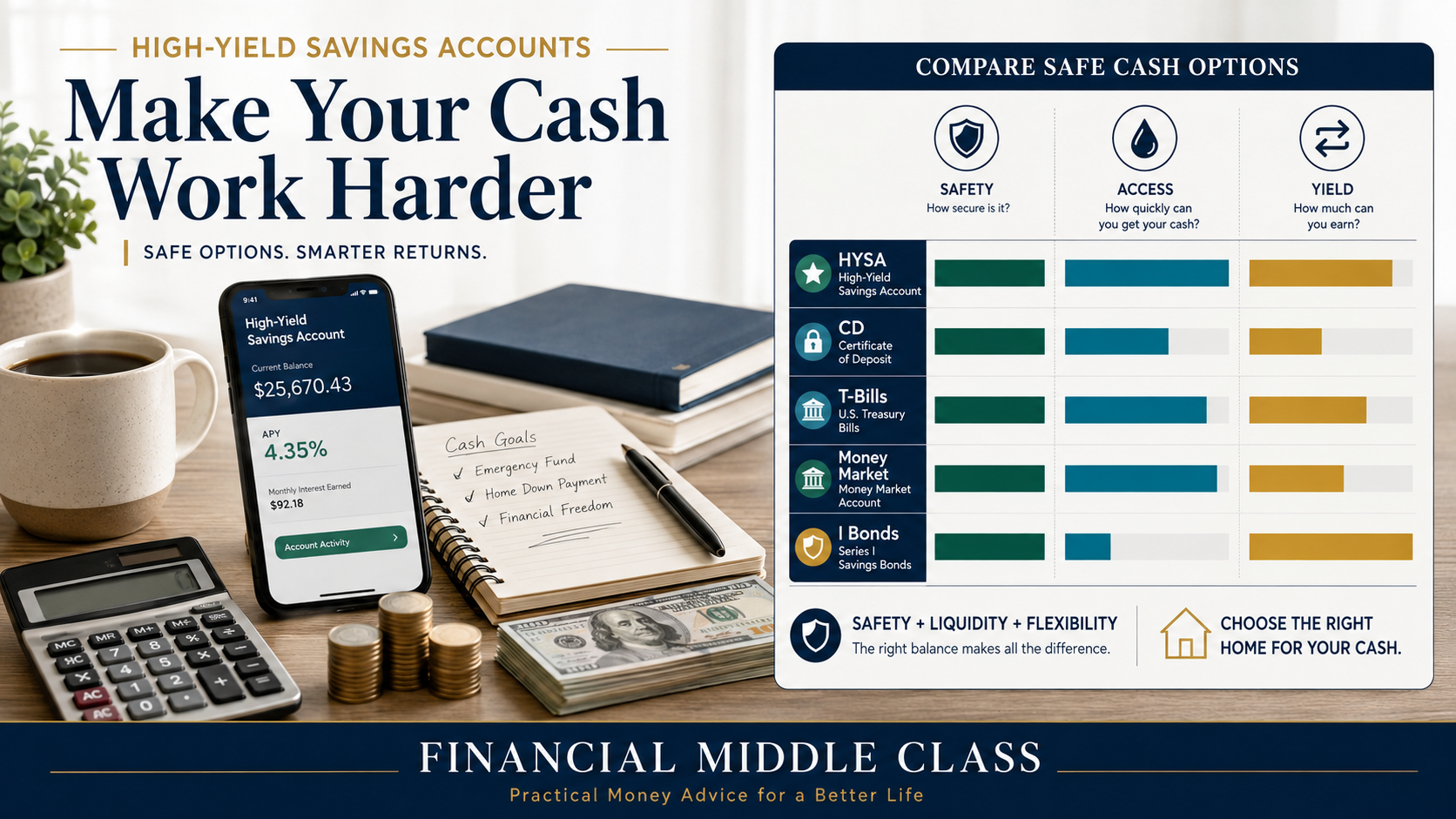
The following table compares the major places households commonly keep short-term cash.
| Option | Principal protection | Rate behavior | Access to money | Tax treatment | Main tradeoff | Best use |
|---|---|---|---|---|---|---|
| Checking account | FDIC or NCUA coverage when eligible and within limits | Usually low or no interest | Immediate for everyday transactions | Interest is generally taxable | Low earning potential | Bills and routine spending |
| Traditional savings | FDIC or NCUA coverage when eligible and within limits | Variable | Generally accessible | Interest is generally taxable | Often pays a low APY | Small savings buffer |
| High-yield savings | FDIC or NCUA coverage when eligible and within limits | Variable | Usually accessible, but transfer timing varies | Interest is generally taxable | Rate can fall; account terms vary | Emergency fund and near-term goals |
| Money market deposit account | FDIC or NCUA coverage when eligible and within limits | Variable | May include checks or a debit card | Interest is generally taxable | Minimum balances and transaction rules may apply | Accessible savings needing transaction features |
| Bank CD | FDIC or NCUA coverage when eligible and within limits | Usually fixed for the term | Early access may trigger a penalty | Interest is generally taxable | Less flexibility | Known expense with a known date |
| Treasury bill | Backed by the U.S. government | Return is established when purchased and held to maturity | Available at maturity; can be sold earlier | Federal tax applies; no state or local income tax | Requires maturity planning or reinvestment | Short-term cash and planned expenses |
| I bond | Backed by the U.S. government | Composite rate includes fixed and inflation-linked components | No redemption for 12 months; penalty before five years | Federal tax applies; no state or local income tax | Limited liquidity and annual purchase limit | Longer-term inflation-sensitive savings |
A money market deposit account should not be confused with a money market mutual fund. The deposit account is a bank product that may receive FDIC insurance. The mutual fund is an investment product and is not FDIC-insured.
High-Yield Savings Account vs. CD
The choice between a high-yield savings account and a certificate of deposit usually comes down to flexibility versus rate certainty.
When high-yield savings is better
A high-yield savings account is usually the stronger choice when:
- You may need the money unexpectedly
- You are building an emergency fund
- Your savings goal does not have a firm date
- You want to make continuing deposits
- You do not want an early withdrawal penalty
The account’s rate can change, but the money remains available under the institution’s normal transfer and withdrawal procedures.
When a CD is better
A CD may be more useful when:
- You know when the money will be needed
- You are comfortable leaving it untouched for the full term
- You want to lock in the current rate
- You believe savings rates may decline
- The CD’s rate meaningfully exceeds the HYSA rate
CDs generally impose a penalty when money is withdrawn before maturity, although the amount varies by institution and term. Federally insured bank CDs receive FDIC protection when the depositor and account remain within the applicable coverage rules.
Consider a no-penalty CD or CD ladder
A no-penalty CD may allow an early withdrawal without the standard interest penalty, although it may offer a lower rate than a conventional CD.
A CD ladder divides money among several CDs with different maturity dates. For example, instead of putting $12,000 into one 12-month CD, a saver might divide the money among CDs maturing at different intervals.
The purpose is not to manufacture a guaranteed superior return. It is to create more frequent access points while retaining some fixed-rate exposure.
High-Yield Savings Account vs. Treasury Bills
Treasury bills, commonly called T-bills, are short-term obligations of the U.S. government. Treasury bills mature within one year.
When high-yield savings is better
An HYSA is usually simpler when:
- The money is part of your first-line emergency fund
- You want to add or withdraw money at irregular times
- You do not want to manage maturity dates
- You prefer ordinary bank-account access
- The difference in after-tax yield is small
The money can remain in the account and continue earning whatever variable rate the institution is currently paying.
When Treasury bills may be better
Treasury bills may be more attractive when:
- You know the approximate period during which the money can remain invested
- You live in a state with an individual income tax
- The Treasury yield exceeds the HYSA yield after considering taxes and convenience
- You are comfortable purchasing securities and managing maturities
- You want direct exposure to U.S. government obligations
Treasury interest is exempt from state and local income taxes. Treasury bills are also backed by the full faith and credit of the United States government.
The liquidity distinction
A Treasury bill held to maturity returns its value according to the terms established at purchase.
If you sell a marketable Treasury security before maturity, however, its price may be higher or lower than the amount you paid. That makes a Treasury bill different from a bank savings account with a stable deposit balance.
For emergency savings, a practical approach may be to keep the most immediately needed portion in an HYSA and place a secondary reserve in short-term Treasury bills. That is a framework, not a universal prescription.
High-Yield Savings Account vs. Money Market Account
A money market deposit account is a bank or credit-union account that may combine savings features with limited transaction features.
Depending on the institution, it may offer:
- Check-writing privileges
- A debit or ATM card
- A competitive variable APY
- Tiered rates based on balance
- A minimum balance requirement
A high-yield savings account is generally more focused on saving and electronic transfers.
Which one is better?
Choose based on the actual account terms, not the product name.
A money market account may be more convenient when you want to write occasional checks directly from the account. An HYSA may be more attractive when it has a better APY, no maintenance fee, and simpler balance requirements.
Compare:
- APY
- Monthly fee
- Minimum balance
- Transfer speed
- ATM or check access
- Withdrawal policies
- Deposit insurance
- Customer service
- Mobile and online banking quality
The practical differences between two specific accounts may matter more than the difference between the two product labels.
High-Yield Savings Account vs. I Bonds
Series I savings bonds are designed to help protect savings from inflation.
Their composite rate combines:
- A fixed rate that remains with the bond
- An inflation rate that is reset every six months
The overall rate can rise or fall as the inflation component changes.
The most important I bond restriction
You cannot redeem an I bond during the first 12 months.
If you redeem it after 12 months but before five years, you lose the final three months of interest. After five years, that early-redemption penalty no longer applies.
That makes an I bond inappropriate for the first layer of an emergency fund.
When an HYSA is better
A high-yield savings account is generally better when:
- You may need the money within a year
- You need straightforward bank access
- The money covers immediate emergencies
- You want to make frequent deposits and withdrawals
When an I bond may be better
An I bond may be worth considering when:
- You will not need the money for at least one year
- Inflation protection is a major goal
- You accept the redemption restrictions
- You remain within the annual purchase limit
- You already have a separate liquid emergency reserve
I bonds can be valuable, but they solve a different problem from a high-yield savings account.
Who Should Use High-Yield Savings?
High-yield savings accounts can be useful for many households, but their strongest applications involve money that must remain stable and reasonably accessible.
Families building an emergency fund
An emergency fund should not depend on the stock market being up on the day the money is needed.
A car repair, medical deductible, home repair, or job loss can occur during a market decline. Keeping first-line emergency savings in an insured HYSA reduces the risk that you will have to sell an investment at a bad time.
First-time homebuyers
Money intended for a home purchase within the next few years generally should not be exposed to substantial stock-market volatility.
Investor.gov describes goals of five years or less as short-term goals for which risky investments may be inappropriate because the saver could be forced to sell at a loss.
An HYSA, CD, or short-term Treasury bill can be appropriate depending on the expected purchase date and the need for access.
Retirees
Retirees may use an HYSA for:
- Near-term living expenses
- Tax payments
- Insurance deductibles
- Home repairs
- A cash reserve that reduces the need to sell investments during a market decline
That does not mean an entire retirement portfolio belongs in savings. Long-term retirement assets may still need diversified growth to offset inflation and support a potentially lengthy retirement.
Young professionals and working families
Investing for retirement is important, but investing every available dollar can leave a household vulnerable to ordinary setbacks.
A cash reserve can prevent a temporary expense from becoming credit-card debt or forcing a premature retirement-account withdrawal.
Business owners
A business HYSA may be useful for:
- Tax reserves
- Payroll reserves
- Seasonal operating cash
- Planned equipment purchases
- Insurance deductibles
Business owners should verify the institution’s insurance status, account ownership category, transaction limits, and whether the account is designed for business use. FDIC coverage includes separate ownership categories for qualifying business accounts, but coverage depends on how the account and business are structured.
Conservative savers
A person who cannot tolerate market volatility may reasonably keep more cash than an aggressive investor.
The important distinction is between money kept in cash for a defined purpose and long-term money kept in cash primarily because of fear. The first can be sound planning. The second can create a substantial inflation risk.
When High-Yield Savings Is Not the Best Choice
A high-yield savings account is useful, but it is not a complete financial strategy.
Long-term retirement savings
Money that will not be needed for decades generally requires a different balance between safety and growth.
Investor.gov notes that cash equivalents have historically offered lower returns than stocks and that long-term investors may need exposure to growth assets to avoid losing purchasing power to inflation and taxes.
A high-yield savings account can protect nominal dollars. It is not designed to maximize long-term wealth accumulation.
Deposits above insurance limits
People holding large cash balances should not assume that opening several accounts at the same bank automatically creates additional FDIC coverage.
Coverage depends on:
- The depositor
- The insured institution
- The ownership category
- How accounts are titled
- Other deposits held in the same category
The FDIC’s Electronic Deposit Insurance Estimator can help depositors evaluate their specific coverage.
Fixed-date expenses
If you know you will need the money on a particular date and do not need early access, a CD or Treasury bill maturing near that date may provide greater rate certainty.
People who require immediate in-person access
Some of the most competitive HYSAs are offered by online institutions. An account may be less useful to someone who routinely needs:
- Branch service
- Cash deposits
- Cashier’s checks
- Immediate same-bank transfers
- In-person problem resolution
The best account is not merely the one with the highest APY. It is the one whose access system works when you need the money.
The Financial Middle Class Cash Pyramid
Different dollars have different responsibilities.
The following pyramid is a planning framework rather than a universal formula. The appropriate amounts depend on income stability, household size, insurance coverage, debt, health, employment, and personal risk tolerance.
Level 1: Everyday checking
Purpose: Current bills and routine spending
Keep enough to cover upcoming obligations and a reasonable buffer. Holding too much in checking may reduce interest earnings, but holding too little can lead to overdrafts or missed payments.
Level 2: High-yield savings
Purpose: Emergencies and irregular short-term expenses
Possible uses include:
- Job-loss reserve
- Insurance deductibles
- Car repairs
- Home repairs
- Medical costs
- Travel for a family emergency
A common guideline is three to six months of essential expenses, but a household with variable income, one earner, dependents, or a volatile industry may need more.
Level 3: CDs, Treasury bills, and selected I bonds
Purpose: Money expected to be needed within roughly one to five years
Examples include:
- Home down payment
- Vehicle purchase
- Tax reserve
- Planned renovation
- Tuition payment
- Major family event
The product should be matched to the date and flexibility of the goal. I bonds should not hold money that may be needed during the first 12 months.
Level 4: Diversified long-term investments
Purpose: Goals that are many years or decades away
Examples include:
- Retirement
- Long-term education funding
- Financial independence
- Generational wealth
These dollars can usually accept more volatility because they have more time to recover from market declines.
Level 5: Speculative assets
Purpose: Optional, high-risk opportunities
Examples may include:
- Highly speculative individual stocks
- Crypto assets
- Private ventures
- Collectibles
- Other assets with substantial loss risk
Speculative assets should not replace emergency savings, insurance, retirement contributions, or money required for near-term obligations.
Too many people try to build the top of the pyramid before securing the foundation.
Wealth is not built by forcing every dollar to chase the highest return. It is built by giving each dollar the right job.
How to Choose the Right Place for Your Cash
Use the following questions before opening an account or buying a security.
1. When will you need the money?
- Within days or at an unpredictable time: Checking or HYSA
- At a known date within a year: HYSA, CD, or Treasury bill
- More than one year away: HYSA, CDs, Treasury securities, or I bonds may be considered
- More than five years away: Consider whether diversified investments are more appropriate
2. How quickly must you be able to access it?
Do not call money an emergency fund if it cannot be reached during the type of emergency you are preparing for.
Review transfer times, withdrawal procedures, weekend access, ATM availability, and any holding periods.
3. Is the rate fixed or variable?
A variable APY can rise or fall.
A fixed rate provides certainty, but that certainty may come with a maturity requirement or early withdrawal penalty.
4. What is the after-tax return?
Bank interest is generally subject to federal, state, and local income taxes.
Treasury interest is generally subject to federal income tax but exempt from state and local income taxes. The difference may matter when yields are close.
5. Is the principal properly protected?
Verify:
- FDIC membership for a bank
- NCUA coverage for a credit union
- The amount held at the institution
- The ownership category
- Whether the product is a deposit account or an investment
A product offered through a familiar financial company is not automatically an insured bank deposit.
6. What conditions could reduce the advertised return?
Look for:
- Monthly fees
- Minimum balances
- Balance tiers
- Expiring promotional rates
- Direct-deposit requirements
- Maximum balances eligible for the top APY
- Early withdrawal penalties
- Automatic renewal provisions
- Transfer restrictions
An illustrative example
Suppose a household has $30,000 reserved for two purposes:
- $12,000 for emergencies
- $18,000 for a home purchase expected in 18 months
The emergency portion may belong in an accessible HYSA.
The home-purchase portion could remain in the HYSA, or part of it could be placed in CDs or Treasury bills scheduled to mature before the expected purchase. The decision would depend on the rate difference, tax treatment, likelihood that the timeline will change, and how much administrative complexity the household is willing to accept.
The example does not produce one universally correct answer. It demonstrates why the same household may use more than one safe savings product.
Frequently Asked Questions
Are high-yield savings accounts safe?
A high-yield savings account is generally considered safe when it is held at an FDIC-insured bank or federally insured credit union and the depositor remains within the applicable insurance limits.
The account’s principal may be protected, but its APY can change and inflation can reduce the purchasing power of the money.
Can you lose money in a high-yield savings account?
You normally should not lose insured principal because of ordinary market fluctuations. However, fees could reduce the account balance, deposits above insurance limits may be exposed if an institution fails, and inflation can reduce the money’s real value.
Is a high-yield savings account better than a CD?
An HYSA is usually better when access and flexibility matter. A CD may be better when the money can remain untouched until a known date and the fixed rate is attractive enough to justify the reduced flexibility.
Is an HYSA better than Treasury bills?
An HYSA is generally easier to manage and better suited to immediate emergencies. Treasury bills may offer a higher after-tax return in some circumstances because their interest is exempt from state and local income taxes.
Compare current yields, taxes, maturity dates, transfer needs, and convenience.
Should an emergency fund be kept in I bonds?
I bonds should not hold the entire emergency fund because they cannot be redeemed during the first 12 months.
Once a household has adequate liquid savings, I bonds may be considered for a secondary reserve that will not be needed during the lockup period.
Are high-yield savings accounts good for retirement?
They can be useful for the cash portion of a retirement plan and for near-term expenses. They are generally not sufficient as the sole home for retirement savings because long-term cash holdings face inflation and opportunity-cost risks.
The Bottom Line
High-yield savings is one of the strongest default options for emergency funds and other short-term cash.
But “strong default” does not mean “best for every dollar.”
A CD can provide rate certainty. A Treasury bill can provide a state-tax advantage. A money market deposit account can provide transaction features. An I bond can provide inflation-sensitive interest. Diversified investments can provide the long-term growth that cash products are not designed to deliver.
The smartest choice depends on five questions:
- When will you need the money?
- How quickly must you be able to access it?
- How much rate certainty do you want?
- What taxes, fees, and restrictions apply?
- What risk is the money supposed to avoid?
Do not move money solely because one account advertises a slightly higher APY.
First decide what the money is for.
Then choose the product that allows it to do that job safely, efficiently, and with as little unnecessary complexity as possible.
Financial Middle Class action step: Review the cash you currently hold in checking, savings, and investment accounts. Assign each portion to a specific purpose and time horizon. Any money without a clear job deserves a closer look.
Continue to Part 3
Part 3 of the Financial Middle Class High-Yield Savings Guide will examine:
- How to compare leading high-yield savings accounts
- Why the advertised APY is not the only factor
- Fees, balance requirements, and transfer restrictions
- Common mistakes when opening an HYSA
- How FDIC insurance works when a bank fails
- Frequently asked questions about choosing and managing an account

RELATED ARTICLES
Cash Strategy: Put Every Dollar in the Right Place
Your checking account, emergency fund, short-term savings, and investments should not be managed the same way. This cash strategy helps assign every dollar to the right financial job.
Best HYSA: How to Choose Beyond the Highest APY
A competitive interest rate matters, but it is only one part of choosing a high-yield savings account. Compare insurance, fees, access, transfer speed, and promotional conditions.
Leave Comment
Cancel reply
Gig Economy
Business / Aug 08, 2026
The Missing Middle in Black Entrepreneurship
Black entrepreneurship has expanded dramatically. The next challenge is helping more Black-owned businesses move from self-employment to employer firms and sustainable scale.
By FMC Editorial Team
Personal Finance / Aug 01, 2026
Cash Strategy: Put Every Dollar in the Right Place
Your checking account, emergency fund, short-term savings, and investments should not be managed the same way. This cash strategy helps assign every dollar to the right...
By Article Posted by Staff Contributor
Personal Finance / Aug 01, 2026
Best HYSA: How to Choose Beyond the Highest APY
A competitive interest rate matters, but it is only one part of choosing a high-yield savings account. Compare insurance, fees, access, transfer speed, and promotional conditions.
By Article Posted by Staff Contributor
Personal Finance / Aug 01, 2026
High-Yield Savings vs. CDs, Treasury Bills, and Other Safe Places for Cash
High-yield savings accounts are excellent for accessible cash, but they are not always the best choice. Compare HYSAs, CDs, Treasury bills, money market accounts, and I...
By Article Posted by Staff Contributor
American Middle Class / Aug 01, 2026
High-Yield Savings Accounts: A Safer Home for Your Cash
A high-yield savings account can pay several times the national savings rate while keeping qualified deposits federally insured. Here is how it works, what to watch...
By Article Posted by Staff Contributor
Real Estate / Jul 30, 2026
Mortgage Lock-In Is Freezing the Housing Market
Millions are trapped by 3% mortgages. Learn how mortgage lock-in worsens affordability—and why homeowners are renovating instead.
By FMC Editorial Team
Real Estate / Jul 26, 2026
Is South Florida More Expensive Than New York? The Complete 2026 Relocation Guide
Is South Florida more expensive than New York? Compare housing, taxes, insurance and 104 municipalities before you move.
By Article Posted by Staff Contributor
Personal Finance / Jul 25, 2026
The Time Value of Life Experiences: What Compound Interest Leaves Out,
Money compounds, but life experiences do too. Explore what compound interest leaves out—and how to balance saving with living.
By MacKenzy Pierre
American Middle Class / Feb 18, 2026
How Wealth Is Passed Across Generations in the United States: Mechanisms, Evidence, and the Policy Debate
How wealth passes between generations—trusts, taxes, and the debate. Get the facts, figures, and tradeoffs. Read now.
By FMC Editorial Team
American Middle Class / Feb 16, 2026
The S&P 7,000: How Wall Street Disconnects from Main Street
S&P 7,000 can rise while wages, benefits, and towns fall behind. See why the market isn’t the economy—read now.
By MacKenzy Pierre
Latest Reviews
Business / Aug 08, 2026
The Missing Middle in Black Entrepreneurship
Black entrepreneurship has expanded dramatically. The next challenge is helping more Black-owned businesses move from...
Personal Finance / Aug 01, 2026
Cash Strategy: Put Every Dollar in the Right Place
Your checking account, emergency fund, short-term savings, and investments should not be managed the same...
Personal Finance / Aug 01, 2026
Best HYSA: How to Choose Beyond the Highest APY
A competitive interest rate matters, but it is only one part of choosing a high-yield...