
High-Yield Savings Accounts: A Safer Home for Your Cash
By Article Posted by Staff Contributor
The estimated reading time for this post is 734 seconds
Why cash sitting in a low-rate savings account may be costing you hundreds—or even thousands—of dollars a year.
For generations, Americans have been taught a simple financial habit:
Put money in a savings account.
The advice itself is not wrong. Savings accounts provide a place to hold money for emergencies, upcoming expenses, and short-term goals.
The problem is not that people are saving.
The problem is where some of that money is being saved.
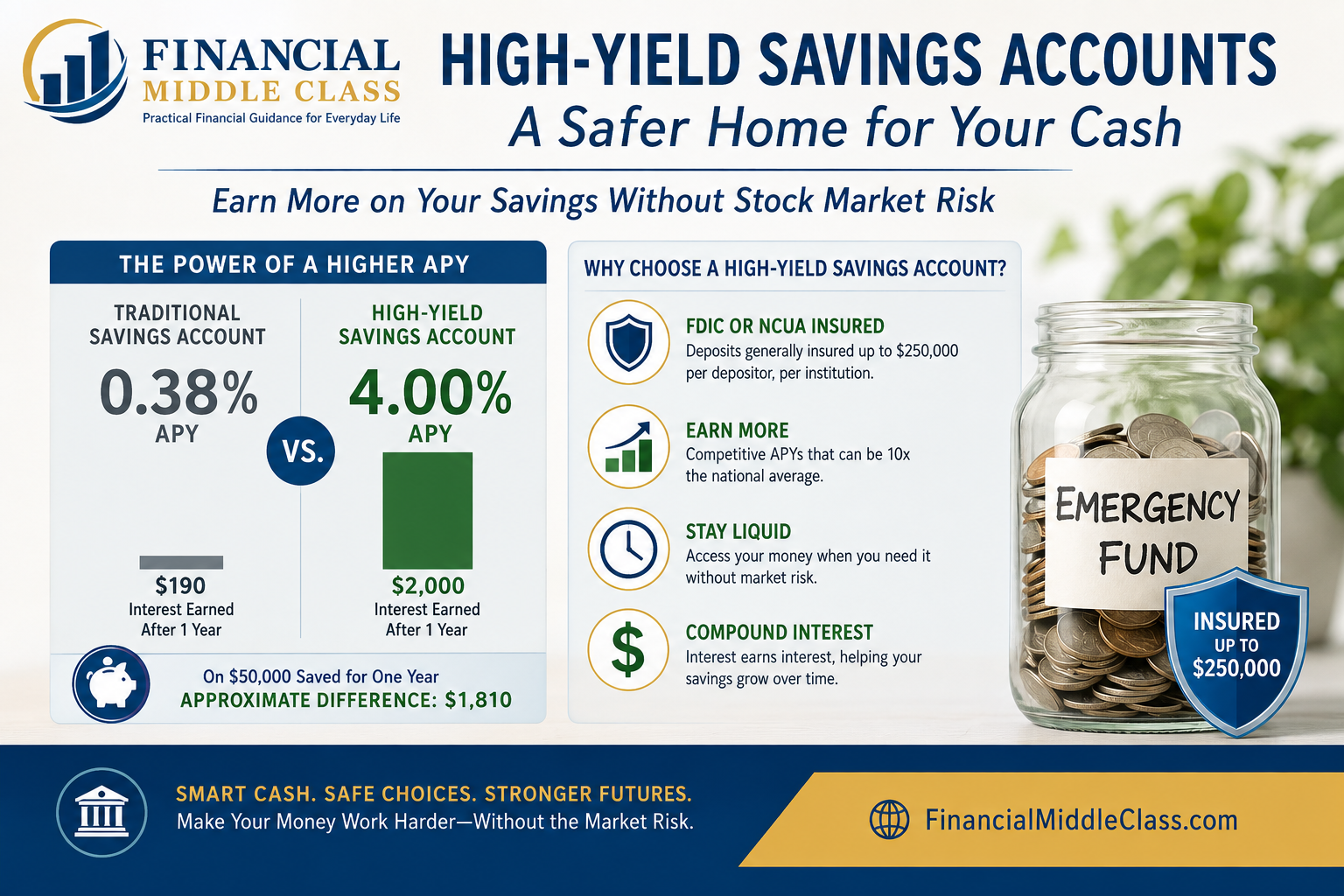
As of July 2026, the national average savings account rate was just 0.38%. At the beginning of August, competitive high-yield savings accounts were generally paying around 4%, with some nationally available offers reaching approximately 4.26%. Rates can change, but that was more than ten times the national average.
That difference may look small when written as a percentage.
It is not small when translated into dollars.
Consider someone keeping $50,000 in cash:
| Savings option | APY | Approximate interest after one year |
|---|---|---|
| Traditional savings account | 0.38% | $190 |
| High-yield savings account | 4.00% | $2,000 |
| Approximate difference | $1,810 |
These estimates assume the balance remains unchanged and do not account for taxes, fees, or rate changes.
The saver did not work additional hours.
The saver did not buy stocks.
The saver did not place the principal at risk in pursuit of a speculative return.
The money was simply moved to a more competitive deposit account.
For middle-class households trying to build stability, that may be one of the more straightforward financial improvements available.
Key Takeaways
- A high-yield savings account is a deposit account, not a stock-market investment.
- Competitive HYSAs may pay several times the national average savings rate.
- Qualified deposits are generally insured by the FDIC or NCUA within applicable limits.
- HYSA rates are variable and can rise or fall.
- These accounts are most useful for emergency funds, short-term goals, and money that cannot tolerate market losses.
- The best account is not necessarily the one advertising the highest rate. Fees, conditions, access, and insurance matter too.
The Hidden Cost of Low-Yield Savings
Most people define financial safety as avoiding a visible loss.
They do not want to see a $20,000 balance fall to $17,000 because the stock market declined.
That is understandable.
But there is another kind of loss that does not appear as a negative number on a bank statement.
Suppose you leave $25,000 in a savings account for five years.
At 0.38% APY, the balance would grow to approximately $25,479, assuming the rate remained unchanged and interest compounded annually.
At 4% APY, it would grow to approximately $30,416 under the same simplified assumptions.
The difference would be nearly $5,000.
Your bank statement may never show that money as a loss. But the opportunity to earn it was still lost.
Inflation creates another problem. When the costs of housing, food, insurance, utilities, and transportation rise faster than your savings, the number in the account may increase while its purchasing power declines.
A high-yield savings account will not eliminate inflation risk. No savings account can guarantee that its yield will remain above inflation.
But high-yield savings can reduce the amount of purchasing power surrendered while the money remains liquid and protected from ordinary stock-market fluctuations.
Safety Depends on the Job of the Money
Financial media often treats maximizing returns as the only rational goal.
Real life is more complicated.
A family planning to purchase a home next year cannot treat its down payment like retirement money that will remain invested for 30 years.
Someone rebuilding an emergency fund after a layoff may care more about immediate access than long-term growth.
A retiree may be unwilling—or unable—to wait several years for the stock market to recover from a downturn.
A self-employed worker may need a safe place to hold quarterly tax payments.
These are not failures of financial courage.
They are examples of matching money to its purpose.
A high-yield savings account is not designed to make you wealthy. Its job is to protect short-term cash, preserve access, and provide a competitive return while the money waits to be used.
Sometimes that is exactly what a household needs.
What Is a High-Yield Savings Account?
A high-yield savings account is a savings account that pays a substantially higher annual percentage yield than many traditional savings accounts.
It may allow you to:
- Deposit money
- Receive direct deposits
- Transfer money electronically
- Earn interest
- Make withdrawals
- Separate savings by purpose
- Establish automatic contributions
Many HYSAs are offered by online banks, although traditional banks and credit unions may also offer competitive accounts.
The term “high-yield” does not describe a separate legal category of bank account. It is primarily a consumer-banking term used to describe savings accounts offering comparatively high rates.
What Does APY Mean?
APY stands for annual percentage yield.
It represents the total amount of interest an account would pay over a year based on both the stated interest rate and the frequency of compounding. This makes APY more useful than the basic interest rate when comparing savings accounts.
For example, an account advertising a 4% APY is showing the approximate annual return after accounting for compounding, assuming the money remains in the account under the conditions used for the calculation.
APY does not mean the rate is guaranteed for a full year.
Unless the bank promises a fixed promotional period, the institution may change a savings account’s rate.
That is why readers should look at more than the number printed in large type.
Are High-Yield Savings Accounts Safe?
A high-yield savings account at an FDIC-insured bank generally receives the same type of deposit-insurance protection as an ordinary savings account at another FDIC-insured bank.
The standard FDIC insurance amount is $250,000 per depositor, per insured bank, for each account ownership category. The FDIC combines eligible deposits held in the same ownership category at the same bank when determining coverage.
Federally insured credit unions receive similar protection through the National Credit Union Share Insurance Fund, which is administered by the NCUA and backed by the full faith and credit of the United States. Coverage depends on account type and ownership structure.
The important words are FDIC-insured bank or federally insured credit union.
Do not assume that every financial app, fintech platform, or company using banking language is itself an insured bank. Some platforms place customer funds with partner banks. That arrangement may provide pass-through insurance when legal and recordkeeping requirements are satisfied, but the customer should understand where the money is actually held.
Before opening an account, verify the financial institution and understand how the deposit is titled.
Why Do High-Yield Savings Accounts Pay More?
People often ask a reasonable question:
If one bank is paying around 4% while another pays almost nothing, what is the catch?
There is not always a hidden catch, but there are business reasons for the difference.
Many online banks operate without a large physical branch network. Lower branch-related expenses can make it easier for them to offer more competitive rates. They may also use higher rates to attract deposits and compete with larger institutions.
A bank’s savings rate can also reflect:
- How badly the institution wants new deposits
- How much it relies on deposits to fund lending
- Competitive pressure from other banks
- Its customer-acquisition strategy
- Its broader balance-sheet needs
- Expectations about Federal Reserve policy
A bank paying more is not necessarily less safe.
A bank paying more is also not automatically the best choice.
The insurance coverage, account conditions, fees, access, and customer service still matter.
What Are the Tradeoffs?
High-yield savings accounts can be useful, but they are not identical.
Depending on the institution, an account may have:
- A minimum opening deposit
- A minimum balance to earn the advertised APY
- A monthly maintenance fee
- A promotional rate that expires
- A higher rate that applies only to part of the balance
- A requirement to make recurring deposits
- No ATM or debit-card access
- Limited options for depositing cash
- Slower transfers to an outside checking account
- Customer service available only online or by telephone
- Institution-specific limits on withdrawals or transfers
The Federal Reserve removed the federal six-per-month limit on convenient savings withdrawals in 2020, but individual banks can still establish and disclose their own transaction policies.
This is why choosing an HYSA should involve more than sorting a comparison chart from the highest APY to the lowest.
A slightly lower rate from an account with no fees, no balance requirements, reliable service, and easy access may be more useful than a headline rate surrounded by conditions.
Why High-Yield Savings Rates Change
Most high-yield savings accounts have variable rates.
The APY can increase or decrease after the account is opened.
Federal Reserve policy is one major influence. Changes in short-term interest rates affect banks’ funding costs and the broader competitive environment for deposits.
On July 29, 2026, the Federal Reserve maintained its target range for the federal funds rate at 3.50% to 3.75%. The Fed had held that range since the beginning of 2026.
That does not require every bank to pay a particular savings rate. Each institution decides what it will offer.
But when prevailing interest rates rise, savings yields often become more competitive. When rates decline, HYSA yields frequently decline as well.
The practical lesson is simple:
Do not treat today’s APY as a permanent promise.
Treat it as the account’s current price for holding your money.
Compound Interest: Letting Interest Earn Interest
Compound interest means that interest can be earned on both your original deposit and previously credited interest.
Suppose you deposit $10,000 and leave the principal and interest in the account.
After interest is added, the next interest calculation may be based on a slightly larger balance. That process repeats over time.
The effect is modest over a few months but becomes more meaningful as the balance and holding period increase.
A high-yield savings account will not turn $10,000 into a retirement fortune.
That is not its purpose.
Its value is that an emergency fund or short-term reserve can continue growing while waiting to perform its real job.
Not Every Dollar Belongs in the Stock Market
Personal-finance discussions sometimes create a false choice:
Invest everything or keep everything in cash.
Neither extreme is appropriate for every household.
Different dollars have different timelines.
| Purpose of the money | Possible location |
|---|---|
| Monthly bills | Checking account |
| Emergency fund | High-yield savings account |
| Home purchase within one or two years | HYSA, Treasury bills, CDs, or another appropriate cash equivalent |
| Known tax payment | High-yield savings account |
| Long-term retirement goal | Diversified long-term investments |
| Money needed tomorrow | Immediately accessible bank account |
Money intended for retirement decades from now may need long-term investment growth.
Money needed for next month’s mortgage payment should not be exposed to the possibility of a sudden market decline.
High-yield savings occupies an important space between checking accounts and long-term investments. It allows households to earn more on cash that still needs to remain relatively stable and accessible.
Who Should Consider High-Yield Savings?
An HYSA may be appropriate for:
- Emergency funds
- Home down payments
- Upcoming tuition payments
- Tax reserves
- Insurance deductibles
- Vacation funds
- Wedding savings
- Home-repair reserves
- Short-term business reserves
- Cash awaiting a near-term decision
It may be less appropriate for:
- Money needed instantly when the account requires an external transfer
- Long-term retirement funds that need growth over several decades
- Deposits exceeding applicable insurance limits without a coverage strategy
- Savers who cannot satisfy the account’s rate requirements
- People relying on frequent cash deposits or in-person banking
The right question is not, “Is an HYSA good?”
The better question is, “Is it appropriate for this particular money?”
What to Check Before Opening an Account
Before moving your savings, review the following:
1. Deposit insurance
Confirm that the bank is FDIC insured or the credit union is federally insured by the NCUA.
2. The standard APY
Determine whether the advertised yield is ongoing, promotional, tiered, or limited to a certain balance.
3. Fees
Look for maintenance fees, transfer fees, excessive-transaction fees, wire fees, and account-closing fees.
4. Minimum requirements
Check the minimum deposit, minimum balance, and any activity required to earn the advertised APY.
5. Access
Determine how you will withdraw money, how long external transfers normally take, and whether the account includes ATM access.
6. Customer service
Find out whether assistance is available by telephone, chat, secure message, or branch.
7. Rate history
A bank’s previous rate does not guarantee its future rate, but a pattern of remaining reasonably competitive may be more useful than a temporary headline promotion.
8. Account ownership
Make sure the account title and ownership category provide the insurance coverage you expect.
The Financial Middle Class Takeaway
A high-yield savings account is not a wealth-building strategy by itself.
It is a cash management strategy.
It will not replace long-term investing, retirement planning, debt reduction, or adequate insurance.
But those limitations do not make it unimportant.
Money that must remain safe still deserves a competitive return.
If your emergency fund, down payment, tax reserve, or other short-term savings is earning almost nothing, comparing high-yield savings accounts may be worth the effort.
You do not have to accept stock-market risk to stop accepting a needlessly low savings rate.
Frequently Asked Questions
Can you lose money in a high-yield savings account?
Your balance generally does not fluctuate with the stock market. However, you can lose purchasing power to inflation, incur fees, or have uninsured funds if your eligible deposits exceed applicable insurance limits.
Are high-yield savings accounts FDIC insured?
An HYSA is FDIC insured when it is held directly at an FDIC-insured bank and the deposit qualifies for coverage. Credit-union accounts may instead be federally insured by the NCUA. Always verify the institution and account arrangement.
Is an HYSA good for an emergency fund?
It can be. An HYSA may provide a competitive yield and deposit insurance, but you should also consider transfer speed and how quickly you could access the money during an emergency.
Does an HYSA rate stay fixed?
Usually not. Most HYSA rates are variable and may change when market conditions, Federal Reserve policy, or the bank’s funding needs change.
Is a high-yield savings account better than investing?
They perform different jobs. An HYSA is generally intended for safety, liquidity, and short-term goals. Investments are typically used for longer-term growth and involve different risks.
Is the highest APY always the best choice?
No. A high advertised APY may come with fees, balance limits, activity requirements, or a short promotional period. Compare the complete account terms.
Read Part 2
In Part 2, we will compare high-yield savings accounts with:
- Treasury bills
- Certificates of deposit
- Money market deposit accounts
- I Bonds
- Short-term bond funds
We will also examine:
- Which option provides the strongest principal protection
- Which offers the best balance of yield and flexibility
- Who should—and should not—use an HYSA
- How much cash a household may reasonably keep in one
- The Financial Middle Class Cash Pyramid, a practical framework for deciding where different types of money belong


RELATED ARTICLES
Cash Strategy: Put Every Dollar in the Right Place
Your checking account, emergency fund, short-term savings, and investments should not be managed the same way. This cash strategy helps assign every dollar to the right financial job.
Best HYSA: How to Choose Beyond the Highest APY
A competitive interest rate matters, but it is only one part of choosing a high-yield savings account. Compare insurance, fees, access, transfer speed, and promotional conditions.
Leave Comment
Cancel reply
Gig Economy
Business / Aug 08, 2026
The Missing Middle in Black Entrepreneurship
Black entrepreneurship has expanded dramatically. The next challenge is helping more Black-owned businesses move from self-employment to employer firms and sustainable scale.
By FMC Editorial Team
Personal Finance / Aug 01, 2026
Cash Strategy: Put Every Dollar in the Right Place
Your checking account, emergency fund, short-term savings, and investments should not be managed the same way. This cash strategy helps assign every dollar to the right...
By Article Posted by Staff Contributor
Personal Finance / Aug 01, 2026
Best HYSA: How to Choose Beyond the Highest APY
A competitive interest rate matters, but it is only one part of choosing a high-yield savings account. Compare insurance, fees, access, transfer speed, and promotional conditions.
By Article Posted by Staff Contributor
Personal Finance / Aug 01, 2026
High-Yield Savings vs. CDs, Treasury Bills, and Other Safe Places for Cash
High-yield savings accounts are excellent for accessible cash, but they are not always the best choice. Compare HYSAs, CDs, Treasury bills, money market accounts, and I...
By Article Posted by Staff Contributor
American Middle Class / Aug 01, 2026
High-Yield Savings Accounts: A Safer Home for Your Cash
A high-yield savings account can pay several times the national savings rate while keeping qualified deposits federally insured. Here is how it works, what to watch...
By Article Posted by Staff Contributor
Real Estate / Jul 30, 2026
Mortgage Lock-In Is Freezing the Housing Market
Millions are trapped by 3% mortgages. Learn how mortgage lock-in worsens affordability—and why homeowners are renovating instead.
By FMC Editorial Team
Real Estate / Jul 26, 2026
Is South Florida More Expensive Than New York? The Complete 2026 Relocation Guide
Is South Florida more expensive than New York? Compare housing, taxes, insurance and 104 municipalities before you move.
By Article Posted by Staff Contributor
Personal Finance / Jul 25, 2026
The Time Value of Life Experiences: What Compound Interest Leaves Out,
Money compounds, but life experiences do too. Explore what compound interest leaves out—and how to balance saving with living.
By MacKenzy Pierre
American Middle Class / Feb 18, 2026
How Wealth Is Passed Across Generations in the United States: Mechanisms, Evidence, and the Policy Debate
How wealth passes between generations—trusts, taxes, and the debate. Get the facts, figures, and tradeoffs. Read now.
By FMC Editorial Team
American Middle Class / Feb 16, 2026
The S&P 7,000: How Wall Street Disconnects from Main Street
S&P 7,000 can rise while wages, benefits, and towns fall behind. See why the market isn’t the economy—read now.
By MacKenzy Pierre
Latest Reviews
Business / Aug 08, 2026
The Missing Middle in Black Entrepreneurship
Black entrepreneurship has expanded dramatically. The next challenge is helping more Black-owned businesses move from...
Personal Finance / Aug 01, 2026
Cash Strategy: Put Every Dollar in the Right Place
Your checking account, emergency fund, short-term savings, and investments should not be managed the same...
Personal Finance / Aug 01, 2026
Best HYSA: How to Choose Beyond the Highest APY
A competitive interest rate matters, but it is only one part of choosing a high-yield...