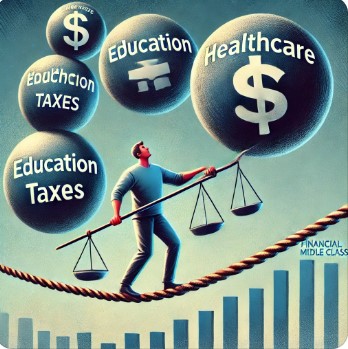
What Matters to Middle-Class Voters
By MacKenzy Pierre
The estimated reading time for this post is 572 seconds
Introduction
Middle-class voters are the backbone of the American electorate. Their votes decide elections, and their voices shape national policy. In the 2020 presidential election, for example, middle-class suburban voters played a critical role in swinging key battleground states, underscoring their influence on electoral outcomes. Yet politicians often speak about the middle class in vague, feel-good terms without addressing the issues they care about most. So, what truly matters to middle-class voters?
This article examines the core concerns—from economic stability to healthcare, education, and beyond—that define the choices of middle-class families when they step into the voting booth.
Economic Stability
The middle class wants one thing above all: economic stability, which means good jobs, decent wages, and policies that work for—not against—them. But too often, economic discussions are hijacked by lofty promises that fail to deliver.
Since the Great Recession began in 2007 and its effects lingered through the following years, wage growth has struggled to keep up with rising inflation and living costs. According to the Bureau of Labor Statistics, real average hourly earnings decreased 0.1% from August 2022 to August 2023, seasonally adjusted. This stagnation contributes to ongoing financial pressure for middle-class families.
While the recession officially ended in 2009, the economic recovery for the middle class has been slow. The expansion of the gig economy, while providing flexible work opportunities, has added more economic pressure by contributing to job insecurity and limiting access to benefits like healthcare and retirement savings.
Job Security
Many in the middle class fear losing their jobs. Despite historically low unemployment rates, automation and globalization are rapidly reshaping industries, leaving people anxious about their livelihoods.
Companies are shifting jobs overseas, and automation is taking over roles once considered safe. While technological advancements can create new job opportunities, the transition can be disruptive. Middle-class voters need reassurance that the government has their back—whether through retraining programs or policies that incentivize businesses to keep jobs on American soil.
This worker anxiety was on display recently when U.S. port workers and operators staged a three-day strike that shut down shipping on the East and Gulf Coasts. One of their core demands was to halt automation and artificial intelligence (AI), which they worry will replace them. While automation can improve efficiency, workers are concerned about job displacement without adequate support or transition plans.
Wage Growth
The debate over minimum and living wages is critical to middle-class voters. Stagnant wages are the silent killer of the American Dream. While living costs soar, paychecks remain stagnant, forcing families to stretch every dollar.
Middle-class voters want to know where their elected officials stand: Are they advocating for a minimum wage that barely scratches the surface, or are they pushing for a living wage that meets basic needs?
The current federal minimum wage is $7.25 per hour—a rate that hasn’t increased since 2009. Although most Americans earn more than the federal minimum wage, the median weekly earnings of full-time workers are about $1,100, translating to an annual salary of approximately $57,200. Meanwhile, the median home price in the United States is $420,846, according to Zillow, representing a significant increase from previous years.
To illustrate the financial burden, consider a potential mortgage payment on a median-priced home of $420,846. Assuming a 20% down payment ($84,169) and a 30-year fixed mortgage at a 6.5% interest rate, the monthly payment would be approximately $2,128 (excluding taxes and insurance). For a household earning $57,200 annually, this mortgage payment would consume roughly 45% of their pre-tax monthly income—well above the recommended threshold for housing affordability. This underscores why stagnant wages and rising housing costs are critical issues for middle-class voters.
Economic Policies
Tax reforms and small business support are make-or-break issues. The middle class doesn’t want tax policies that favor only the wealthy or corporations. They want fairness, plain and simple. That means tangible tax relief for working families and genuine support for small businesses—the lifeblood of many communities.
Middle-class voters want politicians who understand that a thriving Main Street means a flourishing middle class and who reject the old trickle-down economics playbook.
Healthcare
Healthcare costs are like a ticking time bomb for many middle-class families. You’re healthy today, but one unexpected medical bill can throw everything into disarray.
A study published in the American Journal of Public Health found that 66.5% of all bankruptcies in the United States are tied to medical issues due to high costs or time taken off work. This highlights how a single medical emergency can have devastating financial consequences, making healthcare affordability a key concern. The affordability and availability of healthcare are at the core of middle-class concerns.
Middle-class voters don’t want to face impossible choices due to high medical costs—a demoralizing reality for many.
Access to Affordable Healthcare
The price of healthcare in the United States is unsustainable, and middle-class voters know it. They face skyrocketing premiums, high deductibles, and limited options for quality care.
The promise of insurance coverage for everyone sounds great, but middle-class families want more than empty slogans—they want to know how much it’s going to cost them and whether they’ll actually be able to see a doctor when they need one.
Prescription Medication
Prescription medication costs are out of control, and they’re squeezing middle-class wallets. Voters want to see real action to control drug prices.
They’re tired of politicians taking contributions from pharmaceutical companies while families are forced to ration their medication. Middle-class voters are looking for leaders ready to take on Big Pharma and push for pricing transparency and affordable alternatives.
What’s particularly frustrating is knowing that neighbors across the border pay significantly less for the same drugs.
Mental Health Services
Mental health is no longer a taboo topic—it’s something voters care about deeply. They want better access to mental health services, especially given the toll that economic uncertainty and social pressures are taking on families. Access to mental health services can no longer be a privilege; it must be a priority.
The rise in mental health issues exacerbates what some experts call “diseases of despair,” which are conditions linked to hopelessness, such as substance abuse, depression, and suicide. These diseases are connected to bleak social and economic conditions, and their impact on families and communities is too significant for policymakers to ignore.
Education
Education is the ladder to success that the middle class relies on, but that ladder needs rungs. From K-12 to college, middle-class families are worried about access, quality, and the price tag attached to learning.
Quality of K-12 Education
Middle-class voters are frustrated by funding disparities in K-12 education. Schools in wealthier neighborhoods thrive while others are left behind, creating a system that perpetuates inequality. According to a report by EdBuild, schools in high-income areas receive an average of $1,000 more per student in annual funding compared to those in low-income areas.
This disparity significantly impacts the quality of education, resources, and opportunities available to students, further widening the gap between communities.
Middle-class parents also question the current curriculum and the reliance on standardized testing. They want education reforms that prioritize critical thinking, creativity, and the skills their children will need in a rapidly changing job market.
The subpar K-12 education system is a pervasive issue. For instance, a 19-year-old named Alejandra Ortiz sued Hartford Public High School, stating that she never really learned to read. A study revealed that many Los Angeles County school students lack foundational reading and writing skills.
Higher Education Accessibility
The rising cost of college is crushing middle-class families. The student loan debt crisis isn’t just a young person’s problem—it’s a middle-class family problem.
Many parents take on significant financial burdens to help their children afford college, often co-signing loans or using their retirement savings to cover costs. According to a survey by Sallie Mae, nearly one-third of parents with children in college have sacrificed their retirement savings to help pay for tuition.
This creates a ripple effect, impacting the long-term financial stability of middle-class families and increasing anxiety about their future.
Parents are co-signing loans, dipping into retirement funds, and losing sleep over how to afford higher education for their children. Middle-class voters want real solutions to this crisis—whether through tuition freezes, increased grants, or expanded loan forgiveness programs.
Vocational Training and Lifelong Learning
College isn’t for everyone, and middle-class voters know that. Not all students want or need a four-year college degree; they understand the importance of vocational training.
Trades and skills-based education can lead to stable, high-paying jobs, and it’s time these options were given the same respect as traditional college paths.
Circling back to the International Longshoremen’s Association (ILA) workers’ strike mentioned earlier, they reached a tentative deal to raise average wages to about $63 an hour from $39 an hour over the contract’s life. Many of those workers don’t have college degrees.
Middle-class voters also want more support for adult education programs that help workers adapt to new industries and technologies.
Taxes
The tax burden is a big concern for the middle class, which often feels squeezed from all sides. They’re tired of bearing a disproportionate load while the wealthy seem to find loopholes.
Tax Burden on Middle-Class Families
Current tax policies often leave middle-class families feeling like they’re getting the short end of the stick. For example, the 2017 Tax Cuts and Jobs Act provided substantial benefits to corporations and the wealthy, while many middle-class families saw only modest, temporary relief. This disparity has led to a perception that the system is rigged against them.
They work hard and pay their dues, yet they still feel like they’re falling behind. Middle-class voters want a fair system that doesn’t subsidize the ultra-rich or large corporations. They want a tax policy that lets them keep more of their hard-earned money.
Tax Relief Measures
Middle-class voters are paying attention to proposed tax reforms and their impact on disposable income. They need politicians to get serious about tax relief measures that actually make a difference in their monthly budgets—not just temporary fixes or empty promises.
Whether it’s expanding child tax credits or adjusting income brackets, they’re looking for policies that provide real, sustainable relief.
Conclusion
Sometimes what matters to the middle class—the most important, largest, and most consistent voting bloc—can be at odds with responsible governance.
For example, middle-class voters often prioritize tax cuts and immediate economic relief, even if these policies contribute to a growing federal deficit. This contradiction arises because many voters are focused on short-term financial stability for their families rather than long-term fiscal responsibility.
Such conflicts show the complexity of balancing voter preferences with sustainable governance. While voters often mention that the federal debt is a top priority, they repeatedly elect candidates who fail to address it responsibly, instead making decisions that add to the debt. This inconsistency highlights the gap between voter concerns and electoral outcomes, underscoring the complexity of middle-class priorities.
Middle-class voters want to support candidates who understand their struggles—not just in theory, but in practice.
They want leaders who offer real solutions to the issues that keep them up at night: economic stability, affordable healthcare, quality education, fair taxes, and more.
Addressing these concerns isn’t just good policy; it’s the key to winning the trust and votes of the middle class. Politicians must stay relevant and engaged with the issues that matter to middle-class America and deliver on their promises.

Senior Accounting & Finance Professional|Lifehacker|Amateur Oenophile
RELATED ARTICLES
Cash Strategy: Put Every Dollar in the Right Place
Your checking account, emergency fund, short-term savings, and investments should not be managed the same way. This cash strategy helps assign every dollar to the right financial job.
Best HYSA: How to Choose Beyond the Highest APY
A competitive interest rate matters, but it is only one part of choosing a high-yield savings account. Compare insurance, fees, access, transfer speed, and promotional conditions.
Leave Comment
Cancel reply
Gig Economy
Business / Aug 08, 2026
The Missing Middle in Black Entrepreneurship
Black entrepreneurship has expanded dramatically. The next challenge is helping more Black-owned businesses move from self-employment to employer firms and sustainable scale.
By FMC Editorial Team
Personal Finance / Aug 01, 2026
Cash Strategy: Put Every Dollar in the Right Place
Your checking account, emergency fund, short-term savings, and investments should not be managed the same way. This cash strategy helps assign every dollar to the right...
By Article Posted by Staff Contributor
Personal Finance / Aug 01, 2026
Best HYSA: How to Choose Beyond the Highest APY
A competitive interest rate matters, but it is only one part of choosing a high-yield savings account. Compare insurance, fees, access, transfer speed, and promotional conditions.
By Article Posted by Staff Contributor
Personal Finance / Aug 01, 2026
High-Yield Savings vs. CDs, Treasury Bills, and Other Safe Places for Cash
High-yield savings accounts are excellent for accessible cash, but they are not always the best choice. Compare HYSAs, CDs, Treasury bills, money market accounts, and I...
By Article Posted by Staff Contributor
American Middle Class / Aug 01, 2026
High-Yield Savings Accounts: A Safer Home for Your Cash
A high-yield savings account can pay several times the national savings rate while keeping qualified deposits federally insured. Here is how it works, what to watch...
By Article Posted by Staff Contributor
Real Estate / Jul 30, 2026
Mortgage Lock-In Is Freezing the Housing Market
Millions are trapped by 3% mortgages. Learn how mortgage lock-in worsens affordability—and why homeowners are renovating instead.
By FMC Editorial Team
Real Estate / Jul 26, 2026
Is South Florida More Expensive Than New York? The Complete 2026 Relocation Guide
Is South Florida more expensive than New York? Compare housing, taxes, insurance and 104 municipalities before you move.
By Article Posted by Staff Contributor
Personal Finance / Jul 25, 2026
The Time Value of Life Experiences: What Compound Interest Leaves Out,
Money compounds, but life experiences do too. Explore what compound interest leaves out—and how to balance saving with living.
By MacKenzy Pierre
American Middle Class / Feb 18, 2026
How Wealth Is Passed Across Generations in the United States: Mechanisms, Evidence, and the Policy Debate
How wealth passes between generations—trusts, taxes, and the debate. Get the facts, figures, and tradeoffs. Read now.
By FMC Editorial Team
American Middle Class / Feb 16, 2026
The S&P 7,000: How Wall Street Disconnects from Main Street
S&P 7,000 can rise while wages, benefits, and towns fall behind. See why the market isn’t the economy—read now.
By MacKenzy Pierre
Latest Reviews
Business / Aug 08, 2026
The Missing Middle in Black Entrepreneurship
Black entrepreneurship has expanded dramatically. The next challenge is helping more Black-owned businesses move from...
Personal Finance / Aug 01, 2026
Cash Strategy: Put Every Dollar in the Right Place
Your checking account, emergency fund, short-term savings, and investments should not be managed the same...
Personal Finance / Aug 01, 2026
Best HYSA: How to Choose Beyond the Highest APY
A competitive interest rate matters, but it is only one part of choosing a high-yield...