HELOC vs. Cash-Out Refi: Which One Actually Lowers Your Risk?
By Article Posted by Staff Contributor
The estimated reading time for this post is 424 seconds
The Fast Answer (Start Here)
If your current first-mortgage rate is meaningfully lower than today’s, keep it. A HELOC (or fixed second) lets you access equity without touching that “golden” first lien. If you’re facing an ARM reset, want rate certainty for the long haul, or need a single fixed payment, a cash-out refi can de-risk your household—even if the monthly payment nudges up.
Avoid a HELOC if a 2–3 point rate swing would break your budget.
Avoid a cash-out refi if it resets a low-rate mortgage into a higher-rate 30-year clock just to chase a lower monthly payment.
What You’re Really Choosing Between
HELOC (Home Equity Line of Credit)
- What it is: A revolving second mortgage with a credit limit you can draw from. Usually interest-only during the draw period, then it amortizes.
- Why people like it: Flexibility, pay interest only on what you draw, preserve your low-rate first mortgage.
- Hidden risk: Variable rate (index + margin) → payment can rise.
Cash-Out Refinance (New First Mortgage)
- What it is: Replace the existing first mortgage with a larger fixed-rate loan; cash comes at closing.
- Why people like it: One payment, rate certainty, easy to understand.
- Hidden risk: You reset the amortization clock and pay closing costs on the entire balance, not just the cash you needed.
One-Minute Risk Triage (Use This First)
- Is your current first-lien rate materially lower than today’s?
- Yes: Favor a HELOC or fixed second to keep that low rate.
- No / ARM reset ahead: Cash-out refi may win on risk reduction.
- Is your need lumpy or ongoing?
- One-time lump sum (roof, debt payoff): Cash-out or fixed second.
- Phased expenses (multi-stage reno, tuition): HELOC.
- Rate-swing tolerance?
- Low tolerance: Favor fixed (cash-out or fixed second).
- High tolerance + fast payoff plan: HELOC can shine.
- Will this choice shorten your payoff date—not stretch it to 2055?
- If no, stop. Redesign the plan.
- If no, stop. Redesign the plan.
Side-by-Side: Same Dollars, Different Instruments — Scenarios
Same goals, different tools. Use this to see which instrument usually wins and why.
| Scenario | You Need | Current First-Lien | Best Fit (Usually) | Why |
|---|---|---|---|---|
| Pay off $25k at 22% APR | Lump sum | 3.125% fixed (15 yrs left) | Fixed second (or small HELOC + rapid amortization) | Preserves low-rate first; converts high APR to fixed, short-term payoff without restarting a 30-year clock. |
| Phase a $40k renovation over 18 months | Phased draws | 2.875% fixed (23 yrs left) | HELOC | Borrow only when needed; minimize interest with staged draws and scheduled principal; stress-test rate risk. |
| ARM reset in 12 months | Liquidity + rate certainty | 5/1 ARM; cap exposure | Cash-out refi (fixed) | Eliminates reset/volatility; unifies payments. Accept a slightly higher monthly for lower long-term risk. |
| Insurance/tax jump squeezed budget | Payment relief | 6.75% fixed (25 yrs left) | Recast (if allowed) or refi | Recast reduces payment cheaply without restarting term; if unavailable, run refi breakeven math. |
| Likely to sell in 2–3 years | Temporary flexibility | Mixed | HELOC | Avoids large refi fees for a short horizon; pay down aggressively after each draw. |
The Math That Actually Matters
1) Total interest, not just monthly.
A lower monthly payment can still cost more interest if you extend the term. Run numbers over the period you’ll actually keep the loan (e.g., 5–10 years), not a hypothetical 30.
2) Breakeven (for cash-out).
Breakeven months = (Closing Costs + Points) ÷ (Monthly Payment Savings).
If breakeven > 36 months, be skeptical—unless you’re eliminating a real risk (ARM reset, unmanageable payment volatility, or high-APR debt you will truly retire).
3) HELOC rate shock.
Stress-test at +2–3% above the start rate. If the new payment breaks your budget, pick a smaller draw, a partial rate-lock (if offered), or a fixed second.
4) LTV discipline.
Aim for ≤ 80% combined LTV after borrowing. It’s your buffer against home-price dips, job shocks, and insurance/tax spikes.
Two Realistic Scenarios (Illustrative Numbers)
Assumptions here are simplified for teaching. Replace with your actual quotes before deciding.
Scenario A — Keep the Golden First, Use a HELOC
- Home value: $420,000
- Current first mortgage: $240,000 @ 3.25%, 25 yrs left
- Cash needed: $60,000 over 12 months (reno in 3 phases)
- Option: HELOC for $60,000 (interest-only during draw)
Why it can win: You preserve the 3.25% first. You draw only when needed, reducing interest paid. You pre-schedule principal payments (e.g., interest + $500–$1,000/mo) to force amortization during the draw period.
Risk control: Budget for payment at start rate + 2.5%; if that fails your budget, scale back or consider a fixed second.
Scenario B — ARM Reset, Want Certainty
- Home value: $550,000
- Current first mortgage: $310,000 on a 5/1 ARM, reset in 9 months
- Cash needed: $30,000 (debt consolidation + roof)
- Option: Cash-out refi to $340,000, fixed for 30 years
Why it can win: You remove reset risk and unify into a single fixed payment. If closing costs are $7,000 and monthly savings vs. expected reset is $300, breakeven ≈ 23 months—reasonable if you’ll stay 7–10 years.
Risk control: Add $100–$300 extra principal monthly to avoid stretching total interest.
Eligibility & Underwriting Snapshot (Typical, Lender-Specific)
- Credit: Mid-600s to 700s+ often needed for best pricing.
- LTV/CLTV: Many lenders cap at 80%; some HELOCs allow higher with pricing hits.
- DTI: Staying ≤ 43% is a common target; lower is stronger.
- Docs: Income, assets, appraisal; reserves may be required.
- Property Type: Primary usually best pricing; rentals and condos vary.
Red flags: Recent 30-day lates, thin credit, high DTI, appraisal gaps.
Tax & Compliance
- Mortgage/HELOC interest is generally deductible only when funds are used to buy, build, or substantially improve the home that secures the loan.
- Using equity to pay off unrelated consumer debt typically isn’t deductible.
- This is education, not tax/legal advice—talk to a tax pro for your situation.
The Behavioral Trap (and How to Avoid It)
Rolling $25k of 22% card debt into home equity looks smart—until you rebuild the card balances. That’s the double-debt trap.
Counter-moves (do all four):
- Freeze/close the paid-off cards (keep one no-fee card for emergencies).
- Set autopay for the full statement balance going forward.
- Weekly 15-minute cash-flow review (every Friday).
- Put a visible debt-free date on your calendar; automate principal curtailments to hit it.
Action Plan (Step-by-Step)
If you’re leaning HELOC
- Stress-test at +2–3%.
- Make it self-amortizing: pay interest plus fixed principal during the draw period.
- Keep utilization ≤ 50% of the line; pay down after each draw.
- Don’t touch a low-rate first unless necessary.
If you’re leaning Cash-Out Refi
- Get 3–5 quotes; compare APR, points, lender credits, and full fee sheets.
- Keep LTV ≤ 80%.
- Demand breakeven ≤ 24–36 months unless you’re removing a major risk.
- Budget insurance + taxes based on current bills, not last year.
- Set automatic extra principal from month one.
If you’re not sure
- Run numbers for three paths: do nothing, HELOC/second, cash-out.
- Choose the option that reduces risk and shortens time-to-debt-free—not just today’s lowest monthly.
Quick “Which One Fits You?” Quiz
- My first-mortgage rate is far below today’s: HELOC/fixed second.
- I need funds in phases: HELOC.
- I face an ARM reset and will stay 7–10 years: Cash-out fixed.
- I can tolerate rate swings and will pay down fast: HELOC.
- I want one fixed payment and sleep-well certainty: Cash-out.
Pros & Cons at a Glance
HELOC
- Pros: Flexibility, lower upfront cost, keep low first-lien rate, borrow only as needed.
Cons: Variable rate, payment jump at amortization, potential fees to close the line.
Cash-Out Refi
- Pros: Fixed rate/payment, consolidates risk, simpler budgeting.
- Cons: Higher upfront cost, restarts amortization, can increase lifetime interest without curtailments.
Case Studies (Short, Real, Actionable)
Case A — The Renovator
2.99% first, 22 years left; $35k over 10 months → HELOC with pre-scheduled principal. If a +2.5% shock breaks budget, pivot to fixed second.
Case B — The ARM Reset
Reset in 9 months; plan to stay 7–10 years → Cash-out fixed. Breakeven 28 months is acceptable for the horizon.
Case C — The Card Clean-Up
$28k at 22%; first at 3.375% → Fixed second for $28k, add $150 extra principal, target 24-month payoff. Don’t restart a 30-year clock.
Guardrails You Don’t Cross
- Combined LTV ≤ 80%.
- Cash reserve ≥ 6 months expenses after closing.
- No new debt for 180 days post-consolidation.
- Automate principal curtailments from Day 1 ($100–$300/mo compounds fast).
- If your plan only works at fantasy rates or demands perfect behavior, it isn’t a plan—skip it.
Related Reads
Home Equity in 2025: Smart Moves, Real Risks
Top 15 States Seeing the Biggest Equity Gains—Then vs. Now
Property Tax Shock: How to Appeal Your Assessment
Bottom Line
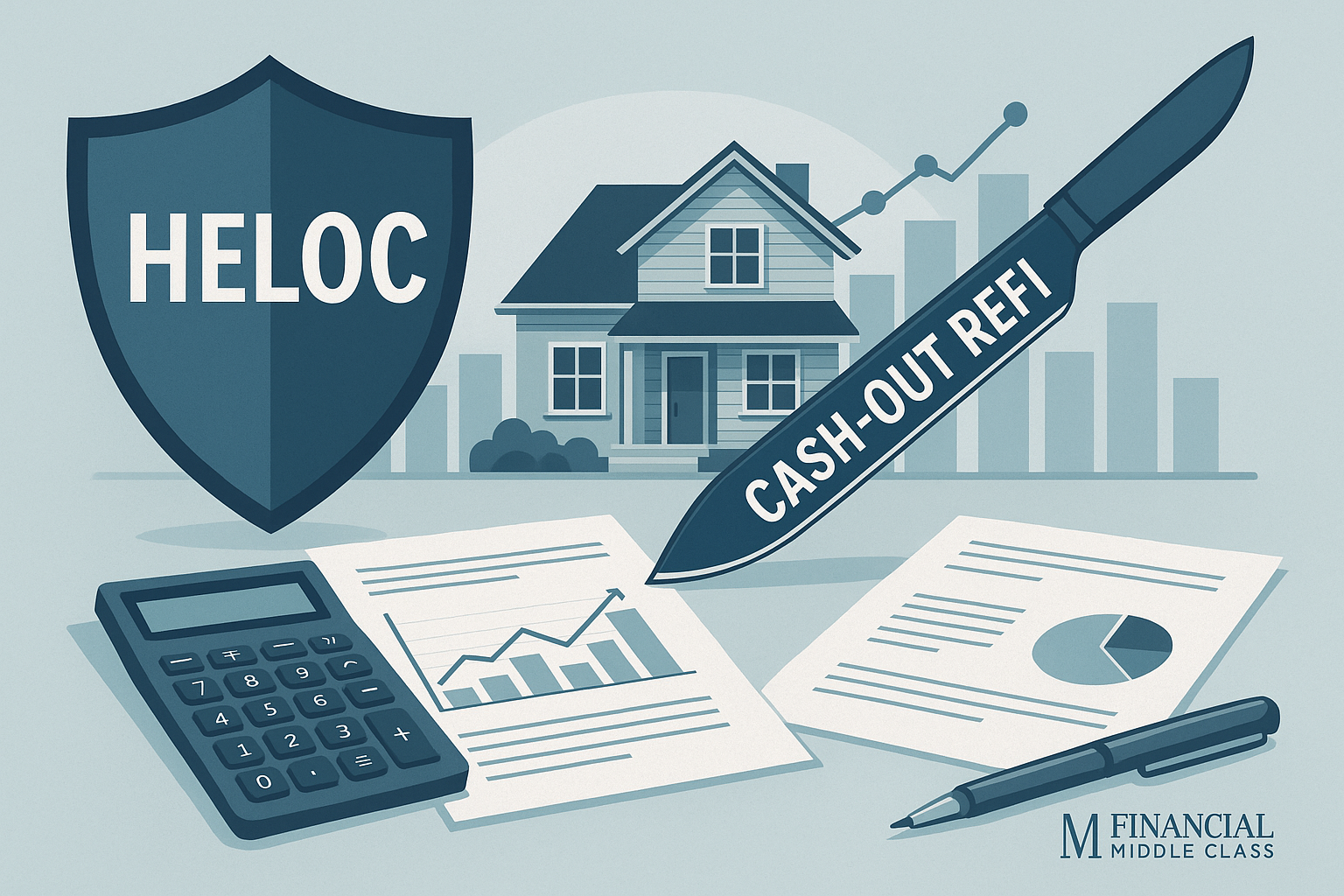
You’re not choosing “cheap vs. expensive” money—you’re choosing between rate risk vs. amortization risk, fees now vs. flexibility later, and whether your household becomes more resilient or more leveraged. A HELOC can be a scalpel. A cash-out refi can be a shield. Either can be a sledgehammer if you misuse it.
Pick the option that reduces risk and pulls your debt-free date forward—full stop.

RELATED ARTICLES
The American Middle Class’s Guide to the 2026 Midterm Ballot Measures
The 2026 midterm elections will put major housing and tax proposals before American voters. From Florida's homestead exemptions to Massachusetts zoning reform and California's affordable housing initiatives, explore the potential effects on homeowners, renters, first-time buyers, and middle-class finances.
FICO Finally Has Competition. Will Homebuyers Get a Better Deal?
For decades, FICO dominated mortgage credit scoring. Now VantageScore 4.0 is challenging that dominance. Discover how new rules from federal housing regulators could affect mortgage approvals, borrowing costs, and financial opportunities for American homebuyers—and why a higher credit score doesn't...
Leave Comment
Cancel reply
Gig Economy
American Middle Class / Oct 16, 2026
The American Middle Class’s Guide to the 2026 Midterm Ballot Measures
The 2026 midterm elections will put major housing and tax proposals before American voters. From Florida's homestead exemptions to Massachusetts zoning reform and California's affordable housing...
By Article Posted by Staff Contributor
Personal Finance / Oct 14, 2026
FICO Finally Has Competition. Will Homebuyers Get a Better Deal?
For decades, FICO dominated mortgage credit scoring. Now VantageScore 4.0 is challenging that dominance. Discover how new rules from federal housing regulators could affect mortgage approvals,...
By Article Posted by Staff Contributor
American Middle Class / Oct 13, 2026
Selling Affordability Through Installments
Americans are increasingly buying based on what they can afford each month rather than what something actually costs. From buy now, pay later services to longer...
By Article Posted by Staff Contributor
American Middle Class / Oct 12, 2026
Fair Capitalism: We Don’t Need to Abolish Capitalism. We Need to Fix It.
Fair capitalism means preserving entrepreneurship and profits while ensuring working Americans share more meaningfully in the prosperity they help create.
By MacKenzy Pierre
American Middle Class / Oct 12, 2026
The Sunday Scaries: How Financial Independence Can Help You Reclaim Your Weekend
The Sunday Scaries can begin long before Monday morning. Building emergency savings, lowering monthly expenses, and increasing financial independence may help you reclaim your weekend.
By Article Posted by Staff Contributor
Business / Aug 08, 2026
The Missing Middle in Black Entrepreneurship
Black entrepreneurship has expanded dramatically. The next challenge is helping more Black-owned businesses move from self-employment to employer firms and sustainable scale.
By FMC Editorial Team
Personal Finance / Aug 01, 2026
Cash Strategy: Put Every Dollar in the Right Place
Your checking account, emergency fund, short-term savings, and investments should not be managed the same way. This cash strategy helps assign every dollar to the right...
By Article Posted by Staff Contributor
Personal Finance / Aug 01, 2026
Best HYSA: How to Choose Beyond the Highest APY
A competitive interest rate matters, but it is only one part of choosing a high-yield savings account. Compare insurance, fees, access, transfer speed, and promotional conditions.
By Article Posted by Staff Contributor
Personal Finance / Aug 01, 2026
High-Yield Savings vs. CDs, Treasury Bills, and Other Safe Places for Cash
High-yield savings accounts are excellent for accessible cash, but they are not always the best choice. Compare HYSAs, CDs, Treasury bills, money market accounts, and I...
By Article Posted by Staff Contributor
American Middle Class / Aug 01, 2026
High-Yield Savings Accounts: A Safer Home for Your Cash
A high-yield savings account can pay several times the national savings rate while keeping qualified deposits federally insured. Here is how it works, what to watch...
By Article Posted by Staff Contributor
Latest Reviews
American Middle Class / Oct 16, 2026
The American Middle Class’s Guide to the 2026 Midterm Ballot Measures
The 2026 midterm elections will put major housing and tax proposals before American voters. From...
Personal Finance / Oct 14, 2026
FICO Finally Has Competition. Will Homebuyers Get a Better Deal?
For decades, FICO dominated mortgage credit scoring. Now VantageScore 4.0 is challenging that dominance. Discover...
American Middle Class / Oct 13, 2026
Selling Affordability Through Installments
Americans are increasingly buying based on what they can afford each month rather than what...