
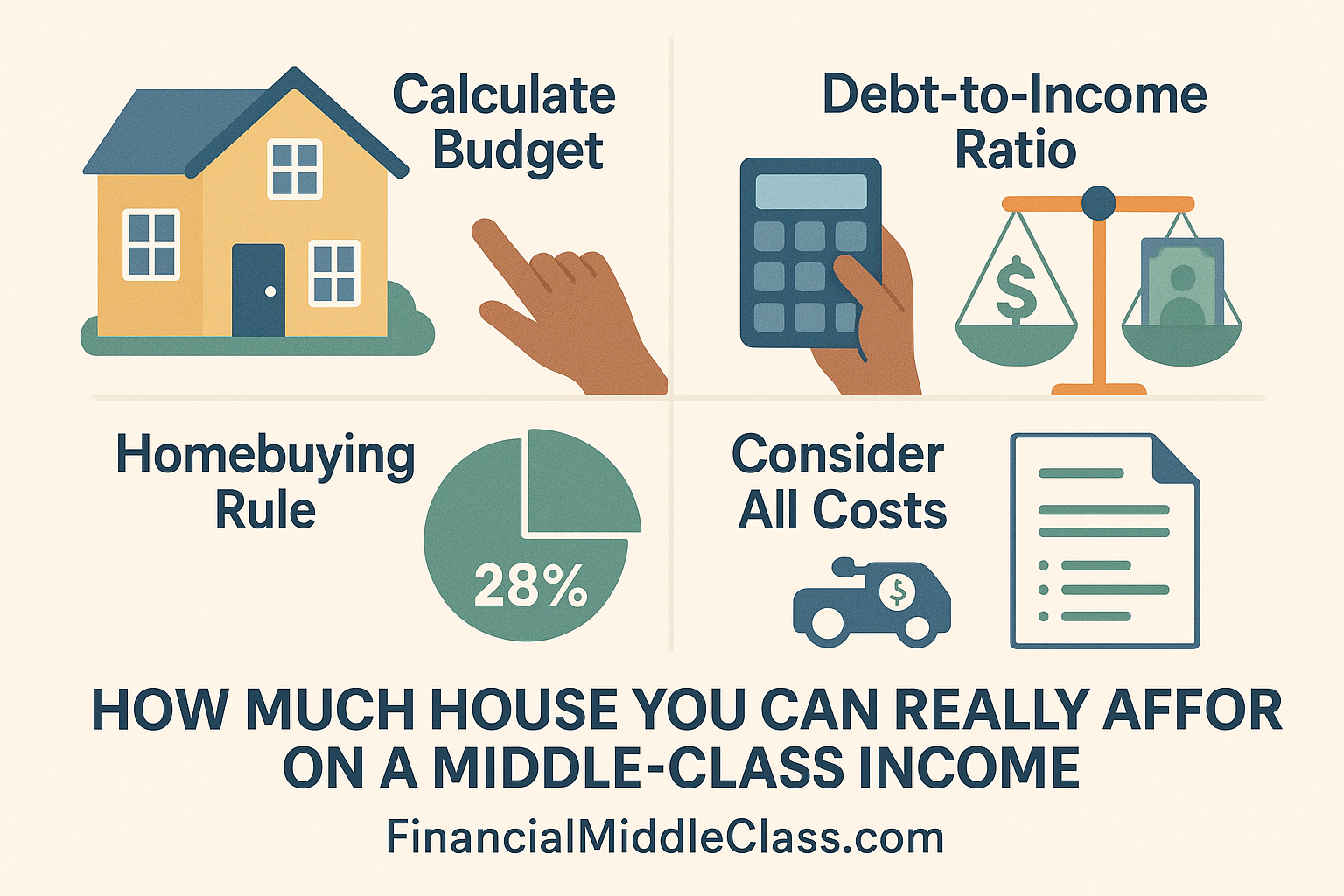
How Much House You Can Really Afford on a Middle-class Income
The estimated reading time for this post is 166 seconds
How Much House You Can Really Afford on a Middle-Class Income
Who this guide is for:

The housing market doesn’t care how hard you work. It cares about your income, your debt, your credit, and what the bank’s models say you can survive without defaulting.
That’s why so many middle-class buyers get whiplash. Their income feels solid. Their lifestyle feels “normal.” Then a calculator tells them they “can afford” a price tag that would swallow half their take-home pay.
Lenders use one definition of “afford.” Your actual life needs another.
This guide walks you through both, with a simple on-page calculator to show how much house you can really afford—not just what a pre-approval email says.
The 28/36 Rule vs Lender Max: Two Very Different Answers
The mortgage industry has a simple rule of thumb: spend no more than about 28% of your gross income on housing, and 36% total on all debt (housing, cards, car, student loans). Lenders often stretch beyond this, but that’s their risk model, not your quality of life.
| Approach | Housing % of Gross Income | Total Debt % of Gross Income | Real-Life Feel |
|---|---|---|---|
| Classic 28/36 Rule | ≤ 28% | ≤ 36% | Balanced. Room for savings, kids, cars, and an emergency fund. |
| “We Can Stretch You” Lender Max | 30–35% (or more) | Up to low 40s+ | Looks fine on paper; feels like constant pressure in real life. |
| Financial Middle Class “Stay Sane” Zone | Closer to 25–28% | Under 36%, ideally closer to low 30s | You can own a house and still have a life, savings, and options. |
Your job is to pick which column you want to live in, not just which one you can pass underwriting in.
How Much House Can You Afford? (Interactive Calculator)
Instead of just guessing, use this how-much-house calculator to see what price range actually fits your income and debt, based on the 28/36 rule.
How Much House Can You Afford?
This tool uses the classic 28/36 debt-to-income rule and your own numbers to estimate a safe maximum home price.
Side-by-Side: Lender Max vs Middle-Class Sanity
Let’s look at an example. Say your household makes $96,000 a year ($8,000 a month) and you have $600 in other monthly debt payments.
| Scenario | Lender-Stretch Approval | Financial Middle Class Range |
|---|---|---|
| Housing % of gross | 32–35% | 25–28% |
| Total debt % of gross | High 30s to low 40s | Low–mid 30s |
| How it feels month to month | Vacation, savings, and car repairs all feel like stress. | You can save, replace a car, and still have a life. |
| Risk if one income drops | Immediate pressure; high risk of credit card use or missed payments. | Painful, but survivable with an emergency fund and cuts. |
Your goal is not “What’s the biggest house I can stand?” It’s “What’s the house I can own and still sleep at night?”
Three Filters for How Much House You Can Afford
Before you chase listings, run your situation through three filters: income, stability, and life goals.
Filter 1: Income and Debt
Use the calculator above to translate your income and debt into a maximum PITI payment and price range. If the number feels smaller than what Zillow is flashing at you, that’s not a glitch. That’s your real life talking.
Filter 2: Job and Lifestyle Stability
If your job or industry is volatile, your target should be even more conservative. The same is true if you know big expenses are coming: kids, daycare, caring for parents, replacing an aging car.
| Profile | Housing Target | Why |
|---|---|---|
| Stable job, two incomes, good savings | Up to ~28% of gross | You can handle some volatility and still save. |
| Single income, variable pay, kids | Closer to 20–25% of gross | You need more margin; the job and life load are heavy. |
| High earners with lumpy bonuses | Base salary supports the payment; bonus is extra. | Never build a mortgage on income that isn’t guaranteed. |
Filter 3: Your Actual Priorities
Some people want the biggest house and don’t care about travel. Others care more about flexibility, investing, or early retirement. Those aren’t wrong answers—but the house has to fit them.
If you say travel, kids’ activities, giving, and saving matter, and then buy a house that eats every free dollar, you didn’t just buy a home. You bought a contradiction.
Next Steps: Turn the Number Into a Plan
Here’s how to use what you just learned:
- Run your numbers through the How Much House You Can Afford calculator and note the price range.
- Drop that range by 5–10% if your job or life is unstable, or if you want aggressive savings.
- Make that lower number your hard cap when you’re looking at houses.
Then line this article up with:
- Common first-time homebuyer mistakes that quietly wreck your budget
- Creating an emergency fund so your house payment never becomes a crisis
- ARM vs fixed in a mid-6% world: who actually wins?
Your goal is not to impress a lender or Instagram. Your goal is to own a home that still lets you be a person.
FAQs: How Much House You Can Really Afford
How much of my income should my mortgage be?
A common guideline is to keep total housing costs—principal, interest, taxes, insurance, and HOA fees—at or below 28% of your gross monthly income. Many middle-class households feel better closer to 25%, especially if they have kids or variable income.
How much total debt is too much when buying a house?
The classic rule is that all debt payments combined (housing + other debts) should stay at or below 36% of gross income. Lenders may approve you above that, but pushing into the 40s is where people start feeling house poor.
Should I buy at the top of my pre-approval?
Usually, no. Pre-approval is the lender’s risk limit, not your lifestyle limit. If the top of your pre-approval leaves no room for savings or surprises, scale back until you can do both: own the home and build wealth.
Does a higher down payment mean I can afford more house?
A larger down payment can lower your monthly payment and help you avoid PMI, but it doesn’t magically change your income or job stability. If putting more down empties your emergency fund, you’re increasing risk, not reducing it.