Sinking Funds: The Missing Line in Your Budget That Stops “Unexpected” Bills
By Article Posted by Staff Contributor
The estimated reading time for this post is 418 seconds
You don’t have a car-repair problem.
You don’t have a Christmas problem.
You don’t have a “the kids outgrew their jeans again” problem.
You have a sinking fund problem.
Most of the “emergencies” blowing up middle-class budgets aren’t actually emergencies. Your car will need tires. Christmas will land on December 25. The school will send the email about picture day, field trips, and spirit shirts right on schedule.
Yet every year, Bankrate finds that nearly 60% of Americans still can’t cover a $1,000 surprise bill from savings. So we act shocked, swipe the card, and blame bad luck.
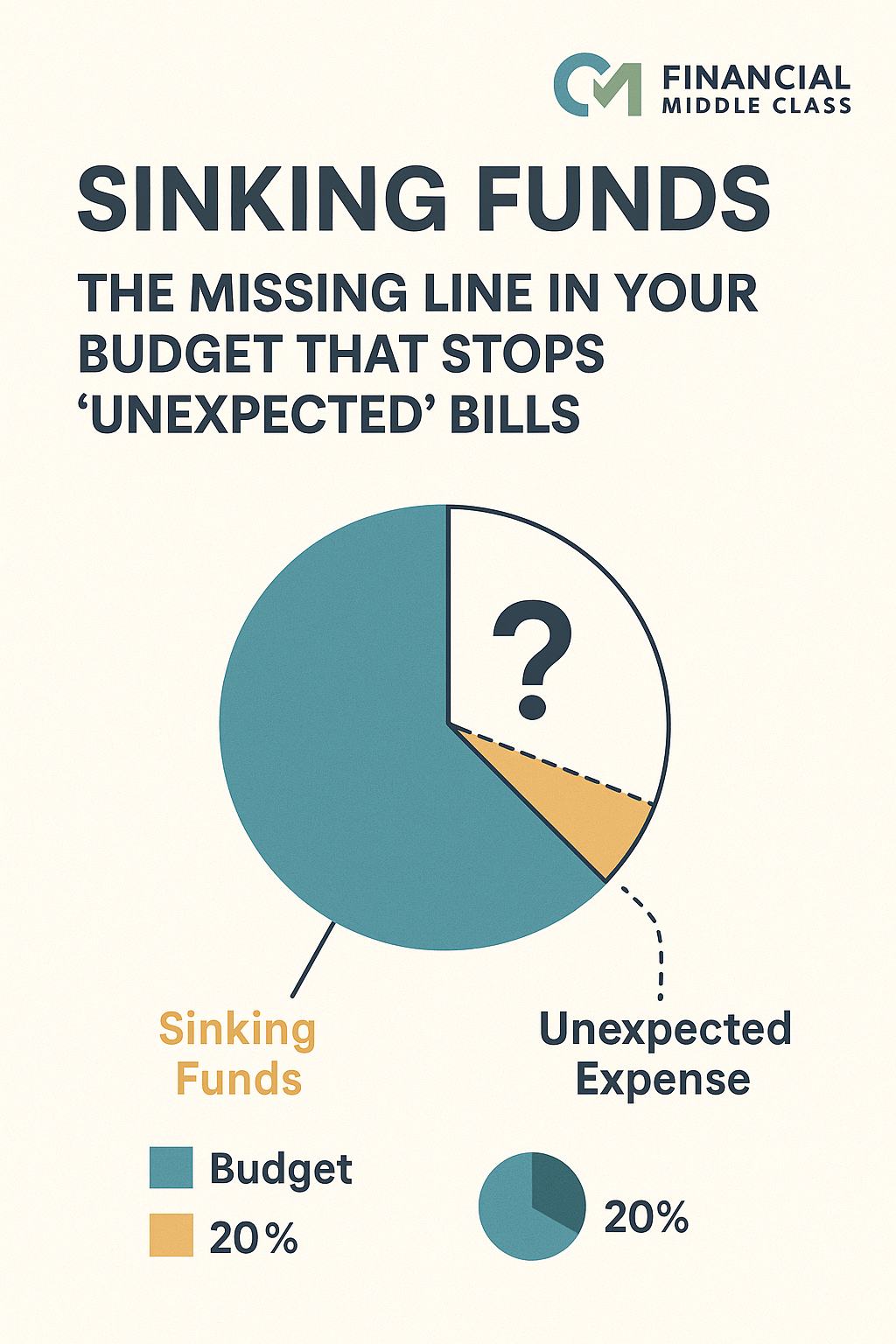
Let’s fix that. Sinking funds are the missing line in your budget that turn “I didn’t see that coming” into “Of course I planned for that.”
What a Sinking Fund Actually Is (In Plain English)
A sinking fund is just this:
Money you set aside on purpose, in advance, every month for an expense you know is coming later.
Personal finance folks love to complicate this, but it’s simple. You’re breaking a big bill into bite-size pieces:
- New tires
- Holiday gifts
- Back-to-school clothes
- Annual car insurance premium
- Summer camp
- Vet visits
Every month, you move a small, specific amount into a separate bucket. When the bill hits, the cash is already waiting. You don’t wreck the month, and you don’t reach for the card.
Ramsey Solutions describes sinking funds as money saved monthly for expenses you can’t or don’t want to pay in a single month—like vacations, Christmas, weddings, or vet bills. Empower gives example categories like transportation, medical care, birthdays, holidays, and more.
The point isn’t the label. The point is intent.
Sinking Fund vs. Emergency Fund: Know the Difference
Here’s where people get tripped up: they’re trying to make one savings account do two jobs.
- Sinking funds are for expected but irregular costs.
- Christmas, car repairs, school clothes, travel.
- Christmas, car repairs, school clothes, travel.
- Emergency funds are for true emergencies.
- Job loss, medical crisis, the transmission dying when you’re already behind.
- Job loss, medical crisis, the transmission dying when you’re already behind.
If it happens every year or every few years, it’s not an emergency. It’s just badly scheduled cash flow.
Think of it this way:
- Sinking funds are how you respect your future self.
- The emergency fund is how you protect your future self.
You need both—one keeps you from sabotaging the month, the other keeps you from bankruptcy when life hits you hard. Budget educators make the same distinction: sinking funds are “for expected expenses that don’t happen every month,” while the emergency fund is reserved for the true curveballs.
The Big Three: Car Repairs, Holidays, School Clothes
You can create 20 different sinking funds if you want. But three categories cause outsized chaos for the middle class:
- Car repairs and maintenance
- Oil changes, tires, brakes, surprise “check engine” visits.
- Cars are mechanical. Mechanical things break. Nothing about that is unexpected.
- Oil changes, tires, brakes, surprise “check engine” visits.
- Holidays and gifts
- You know who you’re buying for. You know roughly what you’ll spend.
- You also know you’re more generous in November and December than in June.
- You know who you’re buying for. You know roughly what you’ll spend.
- School clothes and kid expenses
- New shoes, bigger jeans, backpacks, sports fees, yearbooks, clubs.
- Kids don’t care about your budget categories. They care that their shoes fit.
- New shoes, bigger jeans, backpacks, sports fees, yearbooks, clubs.
If you start with only these three sinking funds, you’ve already prevented half the “budget emergencies” that show up in coaching sessions.
How to Build Sinking Funds Without Blowing Up Your Budget
Now to the question you really care about:
“Where am I supposed to find the money for all this?”
You don’t build sinking funds by inventing new money. You build them by redirecting money you were already spending badly—usually inside your so-called “wants.”
Let’s walk the math.
Step 1: List your “irregular but expected” bills
Start with the big three, then add what applies:
- Car repairs & maintenance
- Holidays and gifts
- School clothes / kids
- Travel
- Annual insurance premiums
- Professional dues / licenses
- Home maintenance (if you own)
Grab a rough yearly number for each. Don’t obsess. If you spent $900 on Christmas last year, call it $1,000. If the mechanic told you “You’ll need tires next year,” and that’s $800, use that.
Step 2: Turn yearly into monthly
Now divide by 12.
Example Sinking Fund Plan
| Category | Estimated Yearly Cost | Monthly Sinking Fund |
|---|---|---|
| Car repairs & maintenance | $1,200 | $100 |
| Holidays & gifts | $1,000 | $84 (round to $85) |
| School clothes & kids | $600 | $50 |
| Travel | $1,200 | $100 |
Total monthly sinking funds: $335
That’s $335 you move on purpose every month into dedicated buckets. Those buckets can be:
- Separate savings accounts nicknamed “Car,” “Christmas,” “Kids,” “Travel,” or
- Digital envelopes inside your budgeting app, or
- Old-school cash envelopes if that works better for you.
Step 3: Carve it out of the 30% “Wants”
Here’s where your angle comes in.
The classic 50/30/20 rule—popularized by Elizabeth Warren—says:
- 50% of take-home → Needs
- 30% → Wants
- 20% → Savings / Debt payoff
Most people treat the 30% wants bucket like a free-for-all: restaurants, streaming, random Amazon purchases, “I work hard, I deserve this.”
That’s where we’re stealing from.
You don’t gut your retirement or emergency fund to start sinking funds. You reassign part of your “fun money” to future you.
If your take-home is $5,000 a month:
- 30% wants = $1,500
- From that $1,500, you carve out $335 for sinking funds (from our example).
- That leaves $1,165 for pure “today” wants.
You didn’t increase your total spending. You didn’t starve your savings rate. You simply admitted that Christmas, car repairs, and school clothes are real wants that deserve a line item instead of a panic.
Side-by-Side: Life Without Sinking Funds vs. With Them
Here’s what actually changes.
| Situation | No Sinking Funds | With Sinking Funds |
|---|---|---|
| Car needs $800 of work | Throw it on the card, minimum payment rises, you feel poor and behind. | Pull $600 from Car fund, $200 from general savings; month is annoying but controlled. |
| December shopping | Swipe until the trunk is full, deal with it in January. | Spend what’s in the Holiday fund; if it feels tight, you adjust gift expectations before the bill hits. |
| Back-to-school | Chaos at the mall, “We’ll figure it out.” | Kids get what they need from the Kids fund; no guilt, no debt spiral. |
Same income. Same car. Same kids.
Different plan.
Where to Park Your Sinking Funds (And What to Avoid)
You don’t need a fancy product. You do need simple separation.
Decent options:
- Multiple savings accounts at your bank or credit union, each nicknamed by goal.
- Digital envelopes in your budgeting app, tied to one main savings account.
- Cash envelopes if physical money helps you behave.
What I don’t love:
- Hiding sinking funds in the same checking account you swipe from every day.
- Dumping everything into a generic “savings” bucket and guessing what belongs to what.
- Investing your sinking funds in something volatile—these are short-term dollars.
The whole point is clarity: “This $85 is for Christmas, not Uber Eats.”
What If There’s Not Enough Left to Fund Them?
Then your budget is telling you the truth you’ve been dodging.
If you genuinely don’t have room to carve out sinking funds from the 30% wants bucket, one of three things is happening:
- Your needs (especially housing) are eating more than 50% of your take-home.
- Your “wants” have quietly become needs in your mind (subscriptions, habits, upgrades).
- Your income is too low for the life you’re trying to finance.
You don’t fix that overnight. But you do acknowledge it.
Start small:
- Pick one sinking fund—usually car repairs or holidays.
- Fund it with $25–$50 a month while you work on dialing back wants or boosting income.
- As raises or side-money show up, grow the list.
Progress beats perfection. A $300 holiday fund is better than “I’ll figure it out on the card.”
Bottom Line: Put Your Future Bills on the Payroll
Sinking funds are not fancy. They’re not Instagram-pretty by default. But they are the difference between:
- “How did this happen again?” and
- “Yeah, I’ve got it covered.”
The Financial Middle Class lives in the space between surviving and thriving. In that space, “unexpected” bills are often just unpaid, predictable bills.
So add the missing line to your budget. Name your top three sinking funds. Slice them out of the 30% wants bucket. Put your future car repairs, holidays, and school clothes on the payroll.
You can’t control when the mechanic calls. You can control whether the call wrecks your month.

RELATED ARTICLES
The Problem With “Good Debt”
Mortgages, student loans, and business financing are often called good debt. But borrowing for the right reasons doesn't guarantee financial success. Explore how interest, hidden fees, limited savings, and unequal homeownership opportunities can turn supposedly good debt into a lasting...
The American Middle Class’s Guide to the 2026 Midterm Ballot Measures
The 2026 midterm elections will put major housing and tax proposals before American voters. From Florida's homestead exemptions to Massachusetts zoning reform and California's affordable housing initiatives, explore the potential effects on homeowners, renters, first-time buyers, and middle-class finances.
Leave Comment
Cancel reply
Gig Economy
American Middle Class / Oct 22, 2026
The Problem With “Good Debt”
Mortgages, student loans, and business financing are often called good debt. But borrowing for the right reasons doesn't guarantee financial success. Explore how interest, hidden fees,...
By MacKenzy Pierre
American Middle Class / Oct 16, 2026
The American Middle Class’s Guide to the 2026 Midterm Ballot Measures
The 2026 midterm elections will put major housing and tax proposals before American voters. From Florida's homestead exemptions to Massachusetts zoning reform and California's affordable housing...
By Article Posted by Staff Contributor
Personal Finance / Oct 14, 2026
FICO Finally Has Competition. Will Homebuyers Get a Better Deal?
For decades, FICO dominated mortgage credit scoring. Now VantageScore 4.0 is challenging that dominance. Discover how new rules from federal housing regulators could affect mortgage approvals,...
By Article Posted by Staff Contributor
American Middle Class / Oct 13, 2026
Selling Affordability Through Installments
Americans are increasingly buying based on what they can afford each month rather than what something actually costs. From buy now, pay later services to longer...
By Article Posted by Staff Contributor
American Middle Class / Oct 12, 2026
Fair Capitalism: We Don’t Need to Abolish Capitalism. We Need to Fix It.
Fair capitalism means preserving entrepreneurship and profits while ensuring working Americans share more meaningfully in the prosperity they help create.
By MacKenzy Pierre
American Middle Class / Oct 12, 2026
The Sunday Scaries: How Financial Independence Can Help You Reclaim Your Weekend
The Sunday Scaries can begin long before Monday morning. Building emergency savings, lowering monthly expenses, and increasing financial independence may help you reclaim your weekend.
By Article Posted by Staff Contributor
Business / Aug 08, 2026
The Missing Middle in Black Entrepreneurship
Black entrepreneurship has expanded dramatically. The next challenge is helping more Black-owned businesses move from self-employment to employer firms and sustainable scale.
By FMC Editorial Team
Personal Finance / Aug 01, 2026
Cash Strategy: Put Every Dollar in the Right Place
Your checking account, emergency fund, short-term savings, and investments should not be managed the same way. This cash strategy helps assign every dollar to the right...
By Article Posted by Staff Contributor
Personal Finance / Aug 01, 2026
Best HYSA: How to Choose Beyond the Highest APY
A competitive interest rate matters, but it is only one part of choosing a high-yield savings account. Compare insurance, fees, access, transfer speed, and promotional conditions.
By Article Posted by Staff Contributor
Personal Finance / Aug 01, 2026
High-Yield Savings vs. CDs, Treasury Bills, and Other Safe Places for Cash
High-yield savings accounts are excellent for accessible cash, but they are not always the best choice. Compare HYSAs, CDs, Treasury bills, money market accounts, and I...
By Article Posted by Staff Contributor
Latest Reviews
American Middle Class / Oct 22, 2026
The Problem With “Good Debt”
Mortgages, student loans, and business financing are often called good debt. But borrowing for the...
American Middle Class / Oct 16, 2026
The American Middle Class’s Guide to the 2026 Midterm Ballot Measures
The 2026 midterm elections will put major housing and tax proposals before American voters. From...
Personal Finance / Oct 14, 2026
FICO Finally Has Competition. Will Homebuyers Get a Better Deal?
For decades, FICO dominated mortgage credit scoring. Now VantageScore 4.0 is challenging that dominance. Discover...