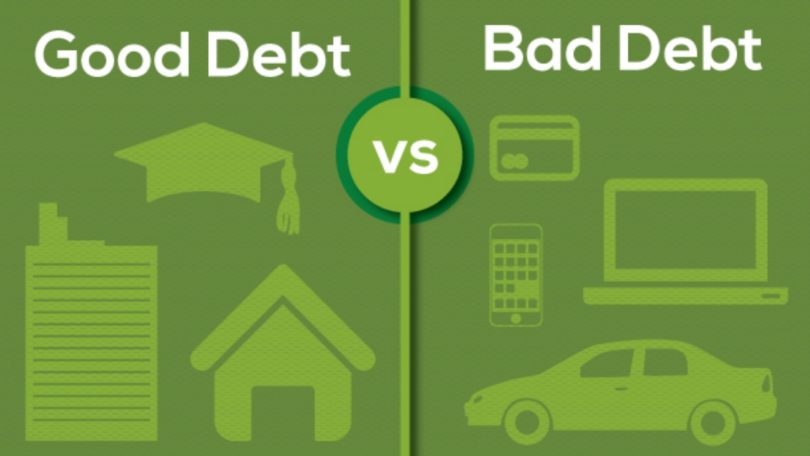
The good debt versus bad debt debate is old and settled, at least that’s what we fought. Forever now, there has been a consensus agreement amongst professionals that a mortgage is a good debt, and credit card is bad debt.
Although credit cards and auto loans are still considered bad debts, the same can’t be said for debt that we used to consider “good.” Is school loan still good debt? Many people buried in student loans with no real job prospects would say no. Is a Mortgage good debt? Many homeowners, who were preyed on and lost their homes during the 2007-09 financial crisis, would say that it is not.
For many American middle-class, it is becoming difficult to differentiate bad debts from good ones because of predatory lending across all the financial sector. However, they are still borrowing a lot.
According to the Federal Reserve Bank of New York, for the second quarter of 2019, America’s total household debt was $13.86 trillion. In nominal terms, Americans hold more debt now than they did at the peak of $12.68 trillion in the third quarter of 2008. It’s no secret that Americans love debt and they borrow exorbitant amount for both good and bad debt
Bad Debt: Credit Card, Store Credit Card, and Auto Loans
There is a saying on Wall Street that “credit card is the only good business left in finance.” Even with a historic low fed funds rate (1.85%), the average credit card interest rate is 17.80 percent.
Credit Cards and Store Credit Cards
The interest rate compounded daily on credit card debt. If you have $10,000 in credit card debt with a 17.80 APR, you are paying $1,780 each year on interest or $148.33 (($10,000×0.1780)/12) per month. As you can see, credit card debt is expensive.
In the second quarter of 2019, American households have $868 billion in credit debt. Servicing that much debt at that absurd interest rate is siphoning disposable income from the middle-class pockets into the pockets of big credit card companies.
Chase, Citibank, and Bank of America, the country’s largest credit card issuers, reported their third-quarter revenues of 2019 a few days ago. 30.1, 18.6, and $22.79 billion, respectively.
Credit card debt remains the worst type of debt. American family goes into serious debt to stay in the middle class.
Auto Loans
According to a Wall Street Journal report, a third of auto loans for new vehicles taken in the first half of 2019 had terms of longer than six years. Americans are financing cars up to 9 years or 108 months.
U.S. consumers held a record $1.3 trillion of debt tied to their cars at the end of June, according to the Federal Reserve, up from about $740 billion a decade earlier.
The interest rate on a new car loan is not as high as it is on credit card, but the middle class is paying a lot for that heated leather seats. According to Bankrate, the average interest rate on a new car loan is about 4.61 percent.
Once it comes to what is considered bad debt, it’s ubiquitous–credit cards and auto and personal loans. However, though, as we will see soon, what is deemed to be good debt in this new environment is dubious.
Good* Debt: Mortgage and School Loans
Mortgage
Homeownership has been the quintessential part of the American Dream, but teaser rate, NINJA loan, inflated appraisals, and Robo-signing robbed that part of the American dream from the middle class.
In 1995, President Clinton launched the National Homeownership Strategy: Partners in the American Dream. The initiative called for Washington’s lawmakers to loosen lending standards and make it easier for the private sector to make home loans to middle-class Americans.
The goal of the initiative was to generate up to 8 million additional homeowners from 1995 through the year 2000. President Bush carried forward the effort, and by 2006, the homeownership climbed to an all-time high at 69 percent.
Why American Middle-Class Sees Mortgage as Bad Debt
The government wanted to open markets for homeownership, but its program did not have any consumer protection clauses.
Private lenders enticed potential customers with teaser rate or adjustable-rate mortgage (ARM) that tripled monthly mortgage payments once it adjusted.
The mortgage broker Countrywide introduced “No income, no job, and no assets (NINJA loans)” Countrywide and other mortgage brokers did not worry about the borrower’s ability to pay because Wall Street firms would buy the loan from them the moment it was originated.
Real estate agents colluding with property appraisers inflated the value of the home. It did not take long for those borrowers to be underwater, owning the bank more than the current market value of the house, the moment the recession hit.
Nearly 10 million homeowners lost their homes to foreclosure during the 2007-2009 financial crisis. A decade after the financial crisis, the middle class is still recovering. More and more middle-class Americans see a mortgage as an absolute bad debt because of their experience or their parents.
Opening markets for homeownership, to increase choice and remove barriers, making homes, mortgage financing, and property insurance more available and affordable for every American.
Student Debt
The reason there is a student debt crisis is that students are experiencing a wage stagnation and lack of opportunities crisis. The rule used to be simpler four decades ago. You went to college, graduated with no debt, and had a job that paid a livable wage.
Nowadays, Starbucks baristas with a master’s degree, adjunct professors with PhDs, and college graduate retail workers are the norm. Even in high-skilled areas of the workforce, workers are being shortchanged; Google’s temporary workers outnumber its full-time ones.
Is student debt good debt? The workers mentioned above would say no.
The Bottom Line
The good debt versus bad debate is part objective and part subjective. Credit card debt and auto loans are flat out horrible and expensive debt; you should hold as little of it as possible.
If you are not thinking of moving out in the next five years, have 20 percent to put down, and factor taxes and insurance into your total monthly mortgage payment, a mortgage might classify as good debt. For highly specialized skills, student debt might classify as good debt. Make sure you take a gap year if you are not sure about attending college after high school.
In the second quarter of 2019, about 232,000 consumers had a bankruptcy notation added to their credit reports. Debt, whether good or bad, should not exceed 36 percent of one’s gross income.



Pingback: Government Policies Built and Destroyed America’s Middle-Class
Pingback: Jamie Dimon IS WRONG: Consumer Balance Sheet Is Not Strong - FMC