
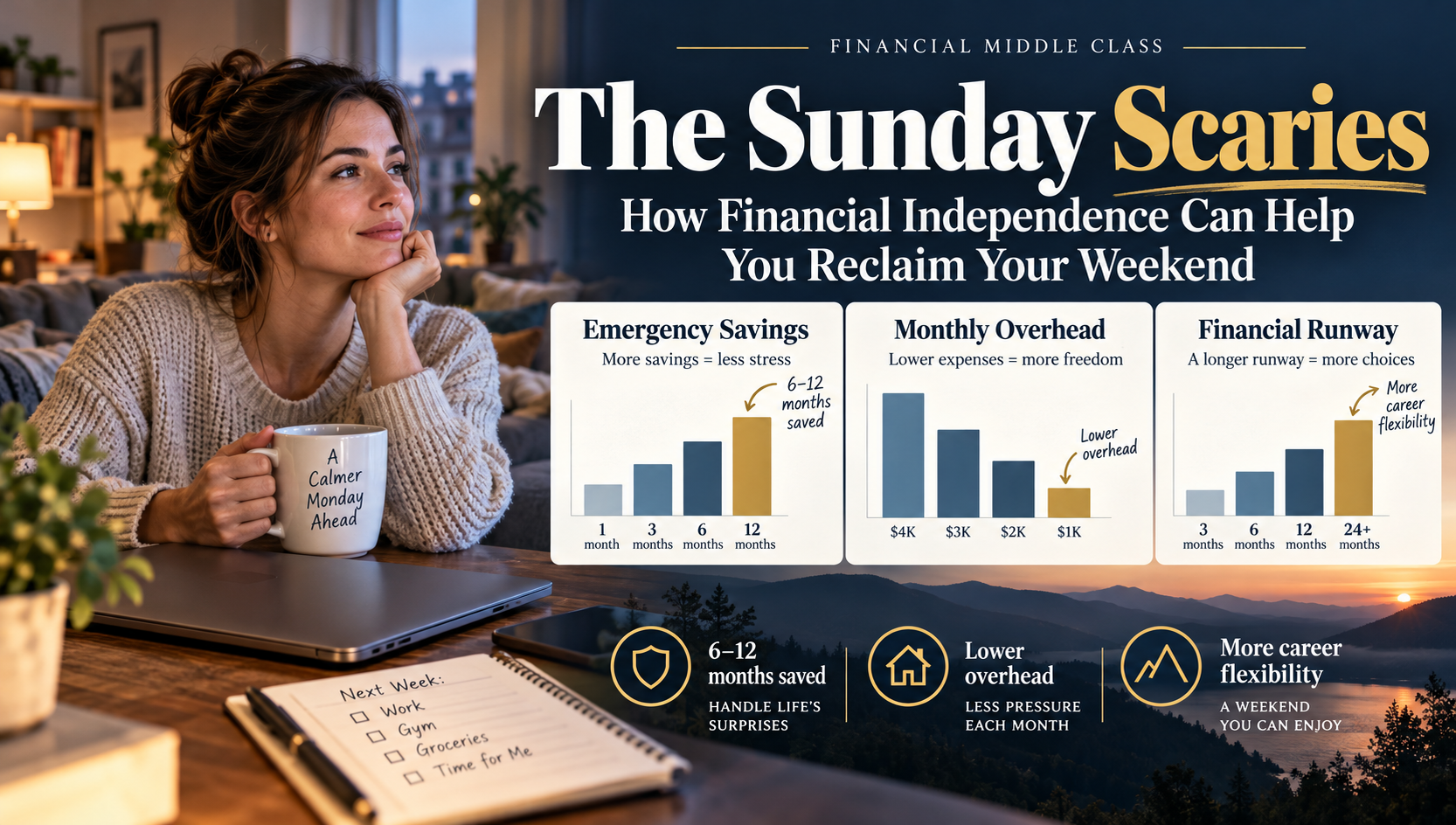
The Sunday Scaries: How Financial Independence Can Help You Reclaim Your Weekend
By Article Posted by Staff Contributor
The estimated reading time for this post is 1562 seconds
You don’t have to win the lottery, become a millionaire, or retire early to feel less anxious about Monday. Sometimes, having enough savings, fewer financial obligations, and the freedom to make your own career decisions can change everything.
Sunday afternoon has a way of slipping away from us.
You might be enjoying brunch with friends, watching a football game, preparing dinner, or relaxing with a glass of wine when you happen to glance at the clock.
It’s 4:30 p.m.
And just like that, Monday enters the picture.
You begin thinking about the emails waiting in your inbox, the meetings on your calendar, the unfinished assignments, and perhaps the difficult conversation you’ve been putting off.
You might even reach for your phone to check your work email, although nobody has asked you to. Or you open your laptop to prepare for the week ahead, telling yourself it will take only fifteen minutes.
Before long, an hour has disappeared.
The weekend isn’t over, but you’re already thinking about work.
This familiar feeling has a name: the Sunday Scaries.
Most discussions about the Sunday Scaries focus on workplace stress, burnout, and the importance of disconnecting. The usual advice is to establish a relaxing Sunday routine, exercise, prepare for the coming week, or practice mindfulness.
There’s value in those suggestions. But I think they overlook an important part of the problem.
For many working Americans, anxiety about returning to work isn’t just about the work itself. It’s also about how much they depend on the next paycheck.
When your savings are limited, your monthly expenses consume nearly everything you earn, and losing your job would create an immediate financial crisis, Monday carries a different kind of weight.
You might dislike your job, feel overworked, or desperately need a break. But you cannot afford to stop working, even temporarily.
Now imagine having enough accessible savings to cover your essential living expenses for six to twelve months, along with manageable debt and relatively low monthly overhead.
You might still dislike Monday. You might even have the same demanding supervisor and unreasonable deadlines.
But you would have more financial flexibility to decide what to do about it.
And that can change your relationship with work.
When Sunday Becomes Part of the Workweek
For most employees working a traditional Monday-through-Friday schedule, the official workweek begins Monday morning.
Yet many of us begin working long before then.
Sometimes it’s actual work: reviewing documents, responding to emails, or preparing presentations. Other times it’s the mental work of anticipating problems, worrying about deadlines, or rehearsing conversations that haven’t happened.
Modern technology has made it increasingly difficult to separate professional responsibilities from personal time.
We can answer an email from the dinner table, review a spreadsheet from the couch, or respond to a supervisor without ever setting foot inside an office.
The convenience is undeniable. So is the temptation to remain available.
A 2021 study published in the Journal of Occupational Health examined after-hours email use among 58 information technology employees. Researchers found that more frequent work emailing outside regular hours was associated with poorer psychological detachment from work and worse sleep-related outcomes.
The study was small and observational, so it doesn’t establish that checking work email causes the Sunday Scaries. But it does support a broader point: time away from work is not necessarily restorative when we’re still mentally engaged with our jobs.
Of course, some people genuinely enjoy planning their workweek on Sunday. Others have professional responsibilities that require weekend attention.
The distinction is whether we’re engaging with work because it serves a useful purpose or because we’re afraid of what might happen if we don’t.
Consider an employee who checks email every Sunday evening because they’re worried about appearing unresponsive. Or a manager who spends hours preparing for Monday’s meetings because they fear being caught off guard.
These behaviors may be understandable, especially in demanding professional environments. But over time, they can turn Sunday into an unofficial extension of the workweek.
And when your financial well-being depends almost entirely on maintaining your employer’s approval, disconnecting may feel like a risk you cannot afford to take.
The Hidden Financial Side of the Sunday Scaries
In its 2025 Work in America survey, the American Psychological Association found that 54% of U.S. workers surveyed said job insecurity had a significant impact on their stress levels.
That finding doesn’t tell us how many people experience the Sunday Scaries because of financial insecurity. But it reinforces something familiar to anyone who has worried about losing a job: employment uncertainty can affect well-being long before a paycheck disappears.
Consider two employees working for the same company.
Both earn $100,000 annually. Both have demanding supervisors, challenging workloads, and Monday morning meetings they’d rather not attend.
The difference is their financial circumstances.
One employee lives paycheck to paycheck. Between housing, transportation, insurance, debt payments, and other obligations, nearly all their take-home pay is committed before it arrives.
They have little saved. Losing their job would quickly create problems paying essential bills.
The second employee has accumulated twelve months of essential living expenses in accessible savings. Their housing costs are manageable, they carry little high-interest debt, and their monthly budget leaves room to save.
Their jobs may be identical, but their financial circumstances create very different levels of vulnerability.
| Financial circumstances | Employee A | Employee B |
|---|---|---|
| Annual salary | $100,000 | $100,000 |
| Emergency savings | Less than 1 month | 12 months |
| Monthly obligations | Consume most take-home pay | Manageable |
| Ability to withstand job loss | Very limited | Substantial financial runway |
| Career-change flexibility | Financially constrained | Greater flexibility |
| Exposure to financial pressure at work | Higher | Lower |
Illustrative comparison. Savings do not eliminate workplace stress or guarantee job security.
The first employee may feel compelled to tolerate an unhealthy work environment because losing their income would create an immediate crisis.
The second employee still has responsibilities and legitimate reasons to protect their career. But if their situation becomes intolerable, they have more room to consider alternatives.
They might begin searching for another job without immediately worrying about next month’s mortgage. They may be better positioned to negotiate, pursue additional training, or take time to make a thoughtful career decision.
This is a benefit of financial independence that rarely receives the attention it deserves.
We often evaluate savings accounts by their interest rates and investment portfolios by their returns.
But having money available when you need it provides another benefit that doesn’t appear on a financial statement: the ability to make decisions without being driven entirely by immediate financial necessity.
The Golden Handcuffs: When a Good Salary Becomes a Trap
Some of the people most vulnerable to this kind of dependence are not necessarily low-income workers.
They’re professionals with good salaries, respectable careers, and lifestyles that have gradually become expensive to maintain.
Consider a professional earning $160,000 annually.
On paper, that sounds like financial success.
But suppose the household has a substantial mortgage, two car payments, childcare expenses, insurance premiums, and other recurring obligations.
Despite the impressive salary, almost every paycheck is needed to keep the household running.
There’s little financial room for an interruption in income.
The professional may have a senior title, significant responsibilities, and a reputation for success while feeling unable to leave a job that has become increasingly stressful.
This is what people often mean by the term golden handcuffs: the financial rewards of a career become intertwined with obligations that make leaving difficult.
The problem isn’t necessarily the salary. It’s how much of that salary the household requires to maintain its lifestyle.
Consider two hypothetical professionals.
| Financial measure | Professional A | Professional B |
|---|---|---|
| Gross annual income | $160,000 | $95,000 |
| Essential monthly expenses | $8,000 | $3,500 |
| Accessible emergency savings | $24,000 | $28,000 |
| Financial runway | 3 months | 8 months |
| Savings needed for 12 months | $96,000 | $42,000 |
Hypothetical figures; expenses are assumed to include unavoidable obligations.
Professional A earns substantially more than Professional B.
Yet if both lost their jobs tomorrow, Professional B could cover essential household expenses for considerably longer.
This doesn’t mean Professional B is wealthier. We don’t know either person’s total assets, retirement savings, property equity, or liabilities.
It does mean Professional B has more short-term financial flexibility based on the information provided.
And that distinction matters.
A high salary is valuable, particularly when it allows someone to accumulate investments, support family members, or enjoy a better quality of life.
But income alone is not a reliable measure of financial independence.
Someone can earn $200,000 annually and still be financially fragile. Someone earning $80,000 may have accumulated substantial savings, carry little debt, and maintain relatively modest expenses.
Neither income level tells the whole story.
The Federal Reserve’s recently released 2025 Survey of Consumer Finances illustrates why we should be cautious about equating increases in household income and wealth with improved financial security. Although inflation-adjusted median household income and net worth increased between the 2022 and 2025 surveys, several measures of household debt stress also worsened.
For middle-class professionals, this raises a useful question: As your income has increased over the years, have your choices expanded along with it?
Or have your expenses simply become larger?
Financial Independence Doesn’t Have to Mean Retirement
When people hear the phrase financial independence, they often imagine someone with millions of dollars invested, a vacation home, and enough passive income to never work again.
That’s one version of financial independence, but it isn’t the only one worth pursuing.
For the average middle-class household, financial security can begin at a much more attainable level.
It might mean having enough money saved to survive a temporary job loss. It might mean paying off high-interest credit card debt, eliminating an expensive car payment, or maintaining a lifestyle that doesn’t require every dollar of household income.
I think we’ve made financial independence unnecessarily intimidating by defining it almost exclusively as the ability to stop working forever.
There’s an important financial milestone that comes long before permanent retirement.
It’s reaching the point where missing your next paycheck would be stressful or inconvenient, but wouldn’t immediately threaten your ability to meet essential obligations.
That doesn’t make you wealthy, and it certainly doesn’t mean you can stop paying attention to money.
But it makes you less financially vulnerable.
The Consumer Financial Protection Bureau recognizes this distinction in its definition of financial well-being, which includes the ability to absorb financial shocks and make choices that allow people to enjoy life.
I find that definition particularly useful because it recognizes something that a bank balance or salary figure cannot fully capture.
Money should provide more than purchasing power. It should also provide security and the freedom to make decisions.
For most households, that freedom develops gradually.
| Financial position | What it can provide | What it doesn’t guarantee |
|---|---|---|
| Less than 1 month saved | Limited emergency protection | Ability to withstand job loss |
| 1–3 months saved | A basic financial cushion | Protection during prolonged unemployment |
| 3–6 months saved | More time to manage an income disruption | Freedom to resign without planning |
| 6–12 months saved | Meaningful employment flexibility | Permanent financial independence |
| Sustainable income from assets | Potential long-term independence from employment | Freedom from every financial or personal concern |
The distinction between financial security and permanent financial independence is important.
Having $40,000 in savings may not allow someone to retire.
But if their essential expenses are $4,000 a month, that money represents approximately ten months of financial runway.
For someone who has spent years living paycheck to paycheck, that’s a meaningful improvement.
How Much Money Would It Take for You to Walk Away?
Traditional personal finance advice frequently recommends maintaining three to six months of essential expenses in an emergency fund.
That’s a reasonable starting point.
But for someone whose objective is to reduce employment-related financial vulnerability, I would consider a more ambitious target of six to twelve months, depending on their circumstances.
I don’t suggest that everyone needs twelve months or that everyone can realistically accumulate that much.
A two-income household with stable employment may have different needs from a single parent, a self-employed professional, or someone working in a specialized field where finding another position could take considerable time.
The appropriate amount also depends on age, dependents, healthcare needs, debt obligations, and the availability of other financial resources.
The basic calculation is straightforward:
Financial runway = Accessible emergency savings ÷ Essential monthly expenses
Suppose your household needs $4,000 each month to cover essential expenses.
| Savings target | Amount required | Financial runway |
|---|---|---|
| 1 month | $4,000 | 1 month |
| 3 months | $12,000 | 3 months |
| 6 months | $24,000 | 6 months |
| 9 months | $36,000 | 9 months |
| 12 months | $48,000 | 12 months |
Assumes no additional income or unexpected costs. Actual financial runway may differ.
Having $48,000 readily available is a substantial achievement. For many households, it could take years to accumulate.
But the first month of savings matters. So do three months and six months.
Each milestone can make a household better prepared for an unexpected interruption in income.
The important phrase in this calculation is essential monthly expenses.
We’re talking about the cost of maintaining a safe, functional household: housing, utilities, groceries, necessary transportation, insurance, minimum debt payments, healthcare, and other unavoidable obligations.
And here’s where a person contemplating leaving a job needs to be especially careful.
The expenses you have while employed are not necessarily the same expenses you’ll have after leaving.
The Costs That Don’t Disappear When You Quit
Imagine a professional who has accumulated $30,000 in savings and spends $4,000 each month on essential expenses.
They might reasonably assume they have seven and a half months of financial runway.
But suppose leaving their job also means losing employer-sponsored health insurance.
They may need to purchase replacement coverage, possibly at a substantially higher monthly cost.
Under federal COBRA rules, eligible workers may generally continue their employer’s group health coverage temporarily, but they can be responsible for the full premium, potentially including an administrative charge.
Losing employer-sponsored coverage may also qualify someone for a special enrollment period through the Affordable Care Act Marketplace, including when they voluntarily leave employment.
Healthcare is only one consideration.
A professional contemplating resignation should examine several financial consequences before making a final decision.
| Financial consideration | Why it matters |
|---|---|
| Health insurance | Replacement coverage may increase expenses |
| Severance | May be available after some involuntary separations, but usually not voluntary resignation |
| Unemployment benefits | Eligibility depends on state rules and circumstances of separation |
| Retirement contributions | Unvested employer contributions may be forfeited |
| Bonuses and commissions | Timing and plan rules may affect what is paid |
| Unused paid time off | Payout rules vary by state and employer policy |
| Job-search duration | Finding comparable employment may take longer than anticipated |
An employee who voluntarily resigns should not assume they’ll qualify for unemployment benefits. Eligibility depends on state law and the particular circumstances.
Similarly, a retirement account balance may appear substantial, but accessing retirement funds early can trigger taxes, penalties, and lost future investment growth.
This is why having enough savings to resign and deciding that resignation is financially prudent are two different things.
In many circumstances, remaining employed while searching for another opportunity may offer the best balance between financial security and career flexibility.
But there are exceptions, particularly when a workplace is seriously damaging someone’s health or safety.
A financial plan should help you evaluate those choices realistically, not dictate that you remain in harmful circumstances simply to protect your savings.
Why Lower Overhead Can Matter More Than a Higher Salary
Once you understand financial runway, something else becomes clear.
The amount you need to save depends heavily on how much your household spends.
This is why I’ve come to believe that reducing recurring financial obligations is one of the most underappreciated strategies for building financial security.
We’re constantly encouraged to earn more.
Negotiate a raise. Pursue a promotion. Start a business. Find another source of income.
Those are worthwhile strategies. For households whose income barely covers essential expenses, earning more may be necessary.
But higher earnings don’t automatically translate into greater freedom.
Not when expenses increase just as quickly.
Consider two households that have each accumulated $30,000 in accessible savings.
One requires $4,000 per month to cover essential expenses. The other needs $7,500.
The first household can survive approximately seven and a half months without income.
The second has only four months.
Now suppose the second household gradually reduces its essential monthly obligations from $7,500 to $5,000.
Without adding another dollar to savings, its financial runway increases from four months to six.
That’s two additional months of breathing room.
And because the household now spends less each month, it may also have more money available to save.
Reducing expenses can improve financial security in two ways: it lowers the amount needed to maintain the household and increases the potential amount available for saving.
This is especially important when considering large, recurring financial commitments.
A monthly car payment might seem manageable when your income is strong. The same payment can become a serious burden after a job loss.
A larger home may be enjoyable and appropriate for your family, but its mortgage, insurance, property taxes, and maintenance costs can reduce financial flexibility.
Credit card balances may appear manageable when you’re making regular payments, yet high interest charges can make it difficult to accumulate meaningful savings.
None of this means people should deny themselves a comfortable lifestyle.
I believe money should help us enjoy life, not simply accumulate in accounts.
But we should distinguish between expenses that genuinely improve our quality of life and expenses that commit us to earning a particular income indefinitely.
There’s something to be said for driving a reliable, paid-off vehicle, living in a home you can comfortably afford, and avoiding debt that consumes a substantial portion of your paycheck.
It may not impress anyone.
But it can make an enormous difference when circumstances change.
Financial Security Changes Your Bargaining Position at Work
One of the more interesting consequences of financial security is how it can change the relationship between employees and employers.
Most Americans depend on employment income for housing, healthcare, transportation, and everyday living expenses.
There’s nothing unusual about that.
But when someone has no meaningful financial cushion, this dependence can make it difficult to challenge unreasonable expectations or leave an unhealthy work environment.
Imagine an employee whose supervisor routinely sends nonurgent requests on Sunday afternoon.
The employee knows the assignments could wait until Monday, but they respond anyway.
Perhaps they want to demonstrate commitment. Perhaps their workplace rewards constant availability. Or perhaps they worry that failing to respond could affect their performance evaluation or job security.
Now imagine that same employee has a year of essential expenses saved.
They may still choose to respond. Professional obligations don’t disappear simply because someone has savings.
But they may feel more comfortable discussing appropriate boundaries, particularly if their employer has no formal weekend availability requirement.
Someone with substantial savings may also be better positioned to negotiate a flexible schedule, question unreasonable demands, or consider a better opportunity elsewhere.
Financial security does not guarantee that an employer will be reasonable. It doesn’t protect someone from every form of retaliation, discrimination, or professional consequence.
Nor does it give employees unlimited bargaining power.
But it can reduce the immediate financial consequences of standing up for themselves or deciding to move on.
This is a benefit of emergency savings that doesn’t appear in most personal finance calculators.
You aren’t simply protecting your household against an unexpected bill.
You’re also preserving the ability to make difficult professional decisions.
And sometimes, having a viable alternative is enough to change how you approach a situation.
When Quitting Your Job Isn’t the Answer
There’s a temptation, particularly when work has become stressful, to imagine that leaving the job would solve everything.
Sometimes it does.
A change of employer, supervisor, responsibilities, or career direction can make an enormous difference.
But not every difficult Monday means you’re in the wrong job.
And not every financially secure employee should respond to workplace dissatisfaction by resigning.
Perhaps the workload has increased temporarily.
Perhaps you’re navigating an organizational change.
Maybe there’s a specific conflict that could be addressed through a direct conversation.
Or perhaps you’ve reached a point in your career where the work no longer provides the satisfaction it once did.
Those situations require different responses.
Before making a major career decision, it’s worth considering whether the problem is temporary, organizational, professional, or personal.
| Situation | A reasonable first response |
|---|---|
| Temporary increase in workload | Reassess priorities and discuss resources |
| Unclear expectations | Seek clarification and establish boundaries |
| Difficult supervisor | Document concerns and evaluate internal options |
| Lack of career advancement | Explore development opportunities and the external job market |
| Persistent burnout | Examine workload, recovery, and appropriate professional support |
| Toxic or unsafe conditions | Prioritize safety and evaluate a practical exit strategy |
The benefit of financial security is that you may be able to consider these options without feeling forced to accept the status quo.
It can also make a job search less desperate.
Instead of accepting the first available opportunity because you urgently need income, you may have more time to evaluate compensation, benefits, organizational culture, and long-term career prospects.
But financial reserves have limits.
Twelve months of savings can disappear quickly during prolonged unemployment, especially if unexpected expenses arise.
The point is not to become careless because you have money in the bank.
It’s to make career decisions deliberately rather than under immediate financial pressure.
What If You Can’t Afford Six Months of Savings?
At this point, someone reading this article may be thinking that six to twelve months of savings sounds wonderful but unrealistic.
That’s a fair reaction.
For many American households, the cost of housing, food, transportation, childcare, and healthcare leaves very little room for saving.
According to the Federal Reserve’s 2025 Survey of Household Economics and Decisionmaking, 55% of U.S. adults reported having enough emergency savings to cover three months of expenses.
That means 45% did not report having that level of protection.
The challenge is particularly significant for households with children. The same Federal Reserve survey found that only 47% of parents living with their children under age 18 had three months of emergency savings.
These findings are reminders that accumulating even a modest financial cushion can be difficult.
That’s why I wouldn’t treat six or twelve months of savings as a prerequisite for financial progress.
Someone starting with nothing can begin by accumulating enough to cover a common unexpected expense.
Then work toward one month of essential expenses.
Then three.
For some households, the best next step may involve reducing an expensive credit card balance. Others may need to focus on increasing income, improving employment stability, or finding less costly housing or transportation over time.
It’s also important to recognize that cutting expenses has limits.
A household already living modestly cannot simply budget its way around inadequate income, unaffordable housing, or significant medical expenses.
Financial discipline matters, but it operates within broader economic circumstances.
For people with relatively comfortable incomes, the challenge may be controlling lifestyle inflation.
For others, the challenge may be finding enough room in the budget to save anything at all.
Both deserve practical advice that reflects their circumstances.
And nobody should conclude that financial independence is irrelevant simply because twelve months of savings feels impossibly far away.
A household with one month of expenses saved is in a stronger position than a similar household with no reserve.
Three months provide more protection than one.
The process is gradual, and each improvement matters.
Sometimes the Problem Isn’t Money
We should be careful not to exaggerate the relationship between financial security and workplace anxiety.
Someone can have a million dollars invested and still dread Monday morning.
A demanding supervisor, excessive workload, workplace conflict, career dissatisfaction, or burnout can create anxiety regardless of financial circumstances.
And sometimes anxiety extends beyond work entirely.
Financial security may help someone respond to these problems, but it doesn’t necessarily eliminate them.
Consider a financially comfortable professional who manages a large team.
They may have substantial investments, relatively low debt, and enough accessible savings to survive a prolonged period without employment.
Yet every Sunday evening, they find themselves thinking about staffing shortages, difficult personnel decisions, unrealistic organizational expectations, or problems that remain unresolved.
The anxiety is real, but inadequate savings may have little to do with it.
That person may need workload changes, stronger organizational support, different professional responsibilities, or an entirely different work environment.
More money in the bank won’t automatically make an unreasonable supervisor reasonable.
Nor will an emergency fund correct chronic understaffing or an unhealthy organizational culture.
This distinction matters because too much personal finance advice implies that financial problems can always be solved through better budgeting.
They can’t.
And workplace problems cannot always be solved by building wealth.
Still, financial security can make it easier to pursue solutions that might otherwise feel too risky.
Sometimes that means changing jobs. Other times it means negotiating responsibilities, taking appropriate leave, or simply knowing that your financial circumstances won’t force you to tolerate an unhealthy situation indefinitely.
Employers Have a Role in the Sunday Scaries, Too
There’s another side to this conversation that deserves attention.
We often place responsibility for workplace stress entirely on employees.
Learn to disconnect.
Establish boundaries.
Improve time management.
Practice mindfulness.
Build an emergency fund.
All reasonable suggestions, depending on the circumstances.
But what about the organization creating the conditions that make employees anxious in the first place?
A manager who routinely sends emails on Sunday evening may not expect an immediate response.
But employees don’t always interpret those messages that way.
When a supervisor communicates outside normal working hours, some employees may feel obligated to respond, especially in workplaces where responsiveness is associated with commitment or promotion potential.
Over time, a culture of constant availability can develop without anyone formally establishing such a policy.
This creates an important responsibility for managers and organizational leaders.
When possible, routine business communications should respect employees’ personal time. Workload expectations should be realistic, and genuine emergencies should be distinguished from matters that can wait.
For managers, the issue also involves setting an example.
If you’re a leader who spends Sunday evening catching up on work, that’s your decision.
But consider whether sending those messages immediately is necessary or whether they could be scheduled for Monday morning.
The distinction between your personal work habits and your expectations of employees matters.
Of course, some organizations operate around the clock. Healthcare, emergency services, transportation, hospitality, and many other industries require employees to work weekends.
The objective isn’t to pretend that every workplace can operate on a traditional schedule.
It’s to establish reasonable expectations for the schedule employees actually work.
Financial independence can help employees manage their relationship with work.
But employers shouldn’t interpret that as permission to ignore their responsibilities for creating healthy, sustainable working conditions.
Building Financial Freedom Without Putting Your Life on Hold
There’s an irony in the pursuit of financial independence.
Sometimes people become so focused on accumulating savings, maximizing income, and building investment portfolios that they begin sacrificing the very experiences financial independence is supposed to make possible.
Every weekend becomes an opportunity to work overtime.
Every hobby becomes a potential side business.
Every purchase is evaluated according to what that money might have earned in the stock market.
Vacations are postponed. Family experiences are delayed. Personal enjoyment is pushed into a future that always seems a few more years away.
First, the goal is to accumulate $10,000.
Then $50,000.
Then $100,000.
Eventually, even a million dollars may not feel sufficient.
I understand the desire to build financial security. It’s an objective worth taking seriously.
But I don’t believe the purpose of financial independence should be to spend our healthiest years preparing to enjoy the later ones.
Money matters because of what it allows us to do with our lives.
That includes taking care of our families, managing uncertainty, enjoying meaningful experiences, and occasionally spending money simply because something brings us pleasure.
An emergency fund should make life more secure, not become a reason to stop living.
Build your savings. Reduce unnecessary debt. Be thoughtful about large financial commitments. Develop professional skills and maintain relationships that give you opportunities beyond your current employer.
But also enjoy dinner with friends. Spend time with your family. Take the trip you’ve been planning when you can responsibly afford it.
And if Sunday afternoon is beautiful, there’s nothing wrong with spending it enjoying the afternoon.
You don’t need to turn every free hour into an opportunity to improve your financial position.
Sometimes, the most valuable use of your time is simply enjoying it.
The Real Luxury of Financial Independence
I don’t think most people necessarily want to stop working.
Many of us find purpose in our careers. We enjoy solving problems, helping others, building organizations, and accomplishing things that matter.
What we don’t enjoy is feeling trapped.
There’s a difference between going to work because you’ve chosen a career that supports your life and going to work because the loss of a single paycheck could put your household in financial trouble.
For many middle-class Americans, that distinction is central to financial independence.
It doesn’t require a winning lottery ticket, a multimillion-dollar investment portfolio, or an early retirement.
It may begin with six months of expenses in the bank, a reliable car without a burdensome payment, manageable housing costs, and the knowledge that you could survive a temporary interruption in income.
Those circumstances won’t guarantee that you love your job or eliminate every source of workplace anxiety.
But they can make it easier to approach professional uncertainty without fearing that everything you’ve worked for is immediately at risk.
And perhaps that’s when Sunday begins to feel different.
You may still think about Monday. You may still have a difficult meeting ahead or a long list of assignments waiting.
But you know that your financial well-being doesn’t depend entirely on everything going right at work.
You can finish your dinner, enjoy the rest of the evening, and deal with Monday when it comes.
Maybe the greatest luxury of financial independence isn’t being able to retire early. It’s being able to enjoy Sunday without worrying so much about Monday.
Research and Sources
- American Psychological Association (2025). Majority of U.S. workers say job insecurity has significant impact on their stress. Findings from the 2025 Work in America survey.
- Federal Reserve (2026). Report on the Economic Well-Being of U.S. Households in 2025. Data on emergency savings and household financial resilience.
- Consumer Financial Protection Bureau. Why Financial Well-Being? Framework covering financial security, financial shocks, and freedom of choice.
- Kubo et al. (2021). Work email after hours and its association with psychological detachment and sleep. Journal of Occupational Health.
- U.S. Department of Labor. A Worker’s Guide to Health Benefits Under COBRA. Guidance on continuation coverage and health insurance costs.
- HealthCare.gov. Health insurance options after losing job-based coverage. Marketplace enrollment eligibility and coverage alternatives.
- Reuters (October 9, 2026). Federal Reserve survey finds rising debt stress despite gains in household income and wealth.
Financial Middle Class explores the financial decisions that shape everyday life, from saving and investing to the choices that give us greater security, flexibility, and control over our future.


RELATED ARTICLES
Fair Capitalism: We Don’t Need to Abolish Capitalism. We Need to Fix It.
Fair capitalism means preserving entrepreneurship and profits while ensuring working Americans share more meaningfully in the prosperity they help create.
Cash Strategy: Put Every Dollar in the Right Place
Your checking account, emergency fund, short-term savings, and investments should not be managed the same way. This cash strategy helps assign every dollar to the right financial job.
Leave Comment
Cancel reply
Gig Economy
American Middle Class / Oct 12, 2026
Fair Capitalism: We Don’t Need to Abolish Capitalism. We Need to Fix It.
Fair capitalism means preserving entrepreneurship and profits while ensuring working Americans share more meaningfully in the prosperity they help create.
By MacKenzy Pierre
American Middle Class / Oct 12, 2026
The Sunday Scaries: How Financial Independence Can Help You Reclaim Your Weekend
The Sunday Scaries can begin long before Monday morning. Building emergency savings, lowering monthly expenses, and increasing financial independence may help you reclaim your weekend.
By Article Posted by Staff Contributor
Business / Aug 08, 2026
The Missing Middle in Black Entrepreneurship
Black entrepreneurship has expanded dramatically. The next challenge is helping more Black-owned businesses move from self-employment to employer firms and sustainable scale.
By FMC Editorial Team
Personal Finance / Aug 01, 2026
Cash Strategy: Put Every Dollar in the Right Place
Your checking account, emergency fund, short-term savings, and investments should not be managed the same way. This cash strategy helps assign every dollar to the right...
By Article Posted by Staff Contributor
Personal Finance / Aug 01, 2026
Best HYSA: How to Choose Beyond the Highest APY
A competitive interest rate matters, but it is only one part of choosing a high-yield savings account. Compare insurance, fees, access, transfer speed, and promotional conditions.
By Article Posted by Staff Contributor
Personal Finance / Aug 01, 2026
High-Yield Savings vs. CDs, Treasury Bills, and Other Safe Places for Cash
High-yield savings accounts are excellent for accessible cash, but they are not always the best choice. Compare HYSAs, CDs, Treasury bills, money market accounts, and I...
By Article Posted by Staff Contributor
American Middle Class / Aug 01, 2026
High-Yield Savings Accounts: A Safer Home for Your Cash
A high-yield savings account can pay several times the national savings rate while keeping qualified deposits federally insured. Here is how it works, what to watch...
By Article Posted by Staff Contributor
Real Estate / Jul 30, 2026
Mortgage Lock-In Is Freezing the Housing Market
Millions are trapped by 3% mortgages. Learn how mortgage lock-in worsens affordability—and why homeowners are renovating instead.
By FMC Editorial Team
Real Estate / Jul 26, 2026
Is South Florida More Expensive Than New York? The Complete 2026 Relocation Guide
Is South Florida more expensive than New York? Compare housing, taxes, insurance and 104 municipalities before you move.
By Article Posted by Staff Contributor
Personal Finance / Jul 25, 2026
The Time Value of Life Experiences: What Compound Interest Leaves Out,
Money compounds, but life experiences do too. Explore what compound interest leaves out—and how to balance saving with living.
By MacKenzy Pierre
Latest Reviews
American Middle Class / Oct 12, 2026
Fair Capitalism: We Don’t Need to Abolish Capitalism. We Need to Fix It.
Fair capitalism means preserving entrepreneurship and profits while ensuring working Americans share more meaningfully in...
American Middle Class / Oct 12, 2026
The Sunday Scaries: How Financial Independence Can Help You Reclaim Your Weekend
The Sunday Scaries can begin long before Monday morning. Building emergency savings, lowering monthly expenses,...
Business / Aug 08, 2026
The Missing Middle in Black Entrepreneurship
Black entrepreneurship has expanded dramatically. The next challenge is helping more Black-owned businesses move from...